

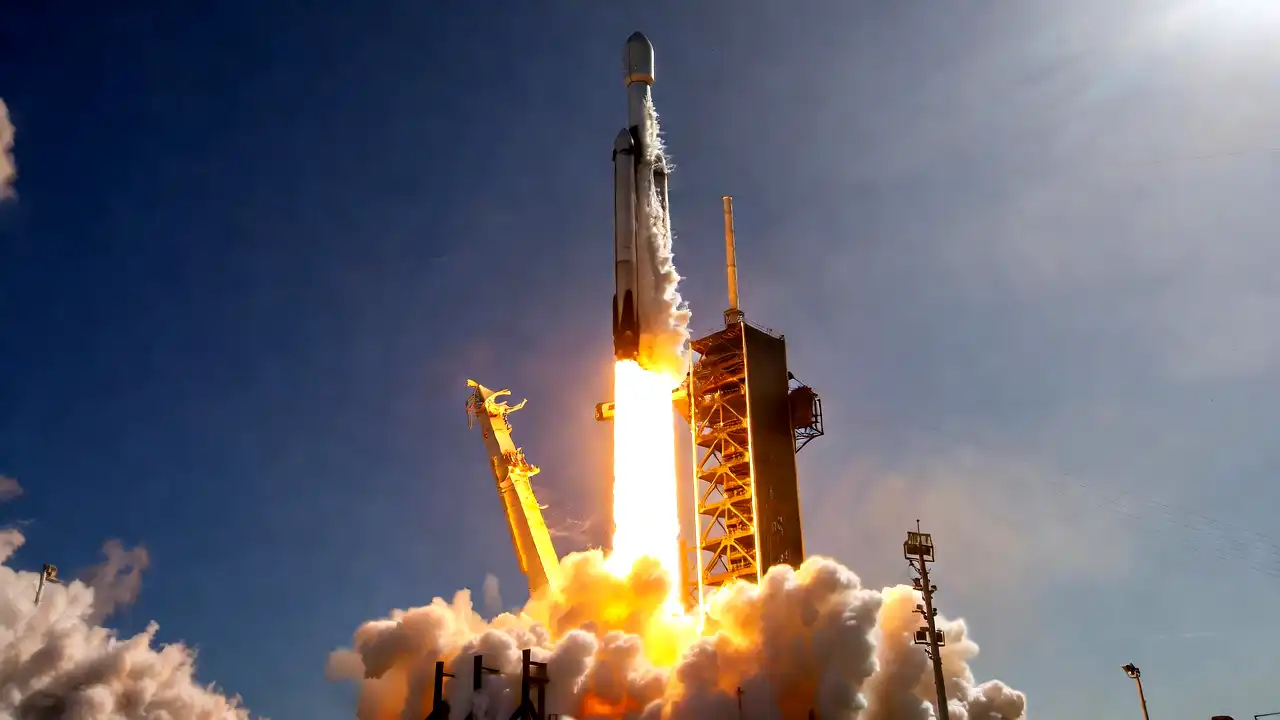
On Wednesday morning at exactly 10:13 a.m. Eastern Time, a massive SpaceX Falcon Heavy rocket roared to life. The rocket launched from the historic Kennedy Space Center in Florida, carrying Boeing’s highly anticipated ViaSat-3 F3 satellite into the sky. This launch represents a massive step forward for global internet connectivity. Spectators felt the ground shake as the heavy-duty rocket pushed the payload, weighing over 13,000 pounds, through the Earth’s atmosphere.
The satellite enjoyed a remarkably smooth ride to space. About 5 hours after the rocket left the launch pad, the satellite successfully separated from the Falcon Heavy upper stage. Back on Earth, engineers at Boeing’s Mission Control Center in El Segundo, California, waited eagerly at their computer screens. They successfully caught the satellite’s signal shortly after separation. The team quickly confirmed they had full command capability and started the initial boot-up sequences.
Right now, the spacecraft travels steadily toward a geostationary orbit. This specific orbit sits exactly 22,000 miles above the surface of the Earth. From this extreme height, the ViaSat-3 F3 will focus its powerful signals directly on the Asia-Pacific region. The machine will beam high-speed broadband internet down to commercial airlines, shipping fleets, fixed service providers, and defense customers operating across 14 different time zones.
This specific launch completes a major piece of a much larger telecommunications puzzle. The ViaSat-3 F3 is the 3rd advanced spacecraft launched as part of the broader ViaSat-3 global network program. Viasat wants to cover the entire globe with high-speed internet, and this third satellite provides the crucial coverage needed for the bustling Asian and Pacific markets. The company invested over $1 billion to bring this ambitious 3-satellite constellation to life.
To build this massive machine, engineers used Boeing’s advanced 702MP+ platform. This hardware serves as the physical backbone of the satellite. Boeing upgraded the structural integrity, power distribution, thermal cooling, and attitude control systems specifically for this project. These heavy-duty upgrades enable the platform to handle the extremely demanding communication payloads required to process over 1 Terabit of data per second.
Ryan Reid, the president of Boeing Satellite Systems International, celebrated the successful liftoff. He called the event a major milestone in the ongoing partnership between Boeing and Viasat. Reid proudly stated that by combining the best Boeing satellite platform with the innovative Viasat payload, the teams delivered the highest-capacity communication satellites anyone has ever launched into space.
The satellite uses some cutting-edge tricks to move around in the vacuum of space. Instead of relying on traditional chemical rockets, the ViaSat-3 F3 uses an advanced electric propulsion system. This electric engine slowly pushes the satellite toward its final 22,000-mile-high orbit. Electric propulsion offers vastly superior fuel efficiency compared to old-school chemical thrusters, saving thousands of pounds in launch weight and drastically extending the machine’s operational life.
The Boeing mission controllers still have plenty of work left to do over the next 4 to 6 weeks. They need to prepare the satellite for its final orbit-raising maneuvers. To get the power flowing, the team will remotely deploy the massive solar arrays attached to the craft. Spectrolab, a wholly owned subsidiary of Boeing, manufactured these high-tech solar panels. The engineers will also unfold 1 critical radiator panel to keep the onboard computers from overheating in the harsh, unfiltered sunlight.
The journey does not end when the satellite reaches its designated parking spot. Once the spacecraft finally settles into its geostationary orbit, Boeing engineers will run a grueling series of on-orbit tests. They will spend roughly 30 days checking every single communication laser, power circuit, and steering thruster to ensure everything survived the violent rocket launch.
After the spacecraft passes all these final tests with flying colors, Boeing will officially hand the digital keys over to Viasat. Viasat will then integrate the massive satellite into its commercial network and make it available to paying customers. When that happens, millions of people flying on airplanes, sailing on ships, and living in remote areas across the Asia-Pacific region will finally gain access to lightning-fast internet speeds for less than $50 a month.















