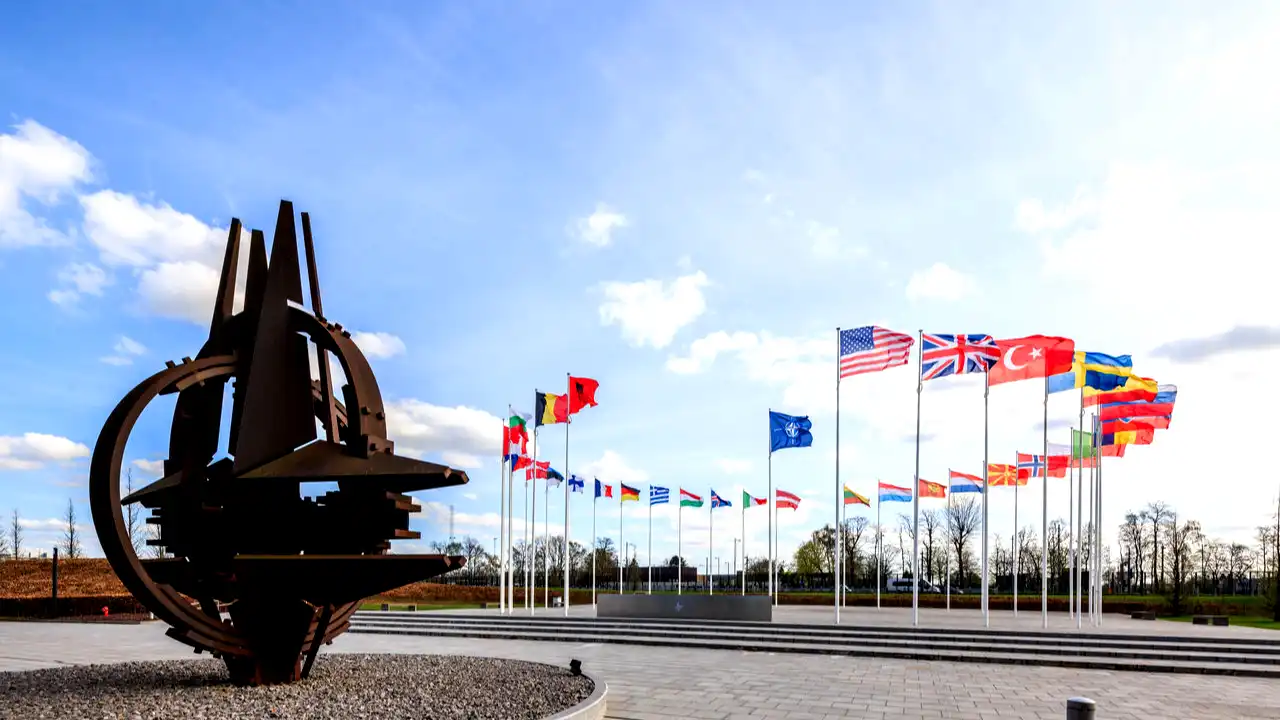
On the eve of a highly anticipated annual summit in Turkey, the North Atlantic Treaty Organization faces a critical shortage of the advanced weaponry needed to protect Ukrainian cities from devastating aerial bombardments. Speaking at a high-profile press conference in Ankara on Monday, NATO Secretary-General Mark Rutte called on alliance members to immediately intensify their military support for Kyiv. However, Rutte delivered a sobering reality check, admitting that while the United States is doing everything possible to fulfill its commitments, the physical supply of Patriot interceptor missiles remains strictly limited. The honest acknowledgment has exposed a severe gap between Western political promises and the actual capabilities of the transatlantic defense industrial base.
The massive controversy began last Wednesday during the United States’ 2-0 victory over Bosnia and Herzegovina in the tournament’s Round of 32. Balogun, who has been the cornerstone of the American attack with three goals in three starts, was sent off with a straight red card after a challenge on Bosnian defender Tarik Muharemovic. Brazilian referee Raphael Claus initially declined to award a foul, but issued the red card after a video assistant referee review showed Balogun’s foot landing on Muharemovic’s upper ankle during a race for possession. Under standard international regulations, a straight red card automatically triggers an unappealable one-game suspension, which would have sidelined the star forward for the crucial Round of 16 clash against Belgium.
Refusing to accept the loss of his country’s star player, Trump personally intervened by calling the FIFA chief on Wednesday evening. The President publicly defended his actions during a press briefing in the Oval Office, arguing that the red-card decision was completely unfair. Trump claimed that he understands sports exceptionally well and that the play was not a foul, but simply two elite athletes colliding at full speed. He went on to launch a sharp, highly public attack on the referee, describing Claus as “horrible” and calling him “a little bit suspect if you check his past.” Trump later took to his Truth Social platform to thank the governing body for reversing what he called a great injustice.
In a decision that surprised the entire sporting world, the governing body’s disciplinary committee announced on Sunday that it had officially suspended Balogun’s one-match ban. Instead of serving an immediate suspension, the 25-year-old forward will serve a one-year probationary period, allowing him to take the field against Belgium in Seattle. This marks the first time since 1962—and the first time in modern history for an incident occurring during the tournament itself—that the organization has reversed a red-card suspension. The historic U-turn has thrown the tournament’s disciplinary procedures into complete disarray, exposing the governing body to accusations of favoritism.
The unprecedented reversal has drawn fierce condemnation from the Union of European Football Associations, Europe’s powerful soccer governing body. In a highly critical public statement, UEFA declared that the organization had crossed a red line, describing the decision as incomprehensible, unjustifiable, and a direct threat to the integrity of the game. The European body warned that when the rules of the sport are no longer guaranteed by their legal guardians, the integrity of the game is at stake and the credibility of a competition is undermined. The statement emphasized that soccer must be governed by a single, transparent standard of rules that applies equally to every nation, regardless of their geopolitical size.
The Royal Belgian Football Association also reacted with absolute astonishment, launching an immediate challenge against Balogun’s eligibility just hours before the kickoff in Seattle. The Belgian federation complained that it had received no official explanation or legal reasoning from the disciplinary committee regarding why the automatic suspension was lifted. Federation officials warned that they had no choice but to file a formal appeal to protect the basic principles of fair play. The legal challenge has injected immense tension into the upcoming match, raising the prospect that Belgium could contest the final score if the United States wins with Balogun on the field.
The controversial intervention has also drawn sharp criticism from former soccer officials and international commentators. Former FIFA President Sepp Blatter, who stepped down in 2015, publicly condemned the move, asserting that red cards are supposed to be overturned by rules, evidence, and independent bodies rather than political phone calls. Blatter warned that allowing a national president to directly influence disciplinary decisions turns the global game into a playground for political power. This sentiment was echoed by several European team managers, who questioned how they can teach their players to respect the referee’s authority when the highest rules can be bypassed by a single phone call.
The lobbying effort to free Balogun was not limited to the President’s personal phone call, but featured a coordinated campaign by several senior U.S. officials. Reports from Washington revealed that Andrew Giuliani, the executive director of the White House’s World Cup task force, also held direct discussions with Infantino regarding the suspension. Additionally, Secretary of Commerce Howard Lutnick was in active communication with the governing body’s leadership. This coordinated government push has convinced many international observers that the host nation was willing to use its full political and economic weight to secure a sporting advantage, permanently tarnishing the tournament’s image.
While Trump insisted that he merely asked for a review and did not dictate the final decision, his public comments have supercharged a highly polarizing narrative surrounding the team’s campaign. The President joked with reporters that if Belgium beats the United States, they can be proud, but if they win due to unfair decisions, he would claim the tournament was rigged, representing a minor 1.5% adjustment in the team’s tournament forecast but a massive blow to their public credibility. This highly partisan rhetoric has deeply frustrated domestic sports fans, who worry that any success the team achieves on the pitch will now carry a permanent asterisk, representing a minor 1.5% adjustment in the team’s tournament forecast but a massive blow to their public credibility.
Ultimately, the historic red-card reversal has placed the 2026 FIFA World Cup at a highly volatile crossroads where sports and geopolitics dangerously collide. By choosing to suspend Folarin Balogun’s ban following a personal call from Donald Trump, the global governing body has successfully kept one of the tournament’s most entertaining players on the field at the expense of its own institutional credibility. While the U.S. team prepares to face Belgium with its full roster intact, the severe test of this intervention is exceptionally high. As the matches proceed under the shadow of political meddling, the beautiful game faces its most challenging credibility crisis in decades.