

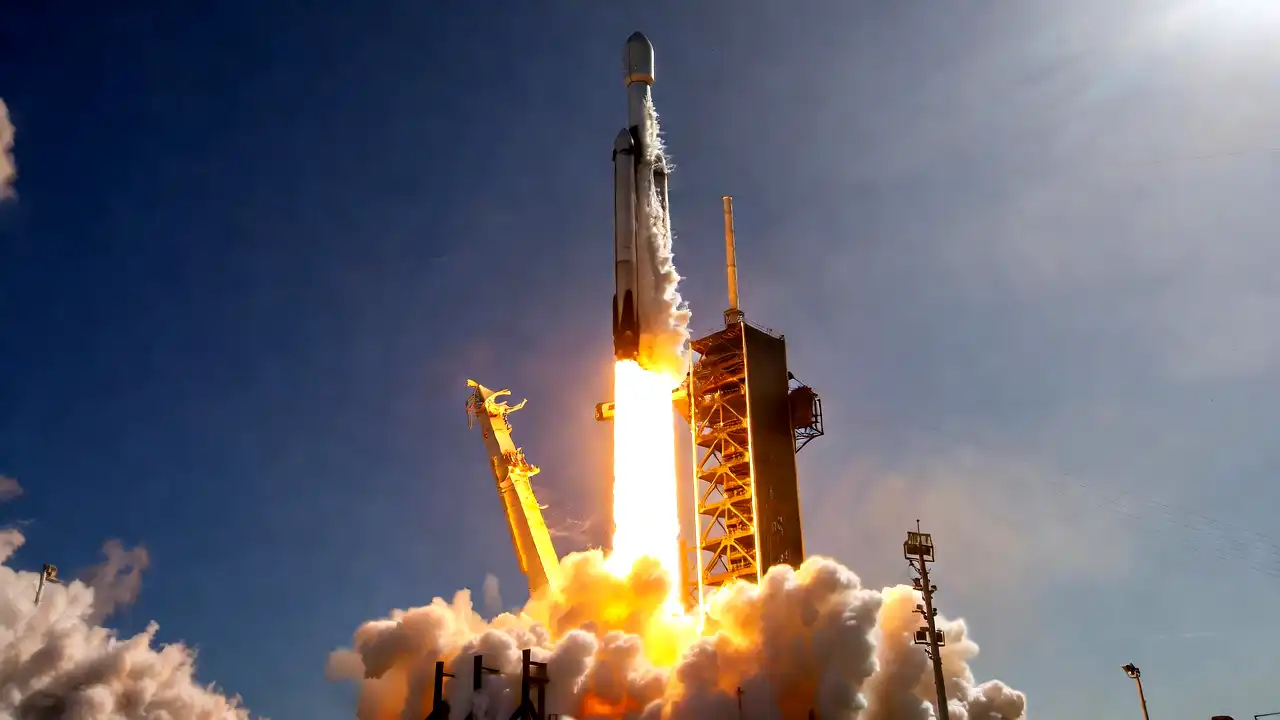
The commercial aerospace industry is experiencing an unprecedented era of rapid expansion, shifting from a domain exclusively controlled by national governments to a fiercely competitive private marketplace. In a spectacular convergence of aerospace scheduling, both SpaceX and Blue Origin have secured high-priority launch windows scheduled for the very beginning of the week. This rare alignment offers a front-row seat to the unfolding dynamics of the modern space race, highlighting the contrasting strategies, technological achievements, and ultimate ambitions of two of the world’s most prominent spaceflight companies. On one coast, SpaceX continues its relentless, rapid-fire deployment of the Starlink megaconstellation, utilizing its heavily proven, reusable rocket architecture. Simultaneously, Blue Origin is making final preparations for the third flight of its monumental “New Glenn” heavy-lift rocket.
This juxtaposition is far more than a mere scheduling coincidence; it represents a critical inflection point in orbital logistics and the global space economy. For SpaceX, the ongoing Starlink missions underscore the company’s mastery of launch cadence and its ambition to dominate global broadband internet. For Blue Origin, the third New Glenn mission is a high-stakes validation of its heavy-lift capability, a crucial step toward securing lucrative national security contracts and establishing itself as a viable, long-term competitor to SpaceX’s near-monopoly. As these two aerospace titans prepare to ignite their engines, the entire global scientific, military, and commercial communities are watching closely. The outcomes of these synchronized launch windows will dictate the pace of orbital development, the pricing of payload deliveries, and the architectural framework for humanity’s expansion into the solar system.
Understanding the magnitude of this moment requires a deep dive into the underlying technologies, economic strategies, and global implications of these concurrent missions.
The Modern Space Race Reaches New Heights
The contemporary era of spaceflight is characterized by rapid innovation, driven primarily by private enterprise rather than geopolitical rivalries. The overlapping launch windows of SpaceX and Blue Origin serve as a perfect microcosm of this new reality, where visionary leadership meets cutting-edge engineering.
To truly appreciate the context of these launches, one must look at the divergent philosophies that drive the two companies involved.
A Tale of Two Aerospace Titans
SpaceX and Blue Origin were founded by two distinct technological visionaries with profoundly different long-term objectives for humanity’s future in space. SpaceX operates under a philosophy of rapid, iterative development, often embracing spectacular failures during testing to accelerate learning. The company’s ultimate stated goal is to make humanity multi-planetary, specifically by colonizing Mars. This requires driving the cost of spaceflight down to unprecedented levels through rapid reusability and high launch frequencies.
Blue Origin, on the other hand, operates with a more deliberate, methodical approach, guided by the motto “Gradatim Ferociter”—step by step, ferociously. The company’s foundational vision is not necessarily to colonize other planets, but rather to move heavy industry and energy production off Earth to preserve our home planet. This vision requires massive, reliable heavy-lift infrastructure to build artificial habitats and orbital manufacturing facilities. The New Glenn rocket is the physical manifestation of this methodical, long-term strategy, designed to be a durable workhorse for deep-space and heavy-orbital logistics.
The Significance of Converging Launch Windows
When two major aerospace companies schedule launches within hours or days of each other, the logistical and regulatory coordination required is immense. It tests the capacity of spaceports, tracking stations, and maritime recovery fleets.
The convergence of these specific launch windows highlights several key developments in the global space sector:
- The normalization of rapid launch cadences is pushing regulatory bodies to streamline approval processes.
- The increasing global demand for launch pads and ground support infrastructure.
- The validation of the commercial space market demonstrates sufficient payload demand to sustain multiple heavy-lift providers simultaneously.
- The shifting reliance of global governments on private companies for critical satellite deployment and national security missions.
SpaceX’s Relentless Starlink Deployment
SpaceX has fundamentally transformed the expectations surrounding orbital launches, turning what was once a rare and precarious event into a routine, almost daily occurrence. At the heart of this relentless launch cadence is the Starlink megaconstellation, an ambitious project to blanket the globe with high-speed, low-latency internet access.
The rapid deployment of these satellites requires a meticulously engineered system that balances mass manufacturing with highly efficient launch vehicles.
The Mechanics of the Starlink Megaconstellation
Starlink is not merely a satellite network; it is a continuously evolving technological ecosystem in low Earth orbit (LEO). Unlike traditional geostationary satellites that orbit tens of thousands of kilometers above Earth and suffer from high latency, Starlink satellites operate much closer to Earth’s surface. This proximity requires thousands of interconnected satellites to ensure continuous, seamless coverage as they rapidly orbit the globe.
SpaceX’s ongoing deployment missions are tasked with injecting batches of these satellites into precise orbital planes. The latest iterations of Starlink satellites are significantly larger and more capable than their predecessors, featuring advanced phased-array antennas and using optical space lasers to communicate with one another. This laser inter-satellite link technology allows the constellation to route data across the vacuum of space at the speed of light, bypassing terrestrial ground stations and providing secure, high-speed connectivity to even the most remote oceanic or polar regions.
Reusability as a Game Changer
The sheer volume of launches required to build and maintain the Starlink network would be financially ruinous using traditional, expendable rockets. SpaceX’s mastery of booster reusability is the economic engine that makes Starlink possible. By landing and rapidly refurbishing the first stages of their rockets, SpaceX has drastically reduced the marginal cost of a launch.
This capability allows the company to act as its own primary customer, absorbing the launch costs of the Starlink network while simultaneously driving down the price of commercial payload delivery for external clients. The current launch window is just another routine day at the office for SpaceX’s recovery fleets, which flawlessly position autonomous drone ships in the ocean to catch returning boosters. This routine reusability has created an unassailable competitive advantage that the rest of the global aerospace industry is desperately racing to replicate.
Global Connectivity and Economic Impact
The successful, continuous deployment of Starlink satellites has profound implications for global communication infrastructure. By bypassing the need for expensive terrestrial fiber-optic cables, Starlink has the potential to bridge the digital divide, bringing high-speed internet to rural, underserved, and developing regions worldwide.
The impacts of this global connectivity stretch across multiple sectors and industries:
- Empowering remote educational and telehealth services in developing nations.
- Providing resilient, backup communication networks during devastating natural disasters.
- Enhancing maritime and aviation logistics with uninterrupted, high-bandwidth tracking and data transmission.
- Offering secure, decentralized communication alternatives for global military and defense operations.
Blue Origin and the Rise of New Glenn
While SpaceX continues to dominate the current launch market with its high-frequency operations, Blue Origin is methodically stepping into the heavy-lift arena. The upcoming third mission of the New Glenn rocket is a pivotal moment, marking the transition of the vehicle from an experimental prototype to a trusted operational launch system.
Named in honor of pioneering astronaut John Glenn, this massive rocket is designed to carry immense payloads, challenging the established hierarchy of the heavy-lift sector.
The Anatomy of a Heavy-Lift Behemoth
New Glenn is an engineering marvel, boasting dimensions and capabilities that place it among the largest and most powerful rockets ever constructed. Standing nearly 100 meters tall, the rocket features a massive seven-meter payload fairing that provides twice the usable volume of existing commercial launch vehicles. This cavernous space is highly attractive to satellite manufacturers, allowing them to design larger, more complex spacecraft without the constraints of traditional, narrow fairings.
The powerhouse behind New Glenn is its array of BE-4 engines. These engines utilize liquefied natural gas (LNG) and liquid oxygen (LOX), a strategic choice that burns cleaner and produces less soot than traditional rocket-grade kerosene. This clean-burning characteristic is vital for Blue Origin’s strategy, as it significantly reduces the refurbishment time required for the reusable first stage. The successful operation of the BE-4 engines during this third launch is critical not just for Blue Origin but for the broader aerospace industry, as these same engines are used by other major launch providers.
The Importance of the Third Mission
In the aerospace industry, the first launch of a new rocket proves that it can fly; the second proves it wasn’t a fluke. The third launch, however, is widely considered the threshold for operational maturity. For Blue Origin, this third New Glenn mission is a crucial demonstration of reliability, repeatability, and precision.
Institutional clients, particularly national defense agencies and massive telecommunications conglomerates, demand a proven track record before entrusting multi-million-dollar payloads to a launch vehicle. A flawless execution of this third mission will serve as the ultimate confidence builder, signaling to the global market that Blue Origin is ready to handle the world’s most sensitive and expensive orbital cargo. It also validates the complex aerodynamics of the first stage’s return-and-landing sequence, thereby proving the economic viability of the New Glenn architecture.
Competing for National Security and Commercial Contracts
The successful deployment of New Glenn will immediately disrupt the current heavy-lift market dynamics. For years, the industry has relied heavily on a very small number of launch providers, resulting in schedule bottlenecks and premium pricing for massive payloads.
The entry of New Glenn into full commercial operation introduces much-needed competition, unlocking new opportunities across the market:
- Providing a vital, redundant launch capability for critical national security and intelligence satellites.
- Serving as the primary deployment vehicle for competing megaconstellations, including Amazon’s Project Kuiper.
- Driving down heavy-lift launch costs through aggressive market competition and advanced reusability.
- Offering dedicated lift capabilities for upcoming lunar landers and deep-space scientific probes.
The Economics of the Commercial Space Industry
The simultaneous launches by SpaceX and Blue Origin are not just technological demonstrations; they are massive economic events. The commercial space industry has evolved into a multi-billion-dollar global sector, encompassing everything from raw material manufacturing and propulsion engineering to satellite data analytics and broadband service provision.
As launch vehicles become larger, more reliable, and reusable, the fundamental economics of accessing space are being rewritten.
Driving Down the Cost to Orbit
Historically, the cost of sending a single kilogram of payload into low Earth orbit was exorbitantly high, effectively locking out small businesses, universities, and developing nations from participating in the space economy. The advent of reusable rocketry has drastically altered this equation. By recovering and reusing the most expensive components of the rocket multiple times, launch providers have slashed the cost of launching to orbit.
This reduction in cost has democratized space access. We are now witnessing a surge in commercial satellite manufacturing, with companies building smaller, cheaper, and more specialized spacecraft. The economic barrier to entry has fallen so low that startups can now launch specialized Earth-observation satellites, zero-gravity pharmaceutical research modules, and privately funded orbital telescopes. The overlapping launch windows of Starlink and New Glenn represent the maturation of this economic shift, proving that high-volume, low-cost access to space is now a permanent reality.
The Ripple Effect on Global Markets
The economic ripple effects of these heavy-lift capabilities extend far beyond the aerospace sector. The data generated by the satellites launched on these rockets feeds into a vast array of terrestrial industries. Agriculture relies on orbital imagery for precision farming; global logistics companies track shipping containers via satellite networks; and financial institutions use space-based time-stamping for high-frequency trading.
Furthermore, the expansion of orbital infrastructure is driving a boom in terrestrial manufacturing. The demand for specialized aerospace materials, advanced semiconductors, and high-tensile alloys is creating thousands of high-tech jobs globally. The competition between SpaceX and Blue Origin accelerates this economic engine, forcing suppliers to innovate and scale their operations to meet the insatiable demand of the modern space race.
Environmental and Orbital Challenges
While the rapid expansion of the commercial space sector offers incredible technological and economic benefits, it also introduces unprecedented environmental and logistical challenges. The sheer volume of rockets launching and satellites orbiting the Earth requires careful management to ensure the sustainable use of outer space.
As the launch windows for Starlink and New Glenn open, the global scientific community continues to heavily scrutinize the ecological and orbital footprints of these massive endeavors.
Managing Orbital Debris and Space Traffic
Low Earth orbit is becoming increasingly congested. The deployment of megaconstellations, combined with the presence of legacy satellites and fragmented space debris, has elevated the risk of orbital collisions. A major collision could trigger the Kessler Syndrome, a theoretical scenario where cascading debris destroys surrounding satellites, rendering specific orbital planes unusable for generations.
Managing this risk requires sophisticated Space Traffic Management (STM) systems and strict adherence to international orbital guidelines. Both SpaceX and Blue Origin must integrate advanced collision avoidance systems into their architectures. For megaconstellations, this means outfitting satellites with autonomous thrusters that can dodge incoming debris. Additionally, launch providers are under increasing pressure to ensure that spent upper stages and defunct satellites are safely deorbited, burning up in the Earth’s atmosphere rather than contributing to the growing cloud of space junk.
The Environmental Footprint of Rocket Launches
The environmental impact of rocket launches on the Earth’s atmosphere is an area of growing concern and intense scientific study. While the aerospace industry accounts for a very small percentage of global carbon emissions, the unique way rockets deposit gases and particulates directly into the upper atmosphere can have complex effects on the ozone layer and global temperatures.
To mitigate these impacts, the industry is exploring several sustainable practices and technological innovations:
- Transitioning from highly refined kerosene to cleaner-burning fuels, such as the liquefied natural gas (LNG) utilized by Blue Origin’s BE-4 engines.
- Developing carbon-capture technologies at launch facilities to offset the emissions generated during liftoff.
- Researching bio-derived rocket propellants that offer a carbon-neutral alternative for future launch vehicles.
- Designing satellite components that completely demise upon atmospheric reentry, preventing heavy metals from lingering in the upper atmosphere.
What This Means for the Future of Space Exploration
The high-priority launches of Starlink and New Glenn are more than just routine commercial operations; they are the foundational building blocks for the next grand era of human space exploration. The technologies refined in low Earth orbit today are the exact systems required to carry humanity back to the Moon, onward to Mars, and deeper into the solar system.
By perfecting heavy-lift capabilities and rapid reusability, private aerospace companies are providing global space agencies with the tools necessary to execute highly ambitious deep-space architectures.
Paving the Way for Lunar and Martian Habitats
The global space community is currently focused on the Artemis program, an international effort to establish a sustainable human presence on and around the Moon. This endeavor requires the transportation of massive amounts of cargo, including habitats, life-support systems, and lunar rovers. The heavy-lift capacity of rockets like New Glenn, combined with the rapid launch cadence pioneered by SpaceX, makes this logistical nightmare manageable.
Furthermore, the orbital refueling technologies being developed to support these massive rockets will be critical for Martian exploration. The ability to launch a spacecraft into orbit, refuel it using subsequent heavy-lift launches, and then propel it toward Mars is the exact architecture required for interplanetary colonization. The successful flights of these commercial rockets validate the mathematical and engineering models that will one day carry humans to other planets.
A New Era of Global Collaboration and Competition
The concurrent launch windows of SpaceX and Blue Origin highlight a beautiful dichotomy in the modern space age: fierce commercial competition driving unparalleled global collaboration. While these companies battle for market dominance, their achievements elevate the capabilities of the entire planet. National space agencies in Europe, Asia, and the Americas now have access to a diverse marketplace of reliable, low-cost launch providers, allowing them to stretch their scientific budgets further than ever before.
This new era ensures that access to the stars is no longer the exclusive privilege of superpowers. By driving innovation, lowering costs, and expanding heavy-lift capabilities, SpaceX and Blue Origin are not just building rockets; they are building the infrastructure of a truly spacefaring civilization.
Conclusion
The converging launch windows of SpaceX’s Starlink deployment and Blue Origin’s third New Glenn mission represent a monumental chapter in the ongoing narrative of human spaceflight. We are witnessing the maturation of the commercial aerospace industry, where the ambitious dreams of tech visionaries are translated into roaring engines, reusable boosters, and a rapidly expanding web of global connectivity. SpaceX’s relentless cadence continues to prove that space access can be routine, affordable, and highly impactful for terrestrial communications. Meanwhile, Blue Origin’s methodical validation of its heavy-lift behemoth ensures that the market will remain fiercely competitive, driving further innovation and securing reliable access to orbit for the heaviest and most critical payloads.
As these powerful rockets clear the launch pad and ascend into the atmosphere, they carry with them the future of global telecommunications, national security, and deep-space exploration. The challenges of orbital congestion and environmental sustainability remain, but the engineering brilliance demonstrated by these two aerospace titans suggests that humanity is more than capable of overcoming them. The modern space race is no longer about simply planting a flag; it is about building a sustainable, economically viable, and permanently accessible bridge to the stars. The success of these current missions guarantees that this bridge is stronger, wider, and more resilient than ever before.















