

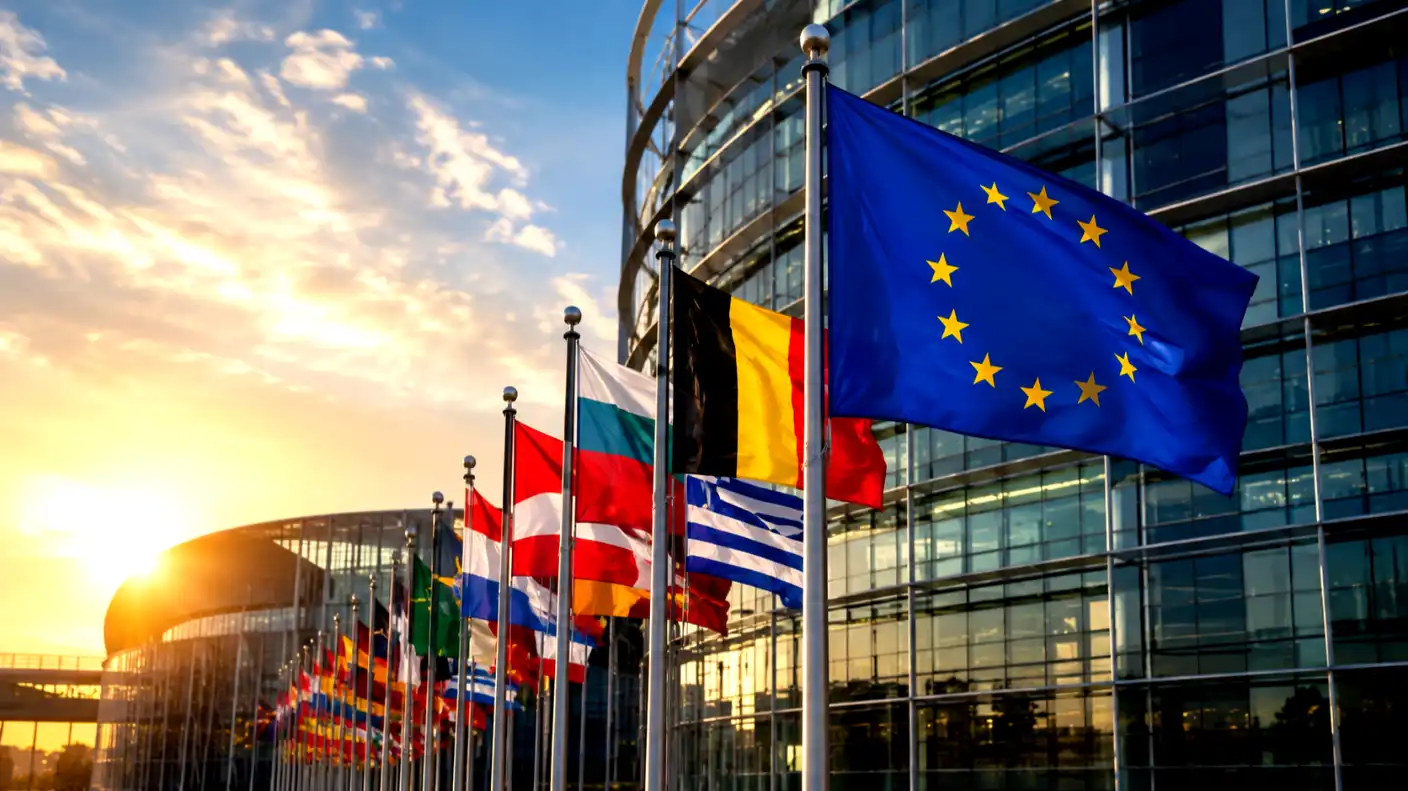
The European Union has officially aligned itself with a major United States-led tech coalition, signaling a massive consolidation of Western control over critical technologies. At a high-profile summit in Washington, D.C., the European Commission formally announced its accession to Pax Silica, a strategic economic-security pact designed to secure the global supply chains needed for artificial intelligence. The controversial decision marks a major escalation in the West’s coordinated campaign to circumvent Chinese manufacturing monopolies, uniting a chosen group of partners under a shared framework of technology trade and export controls. However, the timing of the announcement has triggered intense debate within Brussels, coming just weeks after the bloc unveiled its own independent technology-sovereignty agenda.
First launched by the United States Department of State in December 2025, Pax Silica is an elite, international accord designed to manage the rapidly evolving AI economy. The strategic framework establishes a highly coordinated security network that spans five key industrial sectors: computing power, semiconductor manufacturing, energy resources, digital infrastructure, and critical minerals. By binding its signatories into a unified stance on technology security and export controls, the alliance seeks to build a highly resilient silicon supply chain that can withstand geopolitical shocks. The program’s architects argue that if the 20th century ran on oil and steel, the 21st century runs entirely on high-performance computing.
The formal addition of the European Union, alongside individual accessions by Germany, the Netherlands, and Greece, represents a massive expansion for the security alliance. Speaking at the opening of the Washington summit on Tuesday, Jacob Helberg, the U.S. Under-Secretary of State for Economic Affairs and primary architect of Pax Silica, confirmed that the new additions have brought the total number of participating countries to 24. Helberg revealed that several other nations, including Argentina, Chile, Costa Rica, Kazakhstan, and Panama, are also signing the joint declaration this week. This rapid influx of members demonstrates that the pact’s strategic pull is running ahead of traditional multilateral forums like the G7 and G20.
While the European Commission has praised the pact as a vital step to secure Europe’s digital future, the decision to join has sparked fierce internal political friction. The move arrives just a fortnight after Brussels unveiled a major tech-sovereignty agenda, whose entire premise is reducing the continent’s dependence on foreign technology suppliers, including American ones. France emerged as the loudest skeptic during the closed-door negotiations, with Paris officials publicly framing the U.S.-led initiative as a form of industrial colonization that directly contradicts the EU’s goal of achieving autonomous regulatory power. Although France ultimately agreed to the common position, its public resistance exposed deep philosophical rifts over how Europe should protect its industrial base.
To overcome French opposition and secure the necessary mandate from member states, the European Commission had to negotiate a series of significant commercial and political safeguards. Most notably, the final agreement includes a massive, binding commercial commitment requiring European tech companies to purchase at least $40 billion worth of advanced American AI chips under the broader EU-U.S. trade framework. The decision to join Pax Silica comes at a crucial time, as the EU’s share of advanced chip manufacturing stands at a stagnant 1.5%, forcing the bloc to rely heavily on import agreements to power its local tech sector while it works to develop its own domestic fabrication facilities.
The European Commission also secured firm, written assurances that the Pax Silica declaration is a non-binding political statement that will not alter the bloc’s internal decision-making or regulatory autonomy. Brussels has maintained that its landmark AI Act, which imposes strict, first-of-its-kind regulatory limits on the deployment of generative models, remains fully intact and untouched by the new security pact. This safeguard is a critical victory for European regulators, who have spent years building a robust consumer protection framework and feared that joining a Washington-led initiative would force them to relax their safety standards to qualify for the elite group.
The inclusion of the Netherlands as an individual member alongside the European Union represents a major strategic victory for Washington’s export control agenda. The Netherlands is home to ASML, the world’s only manufacturer of the advanced extreme ultraviolet lithography systems required to produce high-end computer chips. During the initial launch of Pax Silica last winter, the Dutch government chose to stay out of the alliance, raising serious concerns that the U.S. attempt to bypass Chinese bottlenecks would fail without the cooperation of the world’s most important chipmaking equipment provider. By bringing the Netherlands into the fold, the alliance has successfully closed a critical loophole in the global export control network.
The rapid consolidation of the Pax Silica alliance is heavily driven by the deteriorating security environment and escalating trade disputes between the West and China. Over the past year, Beijing has steadily tightened its own export controls on critical minerals like gallium, germanium, and rare earths, creating severe bottlenecks for Western defense and technology manufacturers. Simultaneously, the U.S. government’s aggressive efforts to restrict foreign access to advanced AI models—such as the recent directive forcing Anthropic to disable its Fable 5 and Mythos 5 models globally—have convinced allied nations that they must coordinate their supply chains to avoid sudden, unilateral disruptions.
Addressing concerns that the initiative is designed solely to promote American interests, U.S. officials pointed to the successful track records of early partners like Israel, Singapore, and the United Arab Emirates. Helberg argued that these countries have successfully leveraged American semiconductor and software technologies to build highly prosperous, indigenous tech ecosystems that punch far above their weight on the global stage. By participating in a trusted, secure network, smaller allied nations can gain immediate access to advanced computing resources and capital investments that would otherwise require decades and billions of dollars in duplicative domestic spending to develop.
Ultimately, the European Union’s formal accession to the Pax Silica alliance marks a highly significant milestone in the geopolitical struggle for technological supremacy. While the massive $40 billion chip commitment and the apparent contradiction with the bloc’s tech-sovereignty agenda will continue to draw intense domestic criticism, the move represents a highly pragmatic response to a highly competitive global market. By combining the regulatory weight of the European Union with the industrial and technological dominance of the United States, the newly expanded alliance has established a formidable defensive barrier to protect the Western AI ecosystem. As the 24-member nations begin implementing their coordinated export controls, the battle for the digital future has officially entered a highly structured, bloc-based era.















