

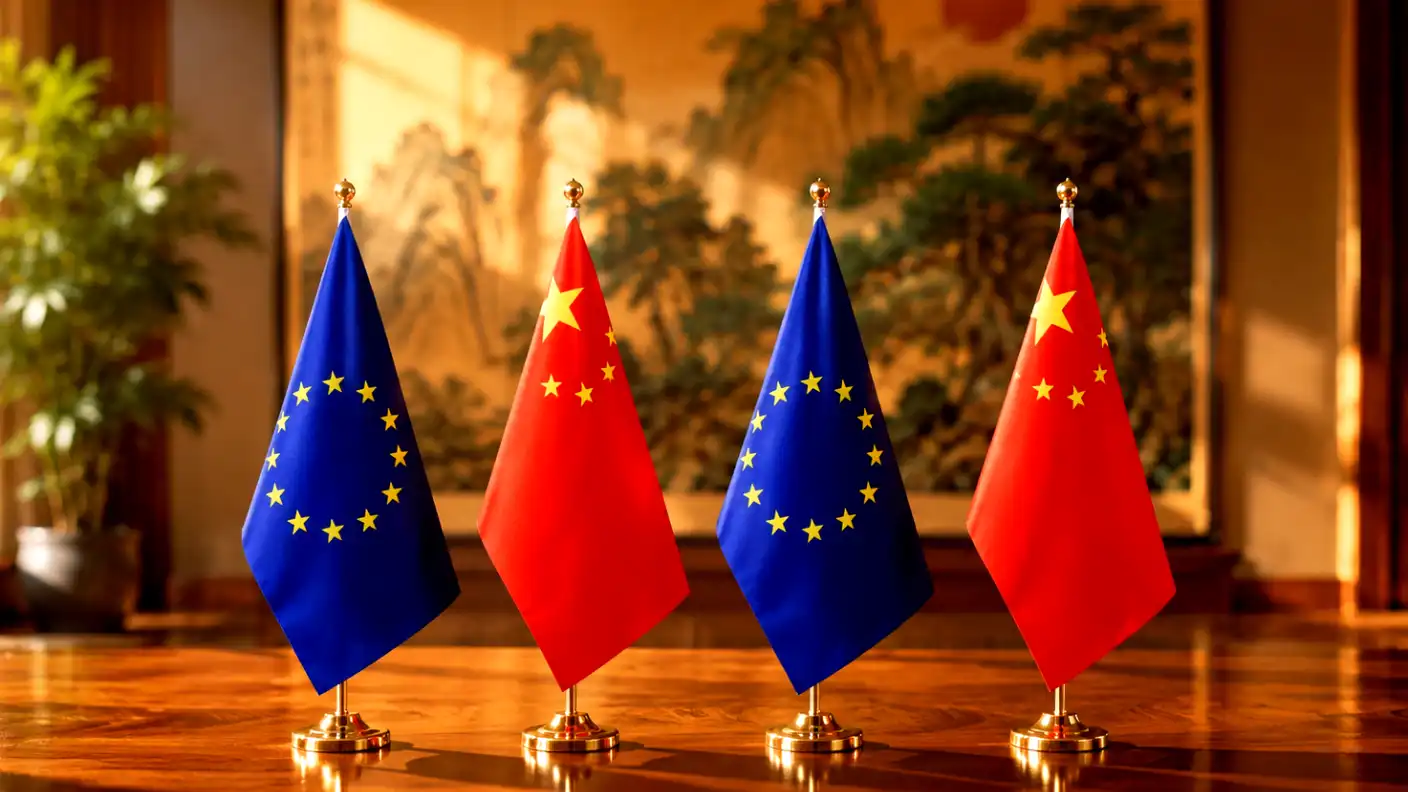
The already strained relationship between the world’s second- and third-largest economies is on the verge of a complete breakdown. State-run media agencies in Beijing have issued a stark, official warning that trade and diplomatic ties between China and the European Union risk dropping to an absolute freezing point. The combative declarations, published following a series of highly tense preparatory consultations in Brussels, accused European negotiators of displaying a total lack of sincerity during critical trade talks. The escalations come as the 27-country bloc prepares to expand its trade defense arsenal, threatening to permanently fracture a bilateral economic relationship that handles more than €1 billion in daily goods exchange.
The immediate spark for the worsening rhetoric was a series of closed-door bilateral meetings held this week to organize the first formal assembly of the China-EU Trade and Investment Consultation mechanism. According to sources close to the Chinese delegation, negotiators in Beijing felt deeply insulted by what they described as the European Union’s uncooperative and hypocritical approach. The state-owned press reported that while the European Commission publicly claims it is fully committed to resolving trade disputes through constructive dialogue, its negotiators have simultaneously refused to make concessions on any of China’s core economic concerns. This rigid posture has convinced Beijing that European authorities are merely using the negotiations as a political stall tactic.
At the heart of the escalating dispute is a massive, structural trade imbalance that European policymakers have declared completely unsustainable. According to official data from the European Union’s statistical agency, Brussels’ goods trade deficit with China ballooned to nearly €360 billion last year, which is equivalent to roughly $408 billion. This staggering deficit means that European consumers buy over €1 billion more in Chinese imports every single day than they export back to the Asian market. European leaders argue that this massive imbalance is not the result of fair market competition, but rather a direct consequence of Beijing’s heavily subsidized industrial model.
To counter this industrial flood, EU member states have officially instructed the European Commission to upgrade and expand its trade defense tools. During a highly charged working dinner at a recent summit, European Commission President Ursula von der Leyen presented a bleak economic picture of falling European exports and rising Chinese manufacturing overcapacity. In response, leaders from Germany, France, Italy, Poland, and the Netherlands called for the immediate implementation of new, aggressive tariff and quota mechanisms to protect local factories. This defensive strategy represents a permanent transition away from open trade, as Europe moves to insulate its domestic green technology and heavy industries from cheap competition.
The most immediate flashpoint in this industrial standoff is the European Commission’s plan to impose steep countervailing duties on Chinese electric and plug-in hybrid vehicles. Brussels argues that massive state subsidies have allowed Chinese carmakers to artificially lower their production costs, threatening the survival of Europe’s vital automotive sector. In a separate, highly contentious move, European Central Bank President Christine Lagarde recently urged global leaders to address the systematic undervaluation of the Chinese currency, which she argued contributes to the trade imbalances endangering the global economy. These coordinated policy moves have convinced Beijing that Europe is launching a comprehensive economic blockade.
The Chinese government has reacted to these defensive measures with a series of blunt, high-level warnings. Speaking at a diplomatic gathering in Brussels on Wednesday, China’s Ambassador to the European Union, Cai Run, warned that Beijing will take immediate countermeasures to protect its economic interests if the bloc insists on imposing restrictive trade policies. Cai strongly opposed what he called the politicization of economic issues under the guise of “de-risking” and reducing dependencies. While emphasizing that China and the EU should remain constructive partners rather than rivals or enemies, the ambassador made it clear that Beijing possesses the tools and the political will to retaliate.
To demonstrate its displeasure before the official trade consultations began, Beijing took the dramatic step of abruptly calling off two highly anticipated, high-level meetings with European officials. The scrapped talks included a ministerial-level digital policy dialogue—originally scheduled to take place in Beijing—and a separate diplomatic planning session with the European External Action Service. The unexpected cancellations represented a major diplomatic snub, forcing EU Deputy Secretary-General Olof Skoog to cancel his planned travel to the Chinese capital to prepare for future high-level visits. This complete freeze in communications has left European diplomats struggling to locate a viable diplomatic off-ramp.
The threat of Chinese retaliation is already a harsh physical reality for major industrial economies in the region. Since the start of the year, Beijing has aggressively tightened its export controls on critical raw materials and heavy rare earths, which are essential for manufacturing high-tech products like electric vehicle motors and wind turbines. The export blockades have already triggered a severe 1.5% drop in industrial output for several dependent manufacturers, forcing companies in neighboring Japan to resort to dismantling old electronics to salvage raw materials. Concurrently, Beijing has launched its own trade-defense investigations targeting imports of European brandy, pork, and dairy products.
Despite the hostile rhetoric, both sides are making a final, high-stakes attempt to contain the economic damage before a full-blown trade war erupts. Chinese Commerce Minister Wang Wentao is scheduled to arrive in Brussels on Monday for an emergency meeting with European Trade Commissioner Valdis Dombrovskis. While European officials have stated they remain open to constructive dialogue, they have also made it clear that any diplomatic resolution must yield concrete results, including a voluntary reduction in Chinese industrial overcapacity. This rigid demand makes a breakthrough highly unlikely, as Beijing views its manufacturing dominance as a core pillar of its national economic model.
Ultimately, the escalating trade dispute between Beijing and Brussels marks a highly volatile turning point that could permanently reshape global commerce. By warning that bilateral relations face a complete freeze and threatening immediate countermeasures, Chinese authorities are demonstrating that they will not allow Europe to restrict their export markets without a fight. As Europe works to protect its industrial base and China defends its subsidized manufacturing model, both sides are sliding toward an expensive economic conflict. Until the two major trading partners can find a way to manage their differences constructively, the economic ties that have anchored global trade will remain highly unstable, leaving the international economy on a dangerous knife-edge.















