

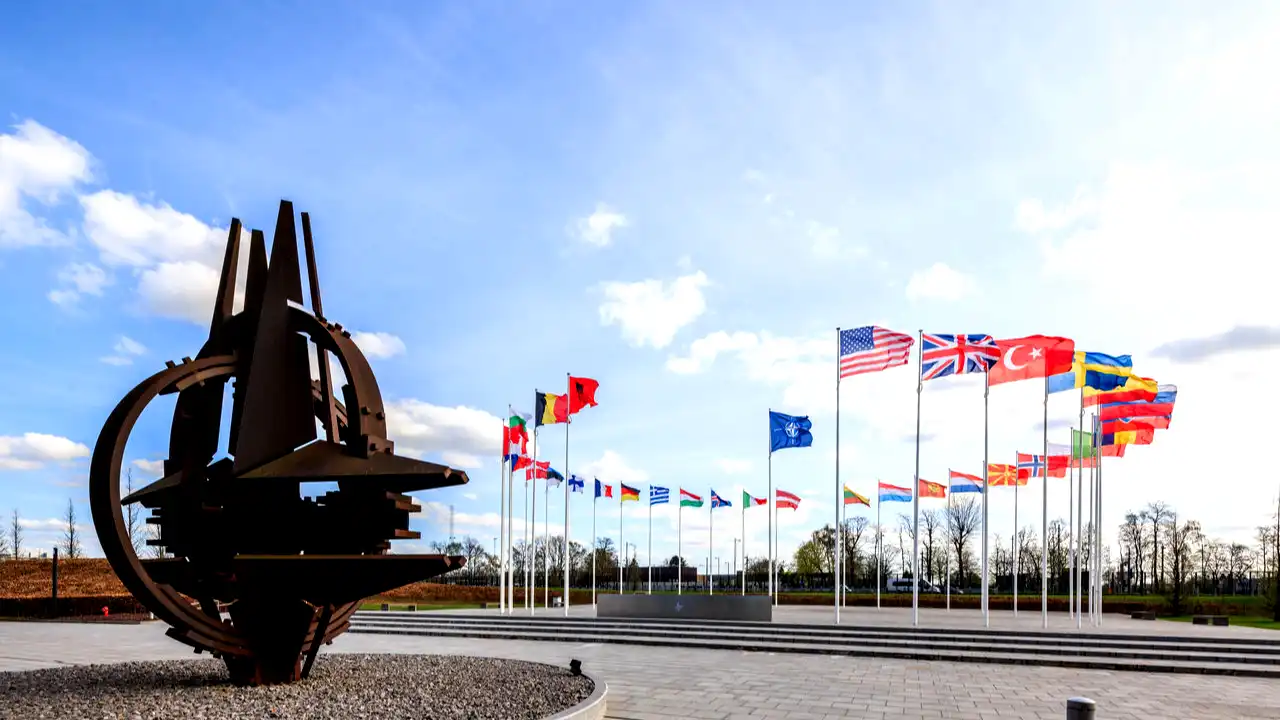
A powerful contingent of European warships has joined American forces for high-intensity military exercises off the East Coast, displaying a united front even as the alliance fights for its political survival in Washington. Timed to coincide with the United States’ 250th anniversary celebrations, the fleet maneuvers took place during a perilous moment for the 77-year-old transatlantic partnership. While President Donald Trump’s administration actively questions the strategic value of the alliance and pushes ahead with plans to withdraw American troops from Europe, allied sailors are continuing to train shoulder-to-shoulder, proving that operational ties remain remarkably resilient at the working level.
The complex war games, hosted off the coast of North Carolina, featured a series of highly demanding scenarios designed to defend the American homeland and secure global trade lanes. During the exercises, Norwegian Lieutenant Thomas Johannsen and his crew aboard the frigate Fridtjof Nansen conducted simulated ship boarding operations, navigating their vessel through cluttered radio frequencies and civilian ship traffic. This hands-on training represents a core mission for NATO’s rapid-response maritime units, allowing allied navies to synchronize their tactics and verify their operational readiness to protect joint interests across the Atlantic.
The specialized flotilla at the center of the North Carolina drills belongs to Standing NATO Maritime Group One, which currently operates under the command of British Commodore Maryla Ingham. The elite unit includes highly capable warships and frigates from Norway, Germany, Belgium, Denmark, the Netherlands, and Turkey. To reach the fleet, military helicopters piloted by Canadian air force crews transported personnel to the flight decks of vessels operating approximately 40 nautical miles off the American coastline. Ingham noted that while her unit is more accustomed to patrolling the icy, high-risk northern waters of the Baltic Sea and the Arctic to monitor Russian movements, operating in American waters provides an invaluable opportunity to hone their collective skills.
However, the display of operational unity stands in sharp contrast to a fierce political battle unfolding in Washington, where the administration is systematically targeting European defense commitments. In a combative address at the alliance’s headquarters in mid-June, Defense Secretary Pete Hegseth announced a sweeping six-month Pentagon review that could lead to a massive drawdown of the 5,000 U.S. troops currently stationed in Europe. Hegseth publicly criticized European partners as free-riders who have taken American taxpayer-funded security for granted, warning that future security cooperation must become a two-way street based on equitable burden-sharing.
The Pentagon has already begun executing this historic strategic retrenchment, implementing major troop and weapons pullbacks that have deeply unsettled European capitals. The administration has officially canceled the planned deployment of long-range Tomahawk cruise missiles to Germany, a key deployment that former President Joe Biden had negotiated to deter eastern aggression. Furthermore, defense officials confirmed that the Pentagon is actively preparing to withdraw several F-35 stealth fighter squadrons from European bases. This massive reduction in conventional deterrence represents a minor 1.5% adjustment in the overall U.S. global defense budget but marks a profound, long-term shift in Washington’s commitment to European security.
The diplomatic pressure peaked during a high-stakes Oval Office meeting between President Trump and the alliance’s new Secretary General, Mark Rutte. During the session, Trump directly admonished the leaders of Britain, Spain, Germany, and France, lashing out at them for their refusal to provide active military and financial support for the U.S.-led war in Iran. The President expressed deep disappointment with most of the European allies, accusing them of displaying a total lack of loyalty while the United States shoulders the heavy burden of reopening global shipping channels like the Strait of Hormuz.
These geopolitical tensions reached a dangerous peak in April, when a leaked internal Pentagon email revealed that the administration had floated a proposal to suspend Spain from the alliance entirely. The controversial draft came after the progressive government in Madrid firmly refused to grant U.S. military aircraft basing and overflight rights for combat operations against Tehran. While the proposed suspension did not ultimately proceed, the public clash exposed a massive, unprecedented rift in the alliance’s decision-making structure, proving that the White House is willing to use hard security sanctions to punish allies that do not fall in line.
Despite the high-level political warfare, European militaries have quietly persisted with their training commitments on American soil. Spanish Marines participated actively in the North Carolina exercises, conducting complex ship-to-shore amphibious operations alongside their American counterparts. Simultaneously, French Marine units traveled to U.S. Marine Corps Base Camp Lejeune to conduct high-intensity live-fire training on heavy machine guns. This continued cooperation shows that while politicians engage in public spats, professional soldiers remain committed to maintaining the mutual readiness required to defend both sides of the Atlantic.
National security analysts and former military commanders have urged the public to distinguish between Washington’s combative rhetoric and the reality of military operations. Speaking to reporters, a retired U.S. Marine officer at the Center for Strategic and International Studies described the joint exercises as a standard, predictable part of military life. He noted that in the absence of a direct executive order to stop, professional militaries will naturally continue to train together. He characterized the ongoing drills as simply the alliance doing its job, transcending the political turbulence of the moment.
Ultimately, the complex maritime exercises off the coast of North Carolina serve as a powerful testament to the enduring depth of the Western alliance, even during its most volatile political crisis in decades. While the Trump administration’s force reviews, missile cancellations, and public admonishments have cast a deep shadow over the future of the 77-year-old partnership, the sight of allied frigates cooperating seamlessly proves that the operational foundation remains intact. As the 24 nations of the Pax Silica pact work to secure high-tech supply chains and diplomats struggle to stabilize global energy routes, the professional soldiers at sea are ensuring that Europe and America can still stand together if a crisis erupts.















