

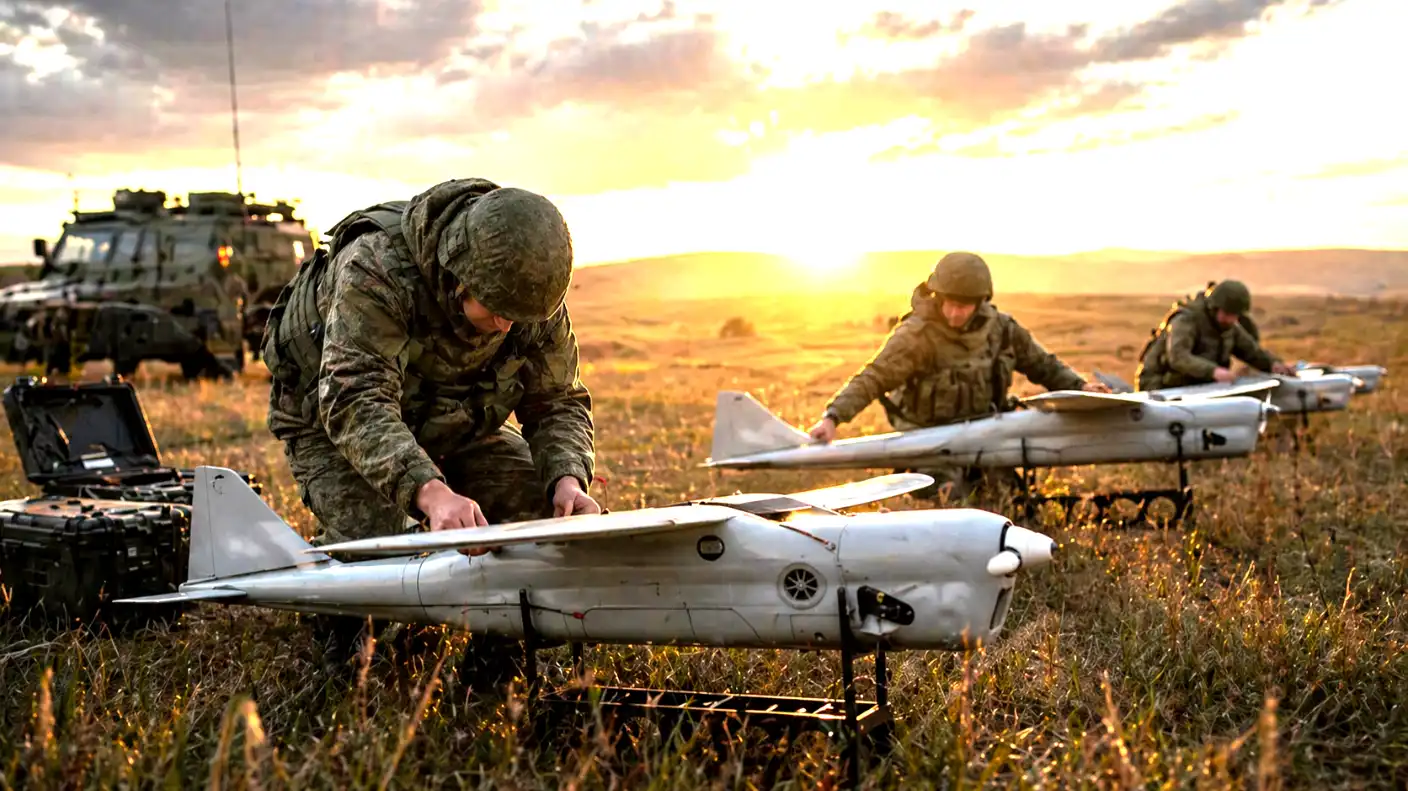
A series of errant Ukrainian drones straying into Baltic airspace has triggered deep unease and raised military tensions along NATO’s eastern flank. Over the past few weeks, several long-range Ukrainian attack drones have sown confusion by crossing into the skies of Estonia, Latvia, and Lithuania. This crisis comes at a highly sensitive time, as European allies already struggle with growing security anxieties and mixed signals from the United States regarding its commitment to NATO’s collective defense.
The dangerous airspace incursions occur as Ukraine seeks to land heavier blows on Russia, exactly four years after Moscow’s full-scale 2022 invasion. Kyiv has launched a massive, long-range drone campaign to hit Russian Baltic ports that handle nearly 40% of Russia’s national oil and gas exports. The drone campaign aims to cripple Russia’s oil revenues, which exceed $1 billion per week, and starve the Kremlin of the vital cash it needs to fund its military operations.
In most cases, both Kyiv and the Baltic states have confirmed that the stray drones are indeed Ukrainian. However, they place the blame entirely on Moscow. They argue that Russia is using powerful electronic warfare defenses to jam and spoof the satellite navigation signals of the incoming drones. This electronic jamming causes the Ukrainian drones to lose their coordinates, veer wildly off their planned flight paths, and fly deep into NATO territory.
The Russian government has responded to the incursions with its own aggressive rhetoric. Moscow has repeatedly suggested that the Baltic states are actively colluding with Kyiv, allowing Ukraine to use their sovereign airspace to stage sneak attacks on Russian targets. The Baltic states and Ukraine have strongly denied these accusations, calling them a complete fabrication. Estonian Foreign Minister Margus Tsahkna stated in a phone interview that Russia is desperately trying to find any opportunity to divide the Western world and pressure Ukraine to stop its highly successful energy strikes. He added that the Baltic nations will not yield to these intimidation tactics.
While most of the stray drones have crashed harmlessly in open fields, one recent incident pushed the military alliance to a historic threshold. On May 19, 2026, a NATO military jet successfully intercepted and shot down a suspected Ukrainian drone in Estonia. NATO officials confirmed to Reuters that this marked the very first time its Baltic air policing mission has fired a missile in defense of the alliance since the three Baltic states joined NATO in 2004. The historic shootdown proves just how close the region is to a direct military escalation.
Despite their unequivocal political and military support for Ukraine, Baltic officials are growing increasingly frustrated with the situation. Behind closed doors, Estonian, Latvian, and Lithuanian diplomats have told Kyiv that these airspace incursions are unhelpful and have demanded that Ukraine better control its drone flights. A Ukrainian military source confirmed that a serious internal investigation is currently underway to determine how Russian electronic warfare is successfully hijacking their guidance systems.
A senior Swedish military source raised another controversial explanation for the wayward flights. He suggested that Ukrainian operators might be flying their drones deliberately close to the Baltic border with Russia, using NATO’s airspace as a protective shield. The operators know that Russian air defense units will hesitate to fire missiles near NATO borders to avoid accidentally striking allied territory and triggering a direct, catastrophic confrontation with the 32-member alliance.
This regional anxiety is worsened by highly erratic signals coming from the United States. President Donald Trump has frequently threatened to pull America out of the NATO alliance completely. Furthermore, the Pentagon recently caused panic in Warsaw by delaying a planned troop deployment to Poland, only to announce days later that it was sending an additional 5,000 personnel. These security alarms have driven up European defense costs by 1.5% this month alone as countries scramble to activate their own air defense networks and purchase more advanced radar equipment. Poland, Lithuania, and Romania have all increased their military readiness, buying billions of dollars’ worth of anti-drone technology to secure their borders.
Ultimately, the errant drone flights highlight the fragile nature of peace along Europe’s eastern borders. A Baltic security official, speaking anonymously, stated that his agency views Russia’s aggressive rhetoric as primarily aimed at its own domestic audience to distract them from their own failures to stop the drone attacks. A strategic consensus has emerged among the Baltic capitals that they must bolster their electronic defenses to protect their airspace from both Russian missiles and stray Ukrainian drones. Until Kyiv can fix its guidance systems, the eastern flank remains a dangerous tinderbox.