

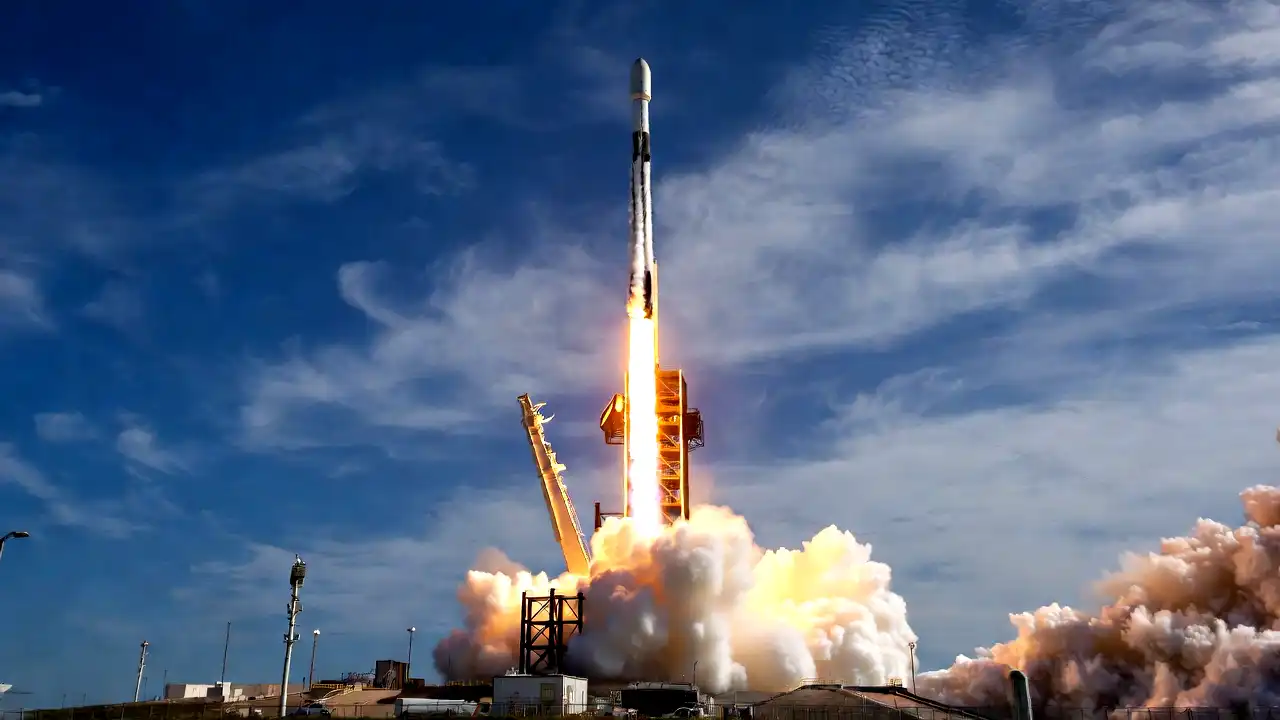
The high-flying space stock market received a brutal reality check on Friday. A massive explosion destroyed Jeff Bezos’ Blue Origin New Glenn rocket during a routine ground test in Florida on Thursday night. The spectacular launchpad disaster immediately cooled the speculative frenzy that had driven space-related stocks to record highs over the last month, reminding investors of the extreme physical and financial risks of commercial spaceflight.
Wall Street quickly punished the commercial space sector on Friday morning, erasing over $1.5 billion in collective market value within hours. The unexpected explosion sent shares of major satellite and aerospace companies tumoring. The Procure Space ETF, which trades under the ticker symbol UFO, fell by 3.5% on Friday, completely reversing its strong weekly gains. Shares of other major private space players, including AST SpaceMobile and Firefly Aerospace, also suffered sharp declines as investors rushed to pull capital from high-risk assets.
This sudden market crash stands in stark contrast to the massive hype that dominated Wall Street earlier in the week. Financial markets had recently entered a rocket-fueled frenzy in anticipation of SpaceX’s historic initial public offering, scheduled for June. Investors expected the SpaceX listing to value the company at at least $1.8 trillion, making it the largest public offering in global history. However, the sudden fireball at Cape Canaveral reminded traders that even the most well-funded tech giants still face devastating engineering failures.
The catastrophic accident occurred around 9:00 p.m. Eastern Time at Launch Complex 36 inside the Cape Canaveral Space Force Station. Engineers were preparing to run a routine hotfire test of the New Glenn’s massive first-stage engines when a major malfunction triggered a massive explosion. The blast destroyed the 188-foot-tall first-stage booster and the 86-foot-tall upper stage. The violent fireball also toppled a 600-foot-high lightning tower, causing millions of dollars in damage and forcing military officials to put the entire base on a strict lockdown.
Fortunately, Blue Origin confirmed that the disaster caused exactly zero injuries or fatalities. Security teams accounted for all personnel on the base within minutes of the blast. Blue Origin founder Jeff Bezos took to his social media account to address the setback, admitting the company had a very rough day. However, the billionaire vowed to rebuild whatever needs rebuilding and get his team back to flying, insisting that the long-term exploration of space remains worth the risk.
The destroyed rocket was originally scheduled to launch next month to deploy a batch of 48 advanced internet satellites for Amazon’s highly anticipated Project Kuiper network. Amazon designed this satellite constellation to compete directly with Elon Musk’s dominant Starlink network, which currently operates over 9,400 satellites in low Earth orbit. While the actual satellites were safe inside a nearby hangar and not on the rocket during the hotfire test, the explosion is certain to delay Amazon’s commercial satellite launches by several months.
The launchpad disaster also throws NASA’s highly ambitious lunar plans into serious jeopardy. Just days before the explosion, NASA announced that Blue Origin had won a major contract to launch the first of three planned missions this year to begin construction on a massive $20 billion moon base. NASA intends to use the heavy-lift New Glenn rocket to transport vital materials and eventually land astronauts on the lunar surface. The space agency must now evaluate how the explosion will delay its timeline.
Blue Origin is currently locked in a fierce, multi-billion-dollar race against SpaceX to provide lunar landers for NASA’s Artemis IV mission planned for 2028. This upcoming mission will land astronauts on the moon for the first time since the historic Apollo 17 mission in 1972. NASA Administrator Jared Isaacman posted on X that the agency will conduct a full evaluation of the mission timeline once Blue Origin investigates the root cause of the anomaly, emphasizing that developing heavy-lift launch capability remains extraordinarily difficult.
The security concerns surrounding global shipping and defense are also driving military investments in aerospace. Just this week, the government of New Zealand announced a massive NZ$1.6 billion, or roughly $936 million, investment plan to buy advanced military drones and upgrade its naval fleet. This massive spending package represents an extra 1.5% boost to the country’s national defense budget. These global increases in defense spending show that, while commercial space companies struggle with technical setbacks, demand for military aerospace technology remains incredibly strong.
For now, the Cape Canaveral Space Force Station remains under strict lockdown as engineers collect telemetry data to determine the cause of the blast. The accident proves that the path to space is unforgiving and expensive. Until the company can rebuild its launchpad and identify the technical flaw in its engines, its ambitious plans to colonize the moon and build a global internet network will remain stuck on the ground, serving as a warning to Wall Street that investing in the final frontier is still a highly risky gamble.















