

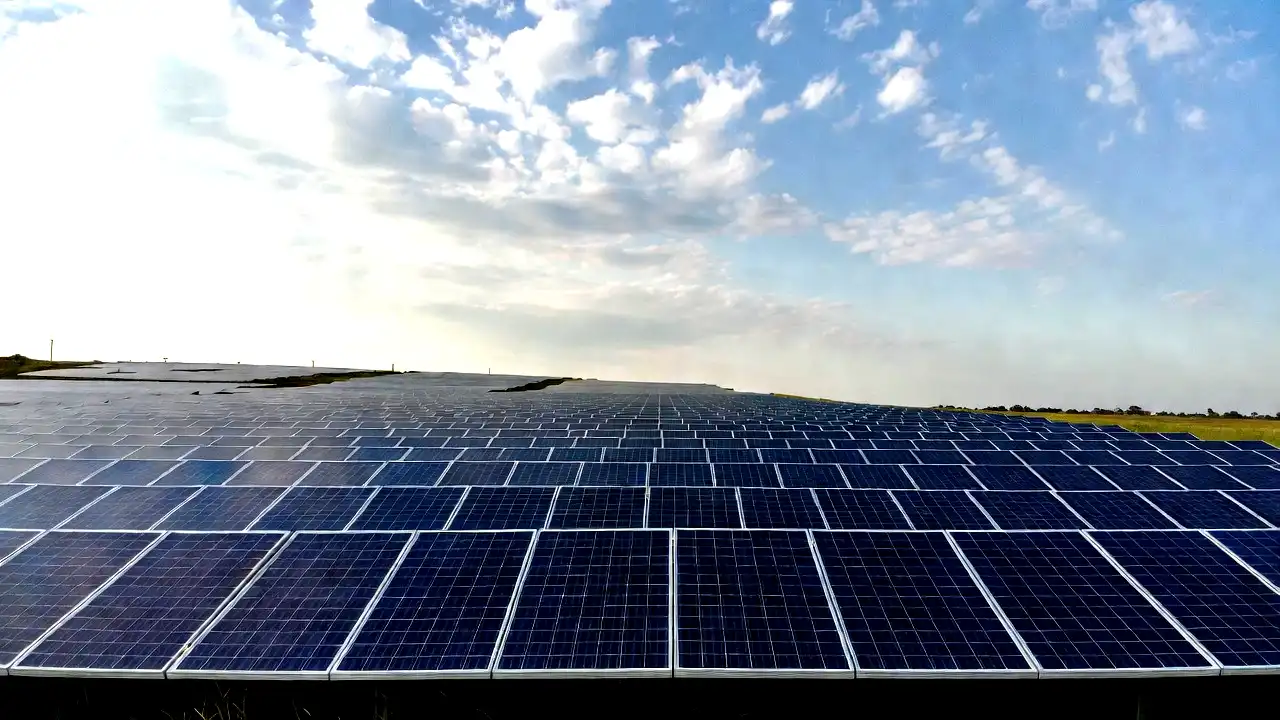
China’s dominant solar manufacturing sector is looking beyond Earth’s atmosphere to escape a brutal economic crisis. On Tuesday, June 2, 2026, a group of the country’s most state-of-the-art solar panel manufacturers and research institutes officially launched a specialized alliance to explore and promote solar energy in space. While the newly formed group released very few immediate operational details, this bold initiative signals a major strategic shift for the Chinese solar industry, which is currently suffering from a severe domestic price war, margin compression, and massive overcapacity in terrestrial projects. By pooling their resources, Chinese companies hope to turn space-based solar power into a viable commercial reality, establishing a new frontier for clean energy.
The new coalition, officially named the Space Energy Development Alliance, made its debut during the International Photovoltaic Power Generation and Smart Energy Conference & Exhibition in Shanghai. A total of 13 founding members joined forces to inaugurate the group, including industry giants GCL Technology Holdings Ltd., Trina Solar Co., and JA Solar. Strikingly, the alliance also counts Shi Zhengrong, the legendary founder of Suntech Power Holdings Co. and formerly the world’s first solar billionaire, as an active participant. Although the founders chose to keep the alliance’s specific objectives and operational details confidential, the move sends a clear message that China’s major players are actively seeking a strategic breakthrough to overcome their current market challenges.
The primary driver behind this sudden interest in outer space is a severe and persistent supply glut that has crippled the domestic solar market. Years of aggressive, state-subsidized expansion have created a massive surplus of production capacity that far outstrips global demand. At the end of 2023, China’s annual production capacity for finished solar modules reached a staggering 861 gigawatts, accounting for roughly 80% of the world’s total capacity. This massive overproduction has caused a collapse in global solar panel prices, squeezing corporate profit margins and driving more than 40 smaller Chinese manufacturers into bankruptcy or forced exits over the past two years, compelling surviving giants to seek new areas of growth.
The scientific appeal of space-based solar power provides a compelling alternative to ground-based installations. Unlike traditional solar panels on Earth, which suffer from atmospheric interference, cloud cover, and the inevitable darkness of night, space-based solar arrays can collect sunlight continuously, 24 hours a day, 365 days a year. Satellites placed in high geostationary orbits can capture up to ten times more solar radiation per square meter than ground-based systems. These orbiting stations convert the harvested sunlight into high-frequency microwave beams or lasers, transmitting the clean energy safely down to ground-based receiver stations connected directly to national power grids.
To make space-based solar power economically viable, Chinese manufacturers are placing massive bets on next-generation solar cell technologies. Traditional silicon-based solar panels are too heavy and fragile to launch into orbit cost-effectively, prompting a shift toward advanced perovskite thin-film modules. These perovskite cells are highly prized for space applications because they are incredibly lightweight and highly flexible, and they can generate electricity more efficiently under extreme space radiation. Chinese companies have already begun testing these materials in orbit, with startup SolaEon successfully launching its flexible perovskite solar modules into a 535-kilometer orbit, proving that the technology can survive the harsh environment of space.
China’s newly formed space alliance is also a direct competitive response to aggressive maneuvers by Western nations and private tech billionaires. The United States and several European countries are currently funding their own intensive research programs into space-based solar power satellites, viewing the technology as a vital national security asset. Earlier in 2026, U.S. billionaire Elon Musk publicly endorsed space-based photovoltaics, proposing to deploy thousands of solar-powered artificial intelligence satellites via SpaceX launches. By coordinating their research and development through the new alliance, Chinese manufacturers hope to maintain their dominant global market share as the clean energy transition expands into orbit.
Despite the immense excitement surrounding the new space energy ecosystem, industry experts warn that the road to commercial space-based solar power is filled with massive engineering and economic bottlenecks. Launching the thousands of tons of equipment needed to build a gigawatt-scale space solar station remains prohibitively expensive, even with the rapid decline in rocket launch costs. Furthermore, scientists must still figure out how to safely assemble massive, miles-wide structures in orbit using robotic systems, while ensuring that the high-power microwave beams used to transmit energy do not pose a health hazard to Earth’s biosphere or disrupt global communications.
While the industry looks to space, it must also navigate severe integration challenges back on Earth. A recent analysis revealed that China’s carbon emissions bounced back up by 2% in the first quarter of 2026, primarily because the country’s inflexible grid management wasted vast quantities of clean power, forcing utilities to burn coal instead. This practice of intentionally reducing renewable generation, known as curtailment, reached alarming levels of 9.2% for solar and 8.5% for wind at the start of 2026. This data shows that even if space-based solar stations successfully beam massive amounts of electricity to Earth, regional grids must undergo significant upgrades to integrate and distribute this clean power.
In the end, the creation of China’s space solar alliance represents a defining moment in the evolution of the global clean energy transition. As terrestrial solar markets reach saturation and profit margins continue to shrink, the final frontier represents an inevitable and highly lucrative path of expansion for the world’s leading manufacturers. If this newly formed coalition can successfully combine China’s unmatched industrial manufacturing power with cutting-edge breakthroughs in wireless energy transmission and perovskite technology, it could establish a powerful monopoly on the next century of global energy. The space solar race has officially begun, and the winners will be those who can successfully harvest the power of a sun that never sets.















