

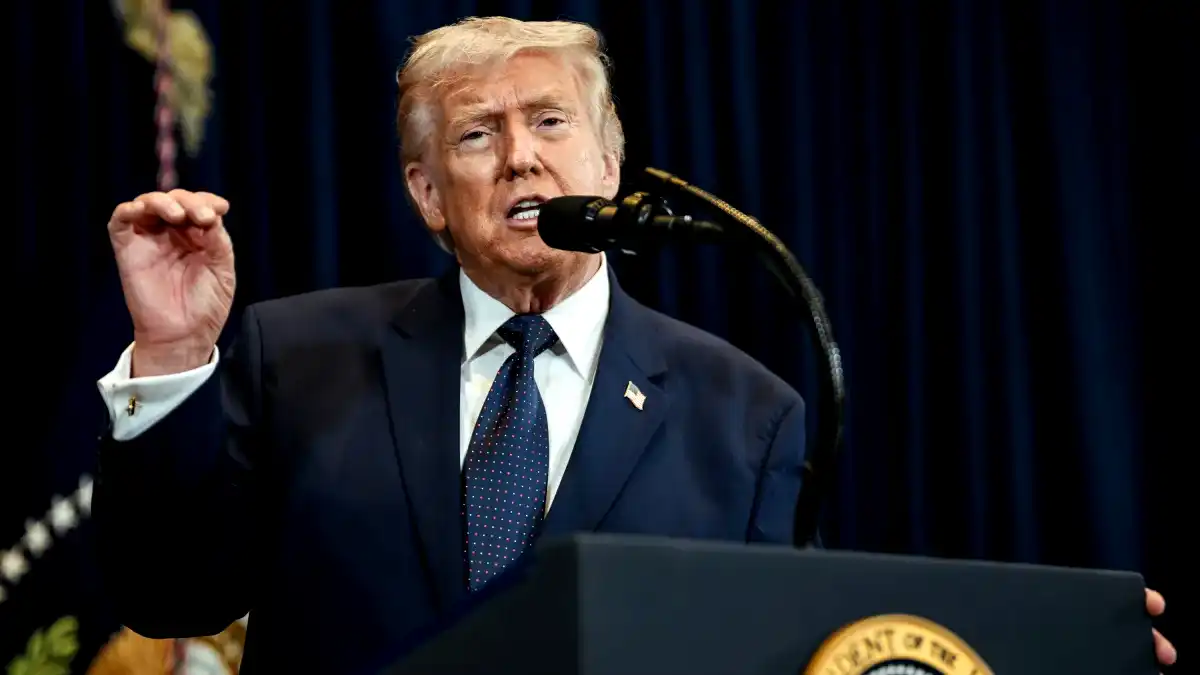
President Donald Trump is barreling toward the highly anticipated midterm elections with a major new vulnerability that represents a fresh crisis in his political life. For years, the president relied on public faith in his handling of economic issues as a reliable political shield against various scandals and controversies. However, a newly released Bloomberg analysis highlights that American voters are rapidly losing faith in the Trump economy.
As the military standoff with Iran drags on and domestic gasoline prices continue to climb, public approval of the president’s economic performance has slumped to levels close to the lowest in either of his two presidential terms. This shift is reshaping the political landscape just as the nation prepares to elect a new Congress, turning what was once the administration’s primary asset into a severe political liability.
The Cold Data: Public Discontent Reaches Historic Levels
Recent polls reveal a profound and widespread decline in consumer confidence across the United States. Voters are expressing deep frustration over the cost of living, grocery bills, and energy costs, and they are increasingly holding the White House directly responsible for their financial pain.
The Breakdown in Economic Trust
A series of major polls released in early June highlights the scale of the public backlash against the administration’s economic policies:
A Reuters/Ipsos poll found that 73% of respondents disapprove of the president’s handling of the cost of living. This marks a massive increase from the 44% disapproval rate recorded when the president first took office.
An Economist/YouGov survey gave the president an overall approval rating of just 34%. This represents his lowest approval rating ever recorded by the pollster.
For two consecutive weeks, almost two-thirds of respondents in the same survey reported that the U.S. economy is getting worse.
An AP-NORC poll showed that even among the president’s core supporters, economic satisfaction is cracking. Republican approval of the administration’s economic handling dropped from 79% in February to 63% as energy costs began to surge.
A Financial Times poll found that 67% of surveyed consumers blamed the president’s policies directly for higher grocery and food prices, showing that the public does not view current price increases as a minor fluctuation.
Upcoming Inflation Threats
This public gloom is likely to intensify in the coming days. Financial analysts and economists expect upcoming government data to show that the U.S. inflation rate has surged back above 4.0% for the first time since the spring of 2023.
While the White House has attempted to reassure the public by touting larger tax refunds and abundant domestic shale energy to shield the country from global supply squeezes, these messaging campaigns are failing to pacify voters who are struggling to pay for basic goods.
The Core Catalyst: How the Iran War Triggered an Energy Crisis
The direct cause of this rapid decline in political support is the ongoing conflict with Iran. The war, which is now entering its fourth month, began in February following a joint U.S.-Israeli strike on Iranian facilities. What the administration initially described as a short-term military operation has turned into a prolonged conflict with severe global economic consequences.
The Standoff in the Strait of Hormuz
The primary economic bottleneck of the war is Iran’s effective blockade of the Strait of Hormuz. This narrow waterway, located between the Persian Gulf and the Gulf of Oman, is the single most critical chokepoint for global energy trade.
Approximately 90% of the petroleum exported from the Persian Gulf and 83% of the liquefied natural gas bound for rapidly growing Asian economies must pass through this strait.
By using drone and missile strikes to target commercial cargo vessels and oil tankers, Iranian forces have effectively halted a large share of the world’s oil supply, triggering a massive global energy shock.
Skyrocketing Energy Costs at the Pump
This maritime blockade has caused energy prices to spike worldwide. International Brent crude prices surged near $120 a barrel before showing some volatility on rumors of temporary ceasefires.
For ordinary Americans, this international supply shock translates directly to higher prices at local gas stations, where fuel costs are rapidly climbing toward or exceeding $4 a gallon.
As families watch a larger share of their weekly incomes go toward filling their fuel tanks, their general economic outlook turns increasingly negative, directly eroding the president’s core political strength.
Economic Contradictions: Strong Jobs versus Public Gloom
The current economic situation presents a puzzling paradox for policymakers. While consumers are expressing extreme pessimism, several traditional economic indicators suggest that the U.S. economy remains resilient.
Low Unemployment and Steady Hiring
The labor market is currently operating in what economists call a low-hire, low-fire mode. While businesses are cautious about expanding their payrolls rapidly due to geopolitical uncertainty, they are also highly reluctant to lay off workers. Consequently, the national jobless rate remains very low by historical standards.
Furthermore, recent employment data indicates that hiring may actually be improving despite the war. U.S. employers added 172,000 jobs in May, capping off the strongest three-month stretch of employment growth in more than two years.
Normally, such strong job numbers would boost a president’s approval rating. However, the positive impact of a stable job market is being completely overshadowed by the daily reality of high grocery bills and expensive fuel, proving that inflation is a far more powerful political force than low unemployment.
The Opposition’s Lack of Appeal
Despite the president’s sliding poll numbers, the administration still possesses a major political saving grace: the lack of public confidence in the opposition.
Voters still remember that the previous Democratic administration presided over the worst domestic inflation in four decades, peaking at nearly 9.0% in 2022.
Because many Americans remain highly skeptical of the opposition party’s ability to manage the economy, the political damage to the ruling party may not automatically translate into major electoral gains for their rivals.
The Congressional and Financial Battle over the War Bill
As public opinion sours on the economic fallout of the conflict, political tensions are rising rapidly in Washington over the soaring financial costs of the military campaign.
Grilling the Defense Department on Capitol Hill
The direct cost of the war has become a major target for lawmakers. On Capitol Hill, congressional representatives have grilled Defense Secretary Pete Hegseth over a massive $25 billion war bill.
The administration is also pushing for a 40% increase in the Pentagon’s overall defense budget to sustain operations in the Middle East and restock depleted munitions.
Critics of the war argue that spending tens of billions of dollars on a foreign conflict while domestic infrastructure degrades and families struggle with inflation is a major policy failure.
The Federal Reserve’s Fight Against Inflation
The war has also complicated the work of the Federal Reserve. Kevin Warsh, who recently took the oath of office as the 17th Federal Reserve Chair, is leading a reform-oriented central bank that is deeply concerned about inflation.
While the president’s political allies have consistently pressured the central bank to cut interest rates to boost the economy ahead of the midterm elections, Federal Reserve officials are warning that the war is actively fueling inflation.
Central bank policymakers have signaled that if the conflict continues to keep oil and commodity prices high, they may have to raise interest rates further to prevent high prices from becoming permanently baked into the American economy, a move that would increase borrowing costs for mortgages and car loans, adding to the public’s economic pain.
Global Repercussions: Slower Growth and Financial Vulnerability
The economic impact of the conflict is not confined to the United States. By disrupting one of the world’s most critical trade corridors, the war has triggered a broad global economic and financial crisis.
The Double Shock in Asia
The economies of East, South, and Southeast Asia are facing a severe double shock due to the blockade of the Strait of Hormuz. Because these countries rely heavily on Middle Eastern crude oil and liquefied natural gas, the disruption of shipping has forced them to purchase energy at highly inflated prices denominated in U.S. dollars.
At the same time, global financial instability has caused their local currencies to weaken against the dollar, compounding the cost of their energy imports.
This financial strain has prompted the International Monetary Fund to downgrade its global growth forecast to 4.3% for the year, a 0.3 percentage-point drop from pre-war projections.
The Creditor Nation Trap
Some economic experts warn that by waging a prolonged war in the Middle East, the United States is exposing its own structural financial vulnerabilities. The U.S. is a debtor nation on a grand scale, running massive current account and budget deficits that require a constant inflow of foreign capital.
To fund its government operations and its military machine, the U.S. relies heavily on international investors and foreign central banks to purchase U.S. Treasury bonds.
If global allies and international investors begin to view the administration’s military campaign as destabilizing or illegal, they may reduce their purchases of American debt.
A sudden reduction in foreign capital inflows would force the U.S. government to pay higher interest rates on its debt, straining the federal budget and leaving the domestic economy highly vulnerable to a severe recession.
Strategic Views: The Search for an Off-Ramp
The ongoing political and economic crisis has sparked intense debate among national security experts, political strategists, and economists regarding how the administration should proceed.
The Security Defense of the War
Proponents of the administration’s military strategy, including Secretary of State Marco Rubio, argue that the military campaign is a necessary national security measure. Rubio has stated that the threat of Iran acquiring a nuclear weapon is a far more serious hazard to global stability than the temporary economic fallout of a localized war.
Supporters of this view argue that the president was fully aware of the economic risks before launching the strikes and that the public must accept short-term financial pain to secure long-term national security.
They believe that once the military operation achieves its goals and the Strait of Hormuz reopens safely, oil prices will fall rapidly, and the economy will quickly recover.
The Political Risk of a Midterm Rout
In contrast, political analysts and former administration officials warn that the president is running out of time. They argue that the public’s tolerance for inflation is extremely low, and that voters will not accept the short-term pain-for-long-term-gain argument if gas and grocery prices continue to climb through the autumn.
Strategists warn that if the administration fails to find a diplomatic off-ramp to end the conflict and stabilize energy prices soon, the ruling party faces the prospect of a devastating defeat in the upcoming midterm elections.
A major loss in Congress would lead to intense legislative gridlock, strip the president of his legislative majority, and severely limit his ability to execute his domestic agenda for the remainder of his term.
In a highly polarized political environment, economic pain remains the ultimate decider of elections, and the ongoing war in the Middle East may have finally dismantled the president’s most powerful political superpower.















