

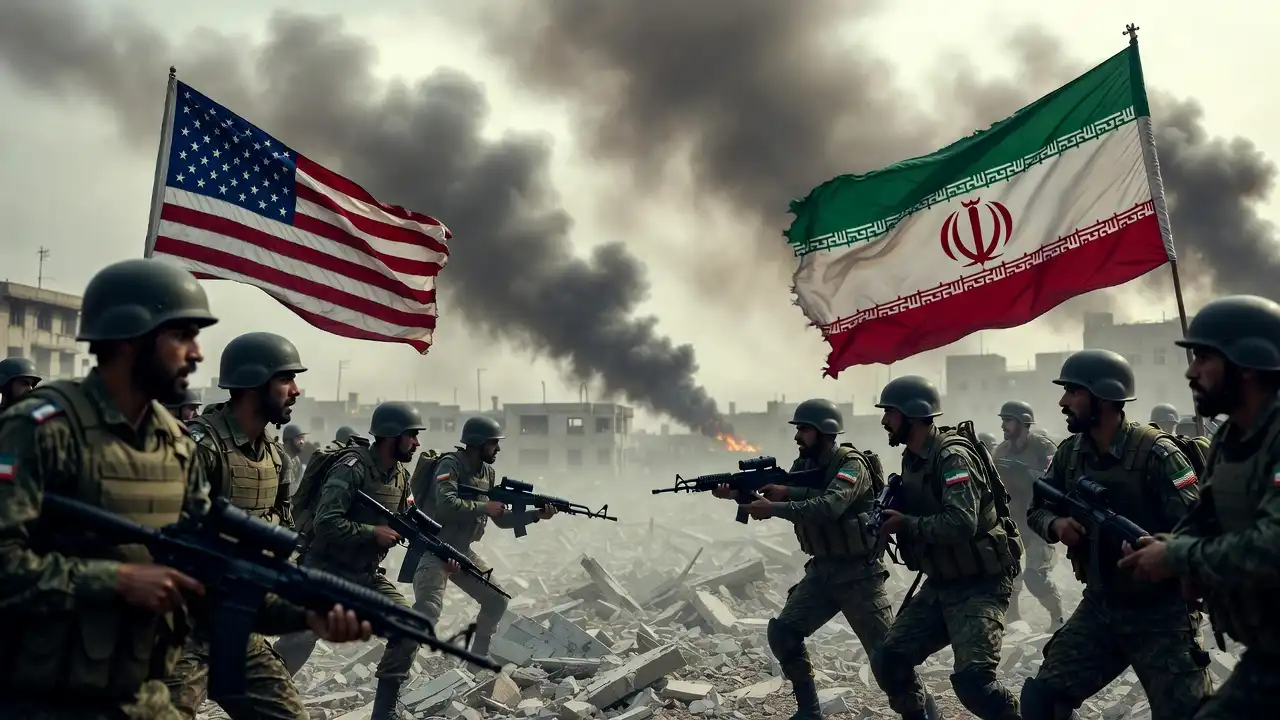
The fragile peace in the Middle East has completely shattered as American and Iranian forces traded heavy military strikes across the region over 24 hours. On Wednesday, June 10, 2026, Iran’s Islamic Revolutionary Guard Corps (IRGC) launched a massive wave of retaliatory missile and drone attacks targeting U.S. military bases in Jordan, Kuwait, and Bahrain. These strikes directly retaliated against a four-hour American bombing campaign that hit almost 20 Iranian targets along the southern coast. The intense exchange of fire represents the most severe escalation since the two nations agreed to a temporary ceasefire on April 8, sending fresh shockwaves through global markets.
The sudden return to open hostilities began with a dramatic aerial incident near the entrance of the Persian Gulf. On Monday evening, June 8, 2026, a U.S. Army AH-64 Apache attack helicopter went down off the coast of Oman. The U.S. military blamed the crash on an accidental collision between the helicopter and a hostile Iranian surveillance drone. In contrast, Iranian parliament national security spokesperson Ebrahim Rezaei publicly praised the downing on social media. In a technological milestone, an autonomous naval surface drone operated by Task Force 59 located and rescued the two American pilots safely from the water within two hours.
While President Donald Trump confirmed that the aviators survived the crash without injuries, he insisted that the United States must launch a powerful response to the attack. Speaking to reporters on Tuesday, Trump defended the strikes as a necessary and powerful reminder to Iranian leaders, stating that he believed the response should be very strong. At Trump’s direct command, U.S. Navy and Air Force fighter jets launched a series of coordinated “self-defense strikes” targeting Iranian air defense batteries, ground-control stations, and surveillance radar installations near the Strait of Hormuz. This critical waterway handles roughly 20 percent of the world’s daily oil supply.
The four-hour American bombardment concentrated heavily on several key port cities and strategic islands. According to local reports, U.S. precision munitions struck Iranian military installations on Qeshm Island, Bandar Abbas, and Sirik. While the American military described the strikes as a proportional response, the ground-level impact was severe. A U.S. strike on two critical water reservoirs in the Bemani area of Sirik destroyed the local infrastructure. The municipal water utility company reported that the destruction of the reservoirs has left over 20,000 people without clean drinking water, exacerbating the humanitarian crisis in the southern province.
Tehran did not leave the American strikes unanswered, launching a broad and coordinated military counteroffensive across the Gulf region early Wednesday morning. The IRGC announced that its forces had targeted several American military installations, including the headquarters of the U.S. Fifth Fleet in Manama, Bahrain. At approximately 2:30 AM local time, a wave of Shahed-136 one-way attack drones targeted the naval base, triggering emergency sirens and forcing personnel into shelters. Simultaneously, Iranian forces launched ballistic missiles targeting the Ali al-Salem airbase in Kuwait, though local air defenses intercepted the incoming threats before they could cause casualties.
The Iranian retaliation also extended deep into Jordanian territory, targeting the Muwaffaq Salti airbase, which hosts U.S. F-35 fighter jets and other critical military aircraft. The IRGC fired several long-range ballistic missiles at the base, claiming to have successfully destroyed F-35 hangars and a command-and-control center. However, Jordan’s military launched a rapid counter-response, with its state-run news agency confirming that air defense units successfully shot down five incoming Iranian missiles over its territory. Exploding debris rained down on empty fields, causing no injuries or significant material damage.
As the military clashes intensified, President Trump adopted an increasingly aggressive stance, signaling that his patience with diplomatic efforts had officially ended. In a series of highly volatile posts on his social media platform, Truth Social, Trump threatened the Iranian leadership with severe consequences. He wrote that Tehran had taken too long to negotiate a peace deal and would now have to pay the price. Trump also asserted that the U.S. naval blockade of Iranian ports—which began on April 13, 2026, and has cost regional economies over $1 billion in lost trade revenues—remains the most successful maritime blockade in naval history.
This dramatic return to open warfare has cast deep doubt over the prospects of a permanent peace deal. The war initially began on February 28, 2026, with joint U.S.-Israeli strikes against Iran, and subsequent efforts to turn the April ceasefire into a permanent treaty have repeatedly failed. Just hours before the latest clashes, Trump had optimistically claimed that peace talks were in their final stages, with an agreement possible in two or three days. Although a high-level Qatari delegation reportedly arrived in Tehran on Wednesday to continue mediating, Iranian diplomats warned that any peace process requires a minimum stable environment, which the recent U.S. strikes have completely shattered.
As the United States and Iran remain locked in a dangerous cycle of physical and economic retaliation, the Middle East faces its most volatile period in decades. The ongoing military standoff along the Strait of Hormuz has forced international shipping companies to completely halt transits, shaving nearly 1.5% off global shipping volumes and driving up energy prices worldwide. Until Washington can relax its financial stranglehold or Tehran halts its missile campaigns, the region will likely remain trapped in this volatile cycle of direct strikes, naval blockades, and devastating proxy wars, keeping the entire global economy on a knife-edge of uncertainty.















