

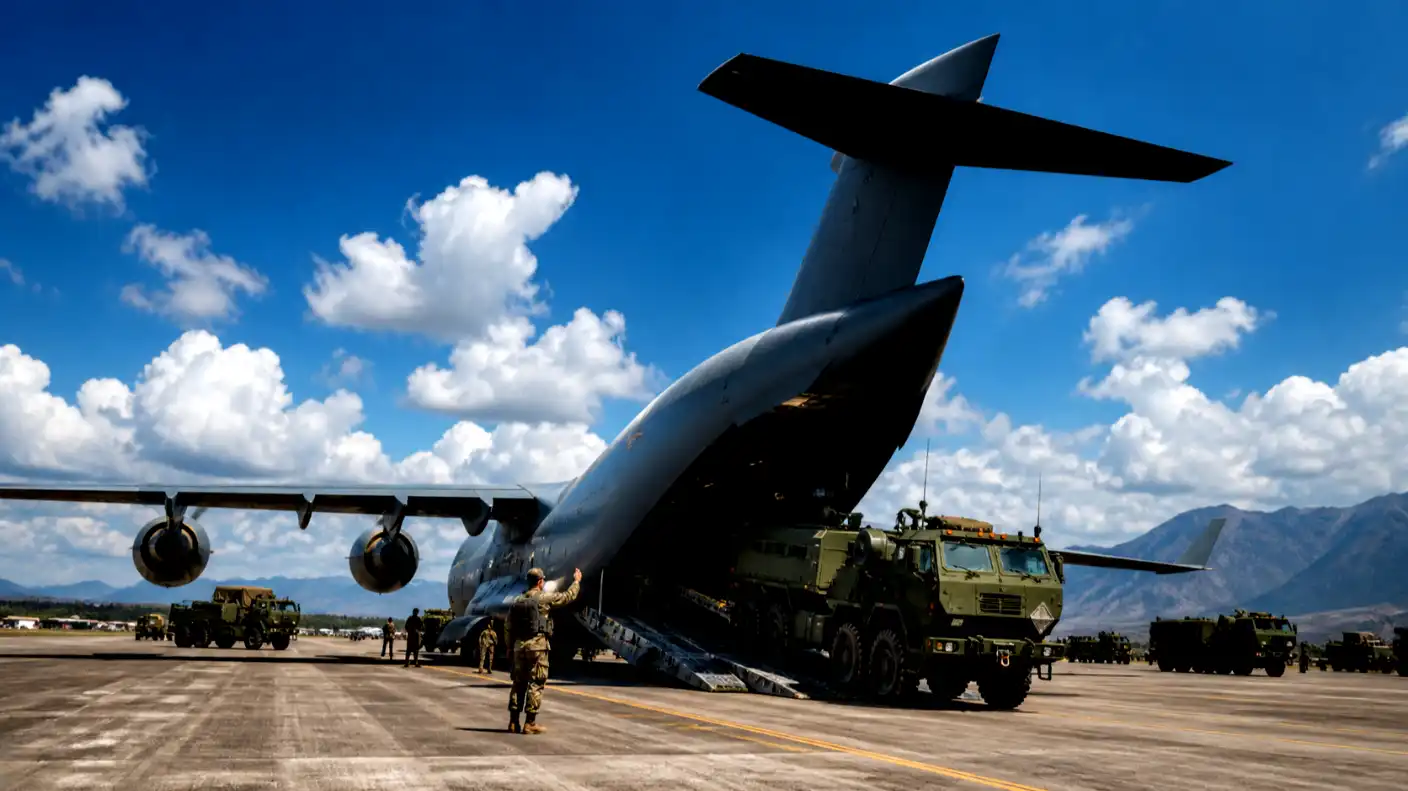
A massive aerial transport operation is currently unfolding across the United Kingdom of Saudi Arabia, the neighboring Gulf states, and the Korean Peninsula. In a highly coordinated logistics campaign, the United Arab Emirates Air Force has deployed its heaviest military transport aircraft to South Korea. The mission aims to accelerate the delivery of a state-of-the-art, drastically South Korean-made surface-to-air missile system.
As the military conflict in the Middle East continues to escalate, regional powers are racing to secure their skies against sophisticated drone and ballistic missile threats. This emergency airlift highlights how air defense has shifted from a long-term modernization goal to an immediate necessity for national survival.
Military cargo planes have begun arriving in successive batches at a major air base in Daegu, located approximately 240 kilometers southeast of Seoul. By bypassing traditional, slow-moving maritime shipping routes and utilizing its own fleet of heavy-lift transport aircraft, Abu Dhabi is sending a clear signal to the world. The country is prioritizing the rapid reinforcement of its domestic air defense umbrella to shield its critical infrastructure, cities, and energy facilities from incoming regional attacks.
This article explores the details of the ongoing airlift, examines the technical capabilities of the Korean-made missile system, and analyzes the strategic perspectives of defense experts tracking this significant shift in global arms exports.
The Daegu Airlift: Logistics of an Emergency Defense Build-Up
The physical logistics of the transport operation illustrate the urgency that the Emirati leadership has placed on securing these weapons systems.
The C-17 Globemaster Fleet on Standby
The United Arab Emirates Air Force has committed its primary strategic cargo workhorse, the Boeing C-17 Globemaster III, to manage the transport bridge. Observers recently spotted one of these massive cargo aircraft on standby on a runway at the Daegu air base, with several more scheduled to arrive in consecutive waves over the coming days.
According to defense industry and military logistics sources, the UAE plans to dispatch a total of eight C-17 transport aircraft to South Korea. This fleet will fly successive, round-the-clock sorties to carry the heavy components of the missile system back to the Gulf.
Each C-17 can carry up to 77,500 kilograms of cargo, enabling it to transport the bulky, high-tech components of missile batteries. This includes the massive multifunction radars, command-and-control cabins, and mobile launcher vehicles.
By utilizing these strategic assets, the UAE can cut the delivery time of these highly complex weapons systems from several months by sea to just a few days by air.
The Second Emergency Transport of the Year
This massive airlift represents the second time this year that the UAE has used its military cargo planes to bypass standard delivery schedules. In March, only a few weeks after the outbreak of the regional war, the same UAE transport aircraft arrived at the Daegu base.
The plane loaded an emergency shipment of interceptor missiles and immediately flew back to the Gulf, proving that the logistical pathway between the two nations was already active and tested.
The decision to launch a second, much larger airlift of eight transport planes indicates that the threat level in the Gulf remains exceptionally high.
With regional missile exchanges showing no signs of slowing, the UAE cannot afford to wait for scheduled commercial deliveries and instead chooses to mobilize its own military assets to fast-track its national defense.
The Korean Patriot: Inside the Cheongung-II System
The system that the UAE is scrambling to deploy is the Cheongung-II, also known as the M-SAM II. Frequently described by defense analysts as the Korean version of the U.S.-made Patriot missile defense system, this medium-range surface-to-air guided missile represents a major achievement for South Korea’s domestic defense industry.
Technical Profile and Altitude Capabilities
The Cheongung-II is a highly sophisticated, road-mobile air defense system designed specifically to intercept incoming ballistic missiles, cruise missiles, and hostile aircraft.
The interceptor utilizes hit-to-kill technology, where the missile destroys the incoming target through direct physical impact rather than detonating a nearby fragmentation warhead.
This capability ensures the destruction of high-speed ballistic warheads at altitudes below 40 kilometers, providing a highly reliable shield for high-value targets.
The Mechanics of a Battery
A standard Cheongung-II battery operates as a highly integrated, self-sufficient tactical unit:
- The Command Post: A mobile engagement control center that manages the entire battle space, analyzing incoming data and coordinating the launch sequence.
- The Multi-Function Radar: A single, advanced 360-degree radar system that performs target detection, tracking, and identification, as well as missile guidance, eliminating the need for separate radar units and reducing the battery’s footprint.
- The Mobile Launchers: Each battery includes four mobile launcher vehicles.
- Firepower Capacity: Each launcher vehicle carries eight ready-to-fire missiles. This allows a single battery to simultaneously engage and launch up to 32 interceptors against multiple incoming threats.
The compact, mobile design of the system allows operators to rapidly redeploy the batteries to different locations in response to shifting threat patterns, making it exceptionally difficult for hostile forces to target or disable the air defense network.
Real-World Validation: Proof on the Battlefield
The primary reason the UAE is investing so heavily in the rapid deployment of the Cheongung-II is that the system has already proven its worth in active combat.
Intercepting Real-World Threats
Unlike many air defense systems that have only been tested in controlled training environments, the Cheongung-II has been tested under actual combat conditions.
According to military sources, the two batteries currently in active service in the UAE have successfully intercepted several incoming targets during the ongoing regional conflict.
The system’s ability to successfully identify, track, and destroy real-world threats has validated the UAE’s multi-billion-dollar investment.
In the highly stressful environment of active warfare, where a single missed interception can destroy a critical water desalination plant or a major oil refinery, the Korean system’s proven track record has given the Emirati leadership the confidence to accelerate delivery of the remaining batteries under contract.
Fulfilling the Massive 2022 Contract
The emergency airlift is part of a larger effort to complete a historic defense agreement signed between the two nations. In 2022, the UAE signed a massive $3.5 billion contract with South Korea to acquire ten complete Cheongung-II batteries.
At the time, the deal was celebrated as the largest defense export contract in South Korea’s history, establishing the nation as a serious competitor in the highly lucrative Middle Eastern arms market.
Under the original terms of the contract, the deliveries were scheduled over a multi-year period, with the final batteries arriving near the end of the decade.
However, the outbreak of the war has forced both sides to abandon the original timeline entirely.
By launching these consecutive airlifts, South Korean defense manufacturers and the UAE military are working together to deliver the remaining eight batteries as quickly as possible, bypassing years of scheduled waiting.
The Strategic Alliance: Rebuilding South Korea’s Defense Profile
The rapid delivery of the Cheongung-II system is a major milestone for South Korea’s broader defense export strategy, which has turned the nation into one of the world’s fastest-growing arms suppliers.
The Rise of the K-Defense Boom
South Korea has spent decades building a highly efficient, high-volume domestic defense industry, driven by the constant need to maintain a strong military posture against its northern neighbor.
This domestic focus has allowed South Korean defense firms to develop a unique competitive advantage: the ability to manufacture high-tech, reliable military hardware quickly and at a lower cost than their Western competitors.
The success of the Cheongung-II contract in the UAE has opened the door to other major defense exports worldwide.
South Korean firms are currently exporting FA-50 light fighter jets, K2 Black Panther main battle tanks, K9 Thunder self-propelled howitzers, and Chunmoo multiple rocket launchers to countries in Europe, Asia, and the Middle East.
By proving that it can deliver advanced weapons systems under the pressure of an active regional war, South Korea is cementing its status as a reliable, go-to defense partner for nations looking to upgrade their military capabilities quickly.
Non-Politicized Technology Transfer
Another key factor driving the partnership between Abu Dhabi and Seoul is South Korea’s willingness to share its technology.
Unlike some Western nations that impose strict, highly politicized restrictions on how their weapons can be used or to whom they can be sold, South Korea has adopted a highly pragmatic, business-oriented approach.
As part of the $3.5 billion contract, South Korean defense firms agreed to work closely with local Emirati defense companies to co-produce certain components of the system and share vital maintenance and engineering expertise.
This cooperative approach allows the UAE to build its own domestic defense capabilities and maintain its equipment independently, reducing its reliance on foreign technicians and ensuring that its air defense network can operate continuously during a crisis.
Views: The Security Dynamics of a Highly Volatile Gulf
The emergency airlift of the South Korean missile system has triggered a wider debate among regional security experts, defense analysts, and international relations specialists regarding the future of military balance in the Gulf.
The Pragmatic View on Rapid Air Defense
Many military analysts argue that the UAE’s decision to fast-track the deployment of the Cheongung-II is a highly pragmatic and necessary response to the changing nature of modern warfare.
They point out that the ongoing conflict has demonstrated that low-cost drones, cruise missiles, and ballistic systems can easily overwhelm traditional, centralized air defense networks if they are launched in high-volume swarms.
From this perspective, the primary requirement for modern air defense is not just high technology, but mass and redundancy.
By rapidly acquiring 10 complete batteries of the Korean system, the UAE is building a highly layered, redundant air defense network capable of protecting multiple high-value targets simultaneously.
The proven ability of the Cheongung-II to successfully destroy real-world targets proves that the system is a highly effective, cost-efficient alternative to the more expensive, slower-to-deliver Western systems, allowing the UAE to secure its skies without waiting years for American-made Patriot batteries.
The Geopolitical View on Supplier Neutrality
Other international relations specialists point out that the partnership highlights a broader shift in how Middle Eastern nations are choosing their defense partners.
Historically, Gulf states relied almost exclusively on the United States and European allies for their high-end military hardware.
However, as Washington’s political focus shifts and regional conflicts become more complex, countries like the UAE are increasingly seeking to diversify their defense relationships.
By turning to South Korea, the UAE can acquire highly advanced military technology from a politically neutral nation with no direct stake in the Middle East’s regional geopolitical conflicts.
This supplier neutrality reduces the risk that future arms transfers will be blocked or delayed by political shifts in Western capitals, giving the UAE greater long-term confidence in its security planning and allowing it to maintain its national defense independent of Western political consensus.
The Danger of a Regional Arms Race
In contrast, some regional security analysts warn that the rapid militarization of the Gulf could have unintended, destabilizing consequences.
They argue that while the acquisition of advanced interceptor missiles is a defensive measure, the massive influx of high-tech military hardware into the region could accelerate an ongoing arms race.
Critics warn that as defensive capabilities improve, rival powers may feel forced to develop even more advanced, high-speed offensive weapons—such as hypersonic glide vehicles or more sophisticated drone swarm technologies—to bypass the new air defense shields.
This self-reinforcing cycle of defense upgrades and offensive innovations could lock regional powers into a highly volatile, expensive military competition, increasing the overall risk of a catastrophic regional conflict if diplomatic efforts to end the current war continue to fail.
Conclusion: The Shifting Coordinates of Global Defense
The emergency airlift of the Cheongung-II missile system from Daegu to the United Arab Emirates represents a historic milestone for both South Korea’s defense industry and the security dynamics of the Middle East.
By utilizing its own military transport aircraft to fast-track the delivery of a $3.5 billion air defense system during an active war, the UAE has demonstrated its unwavering commitment to protecting its national sovereignty and securing its skies from regional threats.
As the C-17 cargo planes continue to fly their successive sorties across the Indian Ocean, the success of this logistics bridge highlights a fundamental truth of modern warfare: in a highly volatile world, the speed of supply and the reliability of your defense partners are just as critical as the technology of the weapons themselves.
By proving that it can manufacture and deliver advanced interceptor missiles under the intense pressure of an active regional conflict, South Korea has firmly established itself as a premier global defense supplier, reshaping the coordinates of the international arms trade and ensuring that its technology will play a central role in guaranteeing peace and stability in the skies of the Middle East for decades to come.















