

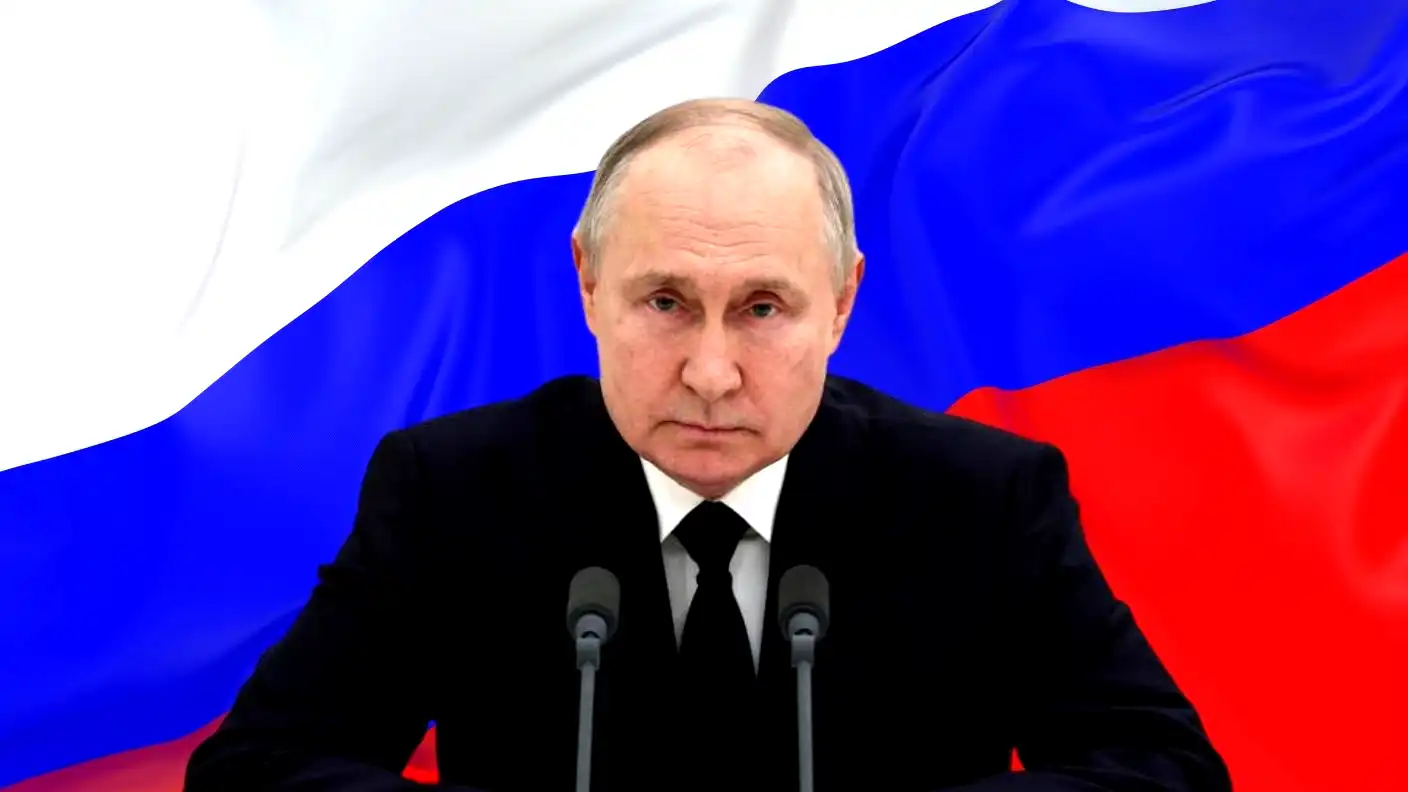
Russia has launched a highly ambitious technological initiative to integrate its rapidly expanding space capabilities with its front-line military operations. Russian President Vladimir Putin announced during a high-level meeting with top military commanders that the country is actively developing an advanced satellite drone control system. This new technological framework aims to enable military operators to control heavy combat drones via satellite links rather than traditional radio-control systems. This strategic upgrade will enable the Russian military to manage drone flights over significantly longer distances, bypassing current line-of-sight limitations and electronic jamming.
The planned control network relies heavily on a rapidly growing constellation of low-Earth orbit communication satellites known as the Rassvet system, developed by a prominent Russian private aerospace company. During the meeting, Putin compared the low-Earth-orbit satellite network to the American Starlink system, claiming that Russian technology could soon match or even surpass its Western rival in data transmission speed and orbital density. The private aerospace firm launched its first three test satellites in 2023, followed by three fully-fledged prototypes in May 2024 to test advanced non-terrestrial network equipment and direct laser communication links between the spacecraft in orbit.
To establish a fully functional, space-based communication network, the Russian government has outlined a phased deployment schedule that will accelerate over the next several years. Following a brief three-month delay due to regional manufacturing bottlenecks, the private developer successfully launched 16 operational satellites into orbit on March 23, 2026, forming the system’s physical foundation. The government’s federal project plans to deploy 156 satellites by the end of this year, increasing to 292 in 2027 to enable the full launch of commercial services. The program aims to have 318 satellites in active service by 2028, with a long-term goal of launching over 900 low Earth orbit satellites by 2035.
Building a sovereign, space-based military communication network represents one of the most expensive and complex engineering projects in Russia’s modern history. The massive space-based military project, which experts estimate will cost over $1 billion to develop fully, has placed an immense strain on the state’s budget. To fund the rapid expansion of these orbital constellations, the government has reallocated nearly 1.5% of its total annual public budget to finance this massive orbit-to-ground security network. This capital injection will support advanced laser communication research, expand local semiconductor manufacturing, and fund the construction of dedicated launch vehicles.
The low-Earth orbit project is also receiving significant support from the Russian federal space agency, which recently announced its own complementary space initiative. The state space agency plans to deploy over 100 specialized satellites—specifically, 102 plus one spacecraft—exclusively to control unmanned aerial systems. This dedicated military satellite network will work alongside 886 Rassvet broadband internet satellites and 114 Earth remote sensing satellites. By creating this highly specialized, multi-layered orbital network, the Russian military hopes to establish a completely unhackable, secure communication loop that can feed real-time targeting data directly to its front-line units.
The drive to build a satellite-based control network aligns with Russia’s broader effort to reorganize its military structure around autonomous drone warfare. In November 2025, the Russian Ministry of Defense officially established the Unmanned Systems Forces (VBS), a dedicated, independent military branch focused entirely on conducting drone operations on land, sea, and air. By May 2026, the specialized branch had grown to an estimated 114,000 active personnel. The creation of the VBS represents a formal recognition by the Russian high command that autonomous systems have become the central, deciding factor in contemporary global conflicts.
In tandem with the drone announcements, President Putin issued a major new presidential decree on Friday to significantly expand the overall size of the country’s armed forces. The new decree sets the authorized size of the Russian military at 2,399,130 individuals, including a massive force of 1,510,000 active service members. This substantial increase in troop strength highlights the Kremlin’s determination to sustain its long-term military commitments in Europe. The government plans to utilize these expanded manpower reserves to secure its borders and reinforce its defensive lines, particularly as the war in Ukraine enters its 1,569th day.
During his address to military officials, Putin also issued a harsh warning regarding the ongoing Ukrainian drone strikes against civilian infrastructure inside Russian territory. The Russian President acknowledged that Ukrainian long-range drones have damaged local refineries and energy depots, but claimed that local engineering crews are restoring the facilities quickly without creating serious economic problems. However, he warned that Russia will increase its retaliatory strikes against Ukraine’s power grid, transport networks, and utility systems. Putin stated that these systematic retaliatory strikes aim to properly respond to the enemy and reduce their motivation to attack Russian civilian facilities.
As both Russia and Ukraine continue to scale up their uncrewed military capabilities, the announcement of a space-based drone control network represents a major escalation in the technological arms race. By integrating low-Earth orbit satellites with autonomous combat drones, the Russian military hopes to secure a decisive edge on the battlefield. However, military analysts remain highly skeptical about whether Moscow’s heavily sanctioned tech sector can manufacture the highly complex components needed to sustain such an ambitious space network. Until the global conflict subsides, the skies and orbits of Eastern Europe will remain a highly volatile testing ground for the future of warfare.















