

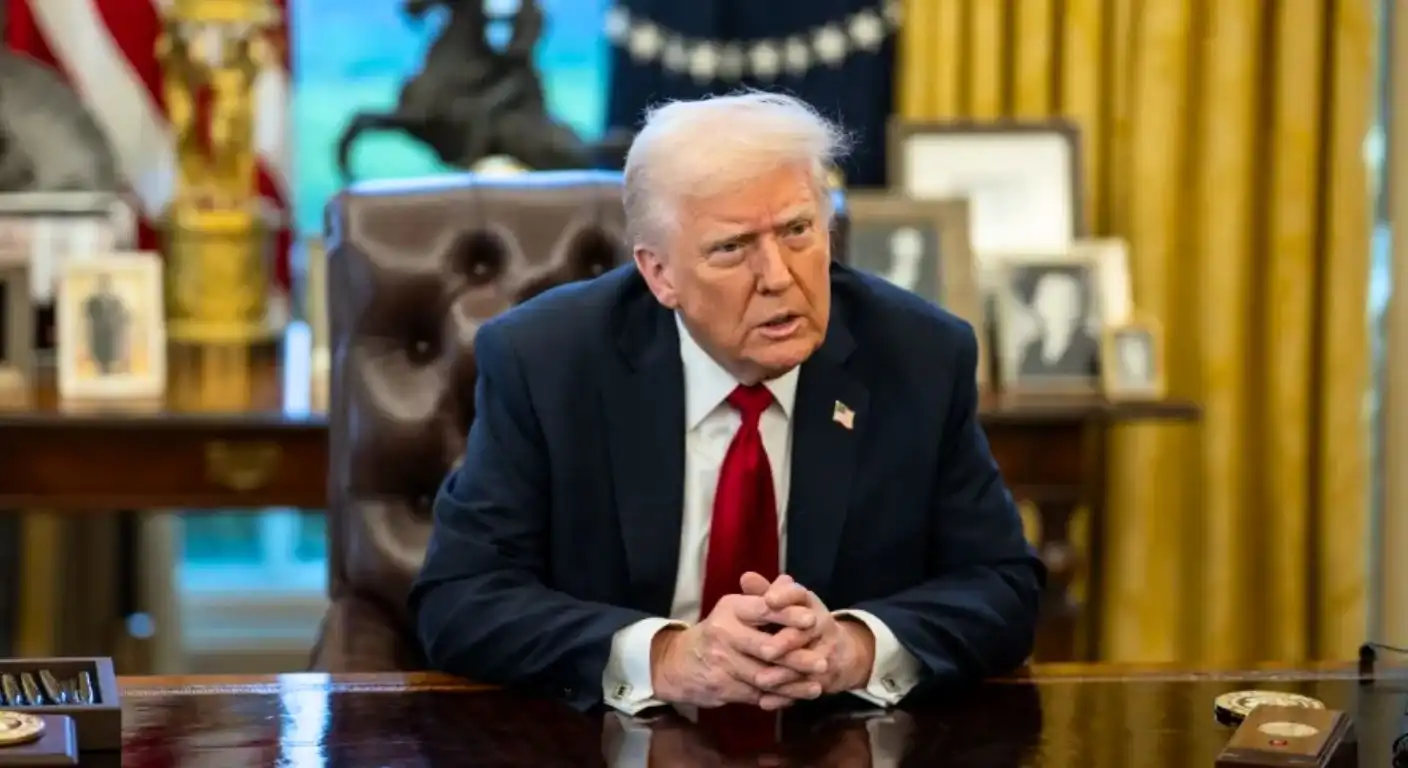
U.S. President Donald Trump has launched an aggressive public relations campaign to defend his controversial preliminary peace agreement with Iran against a rising tide of domestic and international skepticism. Following the digital signing of the 14-point memorandum of understanding, political opponents and hardline conservatives have accused the administration of capitulating to Tehran’s demands by offering sanctions relief and a regional recovery fund. In a series of highly combative statements, the President forcefully rejected claims that the United States negotiated from a position of weakness, declaring that the war had left the Iranian military completely decimated and finished.
The President’s public defense was triggered in part by comments from Iran’s Supreme Leader, Ayatollah Mojtaba Khamenei, who claimed that Washington had pushed through the ceasefire agreement out of sheer desperation. Trump took to his social media platform to deliver a sharp, direct rebuttal, asserting that it was Tehran, not Washington, that entered negotiations out of sheer panic. The President declared that U.S. forces will play out the mandated 60-day negotiation period to hammer out the final details of the treaty, but warned that Iran will receive no immediate financial payouts. He stressed that during this interim phase, the Iranian government will not receive a single cent of American capital.
To reinforce his claim of an absolute American victory, Trump listed off the extensive physical damage that the joint U.S.-Israeli military campaign has inflicted on the Islamic Republic. Since the outbreak of hostilities on February 28, allied forces have conducted over 9,000 highly targeted airstrikes inside Iran, systematically dismantling its strategic defenses. The President argued that the war has effectively diminished Iran’s military capacity, leaving the country without a functional navy, an active air force, functional radar networks, or modern anti-aircraft equipment. By presenting the state as militarily paralyzed, the administration is attempting to show that the ceasefire is not a concession, but a dictated truce.
The President also directed his fury at domestic political critics, particularly members of the Democratic Party who have argued that the interim deal leaves Iran in a stronger strategic position. Trump ridiculed these assertions as foolish, questioning how political commentators could argue that a nation with ruined infrastructure and a decimated military is better off now than it was four months ago. The White House has used these sharp political broadsides to frame any opposition to the peace deal as partisan obstruction, arguing that the administration’s military actions successfully achieved its core objectives of ending the conflict and protecting allied forces.
Supporting the President’s messaging, Vice President JD Vance strongly defended the agreement during a press briefing, describing the ceasefire as a major diplomatic achievement built directly on American military dominance. Vance argued that the U.S. campaign successfully destroyed a substantial portion of Iran’s ballistic missiles and mobile launch platforms, effectively neutralizing its offensive capabilities. The Vice President emphasized that both the United States and Israel retain their inherent rights to self-defense under the terms of the memorandum, ensuring that allied forces can immediately resume operations if Tehran violates its commitments.
In a highly unusual move, Vance also issued a blunt warning to members of the Israeli government who have publicly criticized the administration’s handling of the peace process. The Vice President cautioned Israeli cabinet ministers against attacking their only powerful ally left in the world, pointing out that Washington’s diplomatic cover and military support remain vital for Israel’s long-term security. While Israel has kept its distance from the U.S.-Iran negotiations, the administration’s public pushback shows that the White House is no longer willing to tolerate public dissent from its closest regional partner as it attempts to finalize the truce.
The President’s media surrogates are also working to redefine what constitutes a successful outcome to the war. When pressed by journalists on why the interim agreement fell short of his original demands for the immediate collapse of the theocratic government, Trump argued that the practical outcome of the deal will yield the same results. He asserted that because Iran’s conventional military forces have been destroyed, the eventual treaty will effectively amount to the unconditional surrender and practical regime change that his administration promised at the outset of the war, even if the clerical leadership remains formally in place.
The intense political debate in Washington stands in sharp contrast to the massive human and economic toll of the 14-week conflict. According to official estimates, the war has killed at least 7,000 people, mostly in Iran and southern Lebanon, while stoking global inflation by choking off energy exports. However, the signing of the preliminary peace deal has already brought immediate economic relief. Following the lifting of the U.S. naval blockade, commercial tankers have resumed transit through the strategically vital Strait of Hormuz, which handles nearly 20% of global oil supplies. The resumption of shipping has already pushed global crude prices down, easing inflationary pressures for Western consumers.
Despite the administration’s aggressive defense, the preliminary agreement continues to face deep, bipartisan skepticism. While former President Barack Obama welcomed the ceasefire and expressed hope that the truce holds, other prominent national security specialists remain highly wary. Bipartisan critics argue that by unfreezing billions of dollars in blocked Iranian assets and lifting export blockades, the administration is providing Tehran with an economic lifeline that will allow the regime to rebuild its regional proxy networks, including Hezbollah in Lebanon. They warn that without a verifiable, permanent nuclear disarmament plan, the current ceasefire is simply a temporary pause.
Ultimately, Donald Trump’s aggressive messaging highlights the high-stakes political gamble at the heart of his Middle East strategy. By framing the 14-point memorandum of understanding as an absolute military victory and claiming that Iran is finished, the President is attempting to disarm his critics and secure a major foreign policy triumph ahead of the critical midterm elections. However, with the scheduled technical talks in Switzerland already facing logistical setbacks and active clashes continuing to flare up on the ground, the durability of the peace plan remains deeply uncertain. Whether this agreement represents a genuine path to regional stability or a temporary diplomatic illusion is a question that will test the administration’s credibility for years to come.















