

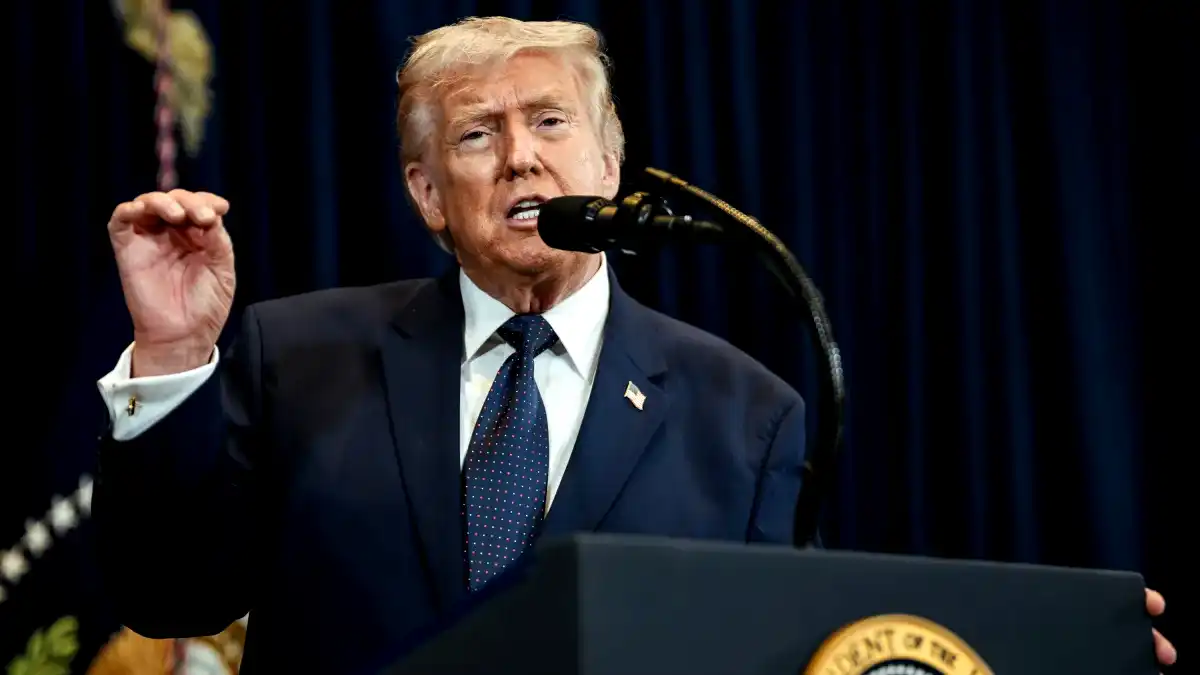
The United States has officially suspended its heavy trade embargo on Iran, marking the first major phase of economic relief under a newly established, high-stakes peace framework. On Monday, the federal treasury announced a temporary 60-day suspension of oil and financial restrictions, allowing Tehran to resume international fuel exports and receive payments. However, the diplomatic breakthrough arrived with a stern, direct warning from President Donald Trump, who declared that Washington will immediately resume military operations if Iran fails to stick to its side of the agreement. The aggressive warning has kept global markets on high alert, emphasizing that the temporary relief is strictly conditional on Tehran’s behavior.
The formal implementation of the sanctions relief follows the conclusion of a highly intense, three-day summit hosted at the Qatari-owned Bürgenstock mountain resort near Lucerne, Switzerland. Acting as primary mediators, representatives from Pakistan and Qatar successfully guided senior U.S. and Iranian officials through their first face-to-face negotiations under the nascent peace deal. The summit resulted in a mutual agreement to establish a comprehensive roadmap designed to finalize a permanent, legally binding treaty within the next 60 days. Diplomatic sources reported that Pakistan’s Prime Minister Shehbaz Sharif and military chief Field Marshal Asim Munir played a central role in brokering the high-level compromise, earning widespread praise for helping to stabilize the global economy.
One of the most critical immediate achievements of the Switzerland summit is the reopening of the strategically vital Strait of Hormuz. The narrow shipping lane, which handles roughly 20% of global oil and liquefied natural gas shipments, had been completely choked off by a joint U.S.-Israeli naval blockade and retaliatory Iranian operations. Under the terms of the temporary agreement, both sides have officially opened an emergency communication hotline to coordinate safe transit and prevent future military clashes in the waterway. Following the announcement, commercial tanker traffic began to pick up steadily on Monday, sending global crude prices down and easing fears of a prolonged, catastrophic energy crisis.
In addition to maritime security, the Bürgenstock roadmap outlines a formal coordination mechanism to permanently end the devastating military conflict in southern Lebanon. The conflict between Israeli ground forces and the Iran-backed Hezbollah militia has displaced more than one million people and claimed thousands of lives over the past several months. While sporadic violations had threatened to derail the peace process earlier in the week, military observers reported a sustained lull in fighting across southern towns following the implementation of the ceasefire. This quiet environment represents the longest period of peace the region has experienced since major hostilities began in late February, providing temporary relief to displaced families.
To give the diplomatic talks a viable chance to succeed, the U.S. Treasury’s Office of Foreign Assets Control issued a broad general waiver designated to run until an August 21 deadline. The temporary license legally permits international banks, shipping companies, and insurance firms to facilitate the transport and sale of Iranian-origin crude oil and petrochemical products. Crucially, the waiver allows payment transactions to proceed through global financial networks, bypassing the strict embargoes that have historically restricted Iran’s oil sales. By providing this short-term economic relief, Washington is attempting to demonstrate its commitment to the peace process while maintaining absolute control over the timeline.
Despite the promised sanctions relief, President Trump faced immediate, intense domestic criticism from political opponents who accused the administration of giving away valuable leverage to a hostile regime. In a press briefing at the White House, Trump strongly rejected these claims, explaining that the newly unfrozen Iranian funds are strictly locked within a tightly controlled trade system. The President asserted that the unfrozen assets will return directly to the United States in the form of massive food and agricultural purchases, which he claimed Iran desperately needs to feed its population of 91 million people. Trump declared that the deal represents a massive victory for American farmers, who will benefit from billions of dollars in new export contracts.
However, the President’s domestic narrative has met with immediate public resistance from Iranian diplomats. Speaking to reporters on Tuesday, Ali Bahreini, Iran’s ambassador to the United Nations in Geneva, confirmed that technical-level talks had been highly productive but flatly denied Trump’s assertions regarding the unfrozen assets. Bahreini clarified that the Iranian government has never agreed to use its retrieved capital to purchase agricultural commodities exclusively from the United States. He emphasized that the cash reserves belong to the Iranian people and will be utilized to support domestic economic reconstruction, warning that Washington cannot dictate how Tehran chooses to spend its own sovereign assets.
The deep diplomatic divide between the two nations is also highly visible in ongoing disputes regarding Iran’s nuclear program. While U.S. Vice President JD Vance announced that the Switzerland summit had established a good foundation to return international inspectors to the country, Iranian foreign ministry spokesperson Esmail Baghaei strongly disputed these claims. Baghaei stated that the technical working groups scheduled to meet this week will focus exclusively on the permanent removal of U.S. economic sanctions and the unfreezing of blocked assets. He made it clear that Tehran has not yet agreed to discuss its nuclear enrichment capabilities or invite International Atomic Energy Agency inspectors back to its research facilities.
This direct contradiction from Iranian officials has supercharged bipartisan skepticism on Capitol Hill. Hardline lawmakers in Congress are publicly warning that the administration is falling into a classic diplomatic trap, accusing the White House of lifting vital oil sanctions in exchange for vague, unverified promises. They argue that by allowing Tehran to openly sell its crude and receive payments, the U.S. is providing a massive financial lifeline that will allow the regime to rebuild its depleted military and proxy networks. Bipartisan critics are demanding that the President immediately cancel the August 21 waiver unless Iran agrees to strict, verifiable limits on its nuclear program.
Ultimately, the temporary suspension of Iran sanctions marks a highly precarious, high-stakes milestone in modern international diplomacy. By utilizing the joint mediation of Qatar and Pakistan to secure the reopening of the Strait of Hormuz and a temporary ceasefire in Lebanon, the global community has successfully avoided a catastrophic economic collapse. However, Donald Trump’s warning that he will do what he must do if Tehran misbehaves serves as a stark reminder that this peace is built on incredibly fragile foundations. As technical working groups prepare to meet this week under the shadow of deep disagreements over nuclear inspections and unfrozen funds, the next 60 days will prove whether this roadmap leads to a lasting peace or a return to total war.















