

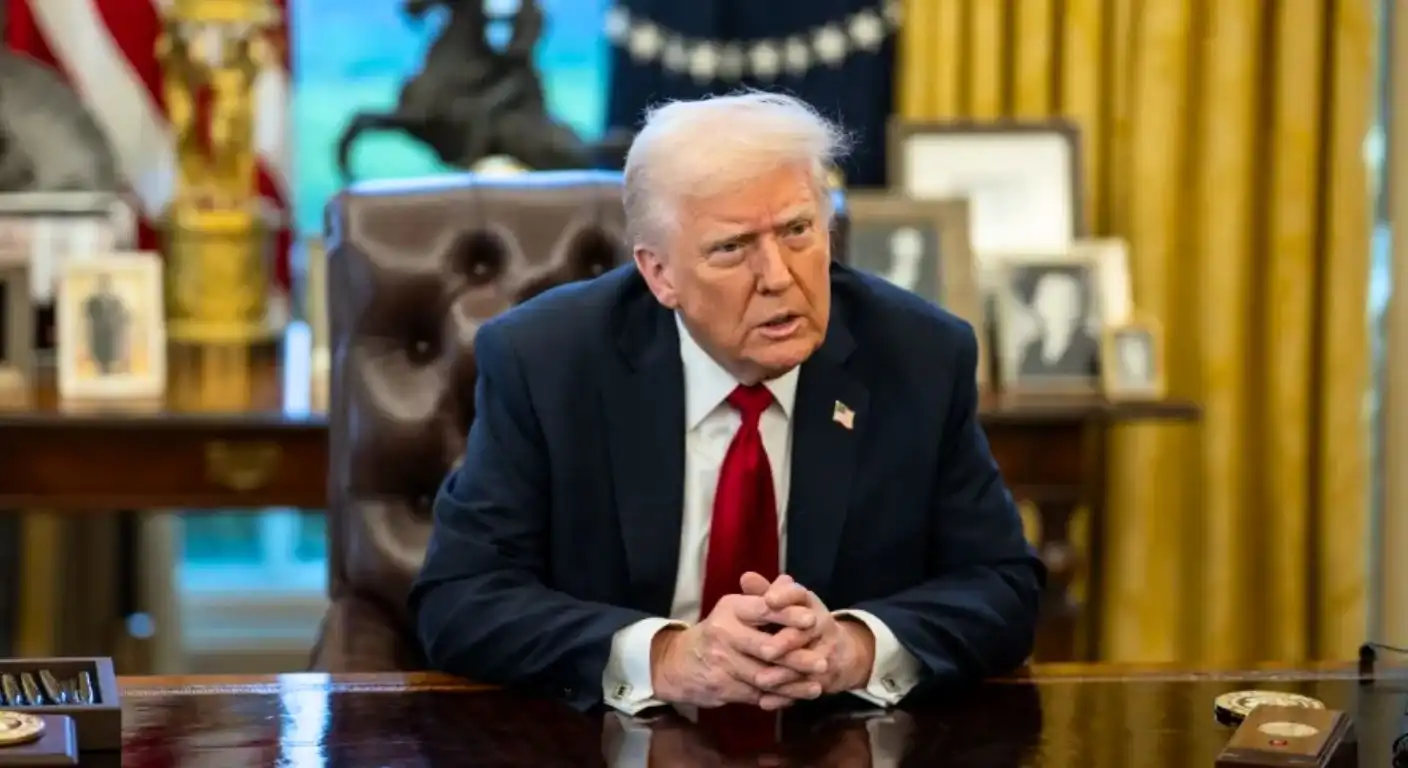
In a stunning move that has thrown Washington into political disarray, President Donald Trump has abruptly canceled the scheduled signing of the most comprehensive housing affordability legislation in more than three decades. Just hours before a bipartisan ceremony on Wednesday, the President announced on social media that he is withholding his signature from the newly passed bill to pressure Congress into passing a highly controversial national voter identification law. The sudden decision has put a rare, overwhelmingly popular bipartisan victory in immediate limbo, catching his own party leaders completely off-guard and triggering fierce condemnation from sponsors who accuse the White House of holding the economic interests of American families hostage.
The dramatic move to block the bill unfolded on Trump’s Truth Social platform, where he officially proclaimed that the planned housing news conference and signing were canceled. The President declared that he would refuse to sign the housing package until lawmakers approved the Safeguard American Voter Eligibility Act, commonly known as the SAVE America Act, which he considered to be an urgent national emergency. Trump went on to publicly dismiss the sweeping housing legislation as a minor matter, comparing it unfavorably to lower interest rates and asserting that it pales in comparison to his priority of tightening voter identification requirements across the country.
The abrupt cancellation stands in sharp contrast to the massive, veto-proof majorities that the housing bill secured during its legislative journey earlier in the week. Officially named the 21st Century Road to Housing Act, the package sailed through the Senate on Monday with an overwhelming 85-5 vote, followed by a resounding 358-32 victory in the House of Representatives on Tuesday. The sweeping legislation represents a highly coordinated, multi-year effort to address the nation’s severe affordable housing shortage, which has pushed homeownership out of reach for millions of working-class families struggling against elevated mortgage rates.
Designed to tackle the root causes of the affordability crisis, the 21st Century Road to Housing Act aims to boost the national housing supply by streamlining environmental reviews and encouraging local governments to reform restrictive zoning laws. Most notably, the bill introduces a first-of-its-kind federal restriction on private equity firms, legally prohibiting large institutional investors from purchasing single-family homes to convert them into rental properties. Proponents of the measure argue that stopping Wall Street firms from buying up domestic housing stock is essential to lower prices and prevent the middle class from being permanently priced out of the housing market.
The President’s sudden decision created a highly awkward and embarrassing moment for the Republican leadership in Congress. Just as Trump published his cancellation online, House Majority Leader Steve Scalise and other key Republican lawmakers were holding a live press conference to praise the housing bill as a massive, affordability-focused legislative triumph. Scalise had just finished describing the package as a vital, really important tool to lower housing costs when reporters informed the lawmakers of the President’s post. The public disconnect exposed a deep structural gap between the White House’s political goals and the legislative agenda of congressional Republicans.
Democratic sponsors of the housing bill immediately launched a fierce public counter-offensive, accusing the President of displaying an absolute lack of concern for the financial struggles of American families. During a live interview on television, Massachusetts Senator Elizabeth Warren, one of the primary co-sponsors of the legislation, described Trump’s decision as entirely nonsensical. Warren argued that instead of taking a well-deserved victory lap on a bipartisan bill that would directly lower housing costs for families, the President chose to blow up the popular measure to force a partisan debate on an unrelated voting bill, illustrating what she called complete indifference to the cost squeeze on households.
The voting legislation that Trump is attempting to force through Congress is one of the most controversial bills in recent political history. The SAVE America Act would establish a strict national requirement requiring individuals to provide documentary proof of U.S. citizenship and official photo identification to register and vote in federal elections. While Trump and his conservative allies argue the measure is necessary to prevent voter fraud, voting rights advocates and Democrats strongly oppose the bill, calling it a highly restrictive form of voter suppression designed to disenfranchise millions of legitimate voters who lack easy access to government-issued documents.
Despite the awkward timing of the cancellation, House Speaker Mike Johnson moved quickly to defend the President’s strategic priorities and ease tensions within the party. Johnson told reporters that he and his Republican colleagues fully share Trump’s preference for the SAVE America Act, pointing out that the House has already passed similar election security measures. The Speaker expressed confidence that once Republicans review the specific details of the housing package with the President, he will understand that it is a good product that fulfills his campaign promises, predicting that Trump will ultimately sign the bill within the next 10 days.
The President’s refusal to sign the document has set up a highly complex constitutional timeline that could ultimately strip him of his leverage. Under the U.S. Constitution, the President has exactly 10 days, excluding Sundays, to sign or veto a bill once it lands on his desk; otherwise, the legislation automatically becomes law without his signature, provided Congress remains in session. If Trump chooses to issue a formal veto, the overwhelming bipartisan majorities that passed the bill in both chambers suggest that Congress has more than enough votes to easily override the presidential veto, forcing the housing package into law regardless of the White House’s objections.
Ultimately, the high-stakes showdown over the 21st Century Road to Housing Act highlights the growing volatility of the national legislative process ahead of the critical midterm elections. By choosing to hold a highly popular, bipartisan housing bill hostage to push for strict voter identification laws, Donald Trump has prioritized a contentious national security narrative over immediate economic relief for struggling families. While Republican leaders are working frantically to resolve the dispute behind closed doors, the public clash has exposed deep internal divisions and raised serious questions about the party’s commitment to tackling the rising cost of living. How the administration handles this self-inflicted crisis over the next 10 days will define its domestic economic credibility for years to come.















