

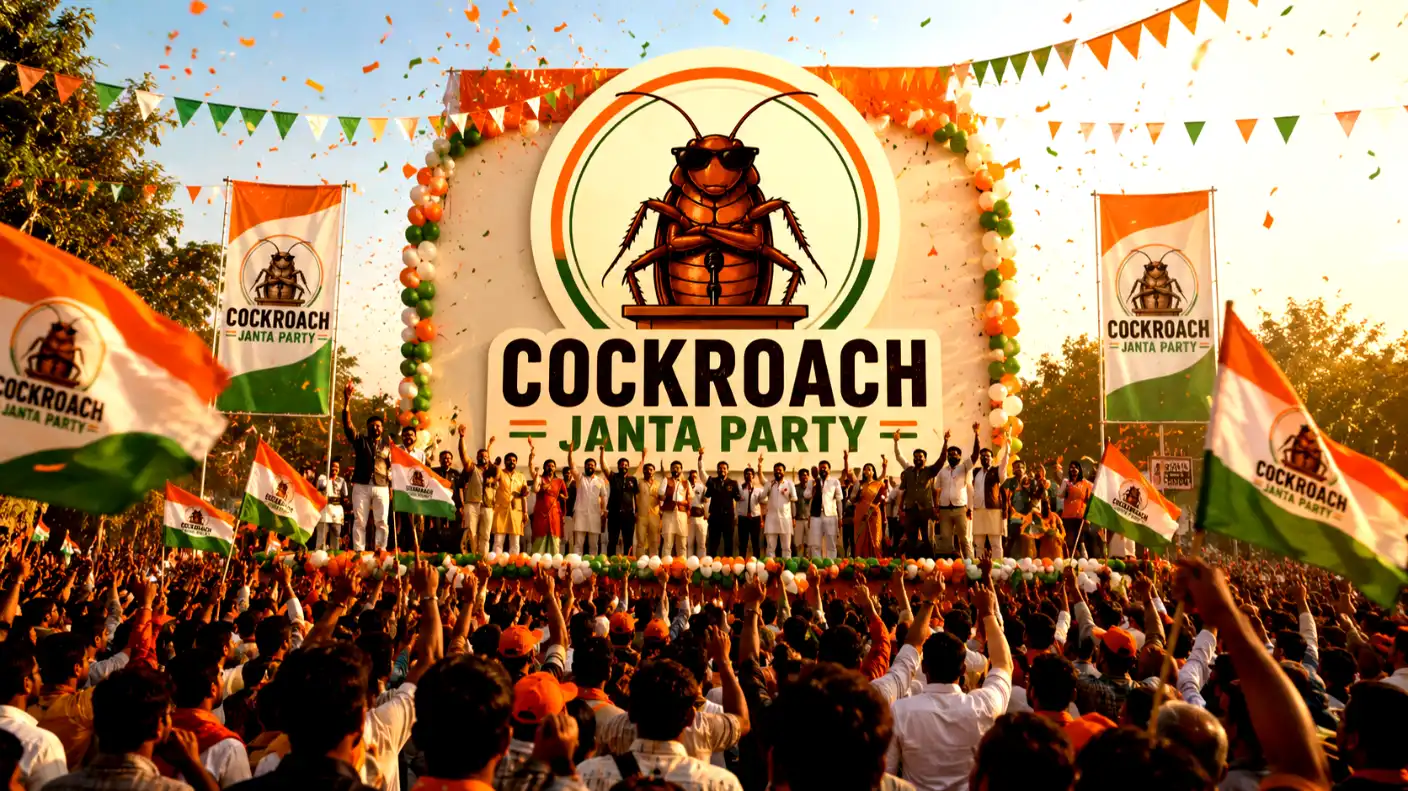
The famous protest strip at Jantar Mantar in New Delhi witnessed an unusual sight. Hundreds of young people gathered near India’s parliament, wearing cockroach masks and holding school textbooks. They waved the national flag, chanted slogans, and demanded the resignation of a federal minister.
This real-world gathering marked the first major offline test for the Cockroach Janta Party, a satirical political movement that had begun only three weeks earlier as an online joke. By Saturday, the movement had successfully transitioned from digital feeds to physical streets, capturing the country’s attention and highlighting the deep economic frustration among India’s Gen Z.
The immediate trigger for the protest was a series of scandals and irregularities in recent national examinations, particularly the NEET medical entrance exam. For millions of young Indians, these structural failures represent a broken educational system and a job market with fewer opportunities.
By reclaiming a public insult and turning it into a badge of honor, the Cockroach Janta Party has created a unique platform for youth-led resistance, presenting a new and unpredictable challenge to the traditional political establishment.
The Spark of Insult: How the Cockroach Became a Symbol
To understand the rapid rise of this movement, one must look back to a specific courtroom exchange that took place in mid-May.
The Courtroom Remark That Ignited Gen Z
On May 15, 2026, during an open Supreme Court hearing concerning fraudulent professional degrees and institutional criticism, Chief Justice Surya Kant made a highly controversial analogy. While expressing frustration over persistent critics and unemployed youth who turn to activism and social media, Kant compared them to parasites and cockroaches. He stated that these individuals, failing to find employment or a place in traditional professions, spend their time attacking public institutions.
Although the chief justice later clarified his remarks, stating that his comments had been taken out of context and were directed at individuals acquiring fake credentials, the damage was already done.
The analogy struck a painful chord with millions of young Indians who are struggling with competitive exams, recruitment delays, and high unemployment. Instead of feeling defeated, many felt deep anger.
The Parody Becomes a Reality
Watching the public reaction from the United States, 30-year-old political communications strategist and Boston University graduate Abhijeet Dipke decided to respond with humor. On May 16, 2026, Dipke posted a simple question on social media: What if all the cockroaches came together?
From that single tweet, Dipke founded the Cockroach Janta Party, a satirical movement whose name directly parodies Prime Minister Narendra Modi’s ruling Bharatiya Janata Party. The CJP’s website recorded more than 350,000 sign-ups within its first week, and its Instagram page quickly exploded, amassing more than 22.2 million followers.
With the tongue-in-cheek slogan “Voice of the Lazy and Unemployed,” the parody party became a massive viral phenomenon, using memes and videos to lampoon government corruption, paper leaks, and economic dysfunction.
The Manifesto: Five Radical Demands
While the CJP relies heavily on self-deprecating humor and internet memes, the movement has also drafted a serious five-point manifesto. This document combines biting political satire with actual structural demands that resonate with frustrated voters.
The first demand targets the judiciary directly, stating that if the CJP comes to power, no retired Chief Justice of India shall receive a seat in the Rajya Sabha or any other post-retirement political reward. This rule aims to protect the independence of the courts from executive influence.
The second demand addresses electoral integrity. The CJP proposes that if the name of any legitimate voter is deleted from the electoral rolls, the Chief Election Commissioner should face immediate arrest under the Unlawful Activities Prevention Act. The manifesto argues that stripping a citizen of their voting rights is a form of state-sponsored terrorism.
The third demand focuses on gender equality, calling for a 50% reservation for women in Parliament and Cabinet positions, without increasing the total number of parliamentary seats. This goes significantly beyond the 33% reservation currently discussed by traditional parties.
The fourth demand seeks to break up corporate media monopolies. The CJP demands the cancellation of broadcasting licenses for major media conglomerates owned by corporate giants like Ambani and Adani, paving the way for truly independent, non-partisan news organizations.
The fifth demand aims to end political defection. The manifesto states that any Member of Parliament or Member of the Legislative Assembly who defects from one political party to another should face a strict 20-year ban from contesting elections or holding any public office.
Additionally, the CJP has committed to operating under the Right to Information Act and has declared that it will not accept anonymous donations or corporate electoral bonds.
The June 6 Jantar Mantar Protest: The Real-World Test
For weeks, skeptics dismissed the CJP as a purely digital gimmick that would never translate into real-world action. The protest at Jantar Mantar was designed to prove those critics wrong.
The Landing and the Airport Barricades
Abhijeet Dipke arrived in New Delhi on Saturday morning, flying in from Boston to lead the demonstration. Anticipating his arrival, Delhi Police laid steel barricades at the international airport’s arrivals section to manage potential crowds.
Dipke walked out of the terminal carrying a copy of B. R. Ambedkar’s autobiography, receiving a warm welcome from supporters before heading straight to the protest venue.
Despite initial concerns that authorities would deny permission for the gathering to prevent public disruption, the Delhi Police quickly approved. Sources later indicated that the police allowed the protest to proceed peacefully to pacify the growing anger of the youth, recognizing that blocking the event could have triggered more spontaneous and uncontrollable demonstrations across the city.
Chants, Slogans, and Peaceful Discipline
Under the punishing summer heat of New Delhi, hundreds of young protesters gathered at Jantar Mantar. Many wore cockroach masks, while others carried dog-eared exam preparation guides and national emblems.
The primary demand of the protest was the immediate resignation of Union Education Minister Dharmendra Pradhan. Over the past month, a string of exam paper leaks, technical glitches, and canceled tests in key national entrance exams, such as the NEET medical test, have left millions of students feeling betrayed by the system.
The crowd chanted, “Cockroaches are coming, Dharmendra Pradhan is going!” Waving national flags and holding schoolbooks, the protesters focused their anger on the education ministry.
Dipke and other organizers instructed the crowd to keep the demonstration disciplined and peaceful. They urged supporters to raise slogans celebrating national unity, Mahatma Gandhi, and B. R. Ambedkar, while actively opposing communal and polarising politics.
While the protest ended peacefully, the Delhi Police briefly detained six individuals to prevent potential confrontations between opposing groups at the venue.
The Seven-Day Ultimatum and the Threat to Go Nationwide
The CJP has made it clear that the Jantar Mantar demonstration was only the beginning of a larger campaign. Following the protest, the party’s leadership escalated its demands.
The Official Statement
During a press conference held after the rally, CJP spokespersons Saurav Das, Vijeta Dahiya, and Ashutosh Ranka issued a formal statement on behalf of the movement. They praised the thousands of young people who participated in the peaceful gathering, noting that for many, it was their very first time taking part in a street protest.
The leadership accused Dharmendra Pradhan of harming the academic and professional prospects of an entire generation of Indian students. The CJP announced a strict seven-day ultimatum: either Pradhan resigns voluntarily from his post, or Prime Minister Narendra Modi must remove him from the Cabinet within one week.
Spreading the Movement Across India
If the government ignores the seven-day deadline, the CJP plans to take its protests directly to other parts of the country.
“If no action is taken within seven days, this movement will spread across the country,” the party’s official statement warned.
Speaking to his followers, Dipke emphasized that the youth would not be intimidated by police presence or potential legal pushback. He argued that the peaceful and unified nature of the movement makes it difficult for authorities to suppress.
“The government cannot touch a unified, peaceful movement. Us cockroaches do not ever need to fear them,” Dipke stated.
Views: How Satirical Resistance Impacts Traditional Indian Politics
The rapid rise of the Cockroach Janta Party has sparked an intense debate among political analysts, mainstream politicians, and ordinary citizens regarding the role of satire in modern democracies.
A Powerful Mirror for Public Dissatisfaction
Many supporters and independent commentators view the CJP as a healthy and necessary development for Indian democracy. Member of Parliament Shashi Tharoor publicly defended the movement, criticizing the brief blocking of the CJP’s social media handle as a major mistake.
Tharoor argued that satirical outlets are essential for expressing public dissatisfaction and that the CJP’s rise reflects a deep restlessness among Gen Z voters that traditional opposition parties have failed to capture.
Prominent activist-lawyer Prashant Bhushan also expressed strong support for the movement. Bhushan argued that the chief justice’s initial comments reflected a deep-rooted prejudice against young, unemployed citizens who are simply trying to hold the system accountable.
He urged the CJP to continue using its massive social media reach to highlight systemic issues such as paper leaks and to advocate for a formal right-to-employment law that would guarantee jobs or a financial allowance for young citizens.
Other notable figures, including environmentalist Sonam Wangchuk and social activist Anna Hazare, have also praised the movement, arguing that the government should address the valid concerns of the youth rather than trying to suppress online humor.
Skepticism and the Challenge of Sustaining Momentum
On the other hand, skeptics and supporters of the ruling party dismiss the CJP as a passing internet trend with little substance. They argue that having 22 million followers on Instagram does not easily translate into winning elections or building a durable grassroots political infrastructure.
Ruling party representatives have dismissed the movement as a social media gimmick and accused its organizers of being puppets of foreign actors or established opposition groups trying to destabilize the government.
Furthermore, political analysts point out that the CJP faces a steep challenge in navigating the heavy administrative and legal pushback that other protest movements in India have faced over the past decade.
In a country where anti-government demonstrations have occasionally faced swift police action, maintaining a purely peaceful, humorous resistance will require immense discipline and coordination as the movement scales up.
Conclusion: Can a Swarm of Cockroaches Change the System?
In just three weeks, the Cockroach Janta Party has pulled off a remarkable feat, transforming a derogatory courtroom remark into a massive national conversation. By blending self-deprecating internet humor with serious demands for educational and economic reform, the movement has captured the imagination of a generation of young Indians who feel ignored by traditional mainstream politicians.
While the long-term survival of the CJP as a political force remains uncertain, the peaceful demonstration at Jantar Mantar proved that the movement is capable of moving beyond the digital screen.
As the seven-day deadline approaches, the ultimate question is whether this creative swarm of young protesters can successfully force institutional accountability, or if their viral momentum will fade in the face of political pressure.
In a polarized political climate, the cockroach—the ultimate symbol of survival and resilience—is proving to be a surprisingly powerful metaphor for India’s youth.















