

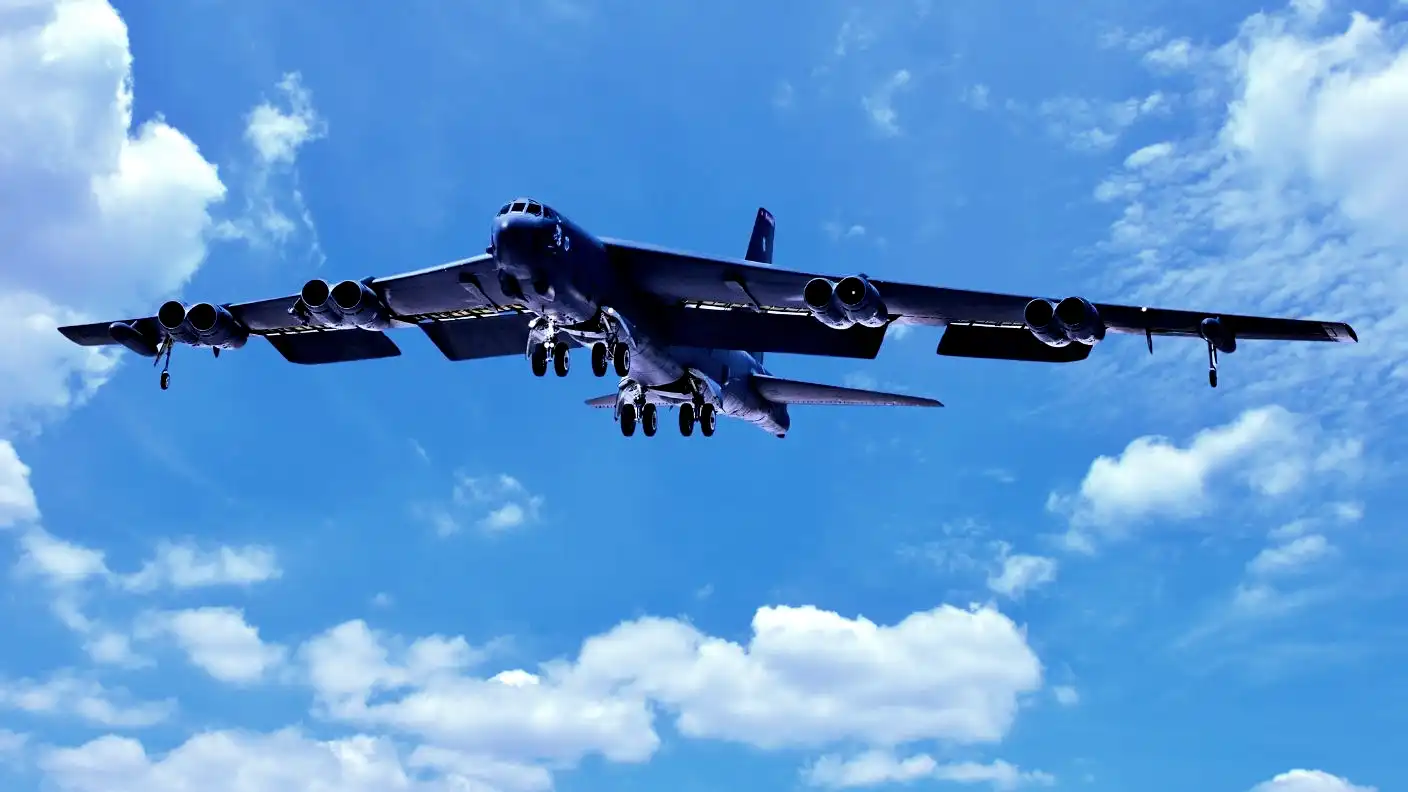
A massive military emergency unfolded in the Southern California desert on Monday morning when a U.S. Air Force B-52 Stratofortress strategic bomber crashed shortly after takeoff. The heavy, nuclear-capable aircraft went down at approximately 11:20 a.m. local time on the airfield of a prominent flight test facility in the Mojave Desert, sending a towering plume of thick black smoke rising into the sky that was visible for miles across Lancaster and Kern County. Base authorities immediately dispatched specialized fire and emergency rescue teams to the crash site, initiating an active response operation that continues to develop. The incident marks a highly critical and rare loss of one of the military’s most enduring and valuable aerial assets.
At the time of the crash, the status and safety of the aircraft’s crew members remained immediately unclear, with military officials refusing to release early details about casualties or survivors. A standard B-52 Stratofortress operates with a crew of five highly trained personnel, which typically includes an aircraft commander, a pilot, a radar navigator, a navigator, and an electronic warfare officer. In response to the unfolding emergency, base commanders ordered a complete closure of the airfield at approximately 1:00 p.m., forcing all incoming military and test flights to divert to alternate regional air strips. Additionally, the base suspended all non-commercial visitor passes for the day to allow emergency responders to focus entirely on containing the fire and securing the wreckage.
Designed and manufactured by Boeing, the B-52 Stratofortress has served as the absolute backbone of the United States’ manned strategic bomber force for decades. First entering active military service in 1955, this massive subsonic aircraft can carry up to 70,000 pounds—or 35 tons—of conventional and nuclear weapons. With eight powerful jet engines and a wingspan stretching 185 feet, the long-range bomber can fly more than 8,000 miles without requiring aerial refueling. Valued at approximately $110 million per jet, the Stratofortress has played a pivotal role in major global conflicts ranging from the Vietnam War to recent deterrence operations in the Middle East.
The site of the crash, Edwards Air Force Base, holds a legendary status in global aviation history as the premier test and development facility for the U.S. Air Force. Located about 100 miles north of Los Angeles and 70 miles east of Bakersfield, the vast desert base is famously where legendary pilot Chuck Yeager first broke the speed of sound in 1947. Today, the base is managed by the 412th Test Wing, which conducts developmental testing of all new military aircraft, advanced weapons systems, software, and electronic components before they enter active service. The airfield itself boasts the world’s longest runway, making it a critical hub for high-stakes flight testing.
Despite having flown regularly for more than 64 years, the aging B-52 fleet is currently undergoing a series of extensive modernization programs to extend its operational lifespan. The Air Force plans to keep flying these heavy bombers until at least 2050, which would mark a century of continuous service. As part of these upgrade efforts, a B-52 equipped with a highly advanced, modernized radar system arrived at the base in December 2025 to undergo a rigorous series of flight tests. While officials have not confirmed whether the crashed bomber was the specific aircraft carrying the upgraded radar system, the incident represents a significant setback for the military’s ongoing modernization timeline.
This sudden crash represents the first loss of a B-52 Stratofortress since 2016, when a bomber crashed shortly after takeoff at Andersen Air Force Base in Guam, a non-fatal accident where all seven crew members successfully escaped. The incident also follows a major safety scare that occurred in July of last year, when a commercial regional airliner flying over North Dakota had to make an unexpected, sharp banking turn to avoid a potential midair collision with a military B-52 that had entered its active flight path. These events have renewed discussions among aviation safety experts regarding the challenges of keeping these giant, decades-old intercontinental bombers flying safely in modern airspace.
While the base’s internal fire department deployed multiple emergency vehicles from its five dedicated fire stations, local county agencies remained on standby. Representatives from the Los Angeles County Fire Department and the Kern County Fire Department confirmed that while they monitored the thick smoke rising from the base, they did not receive immediate requests for off-base mutual aid. Due to the highly sensitive nature of the base’s developmental testing operations and the potential presence of specialized equipment or munitions onboard the aircraft, military police restricted access to the airfield, keeping the crash site tightly secured as accident investigators began arriving at the scene.
As the smoke clears over the Mojave Desert, a formal military accident investigation board is preparing to take over the crash site to determine what triggered the catastrophic failure. Investigators will focus heavily on reviewing the aircraft’s flight data recorders, analyzing the maintenance history of the eight jet engines, and interviewing the air traffic controllers who monitored the flight’s brief path. Until investigators can thoroughly dissect the wreckage and release their final report, the global aviation community and military strategists will watch closely, hoping to understand whether the loss was caused by a mechanical failure in the aging airframe or an unexpected error during the critical takeoff phase.