

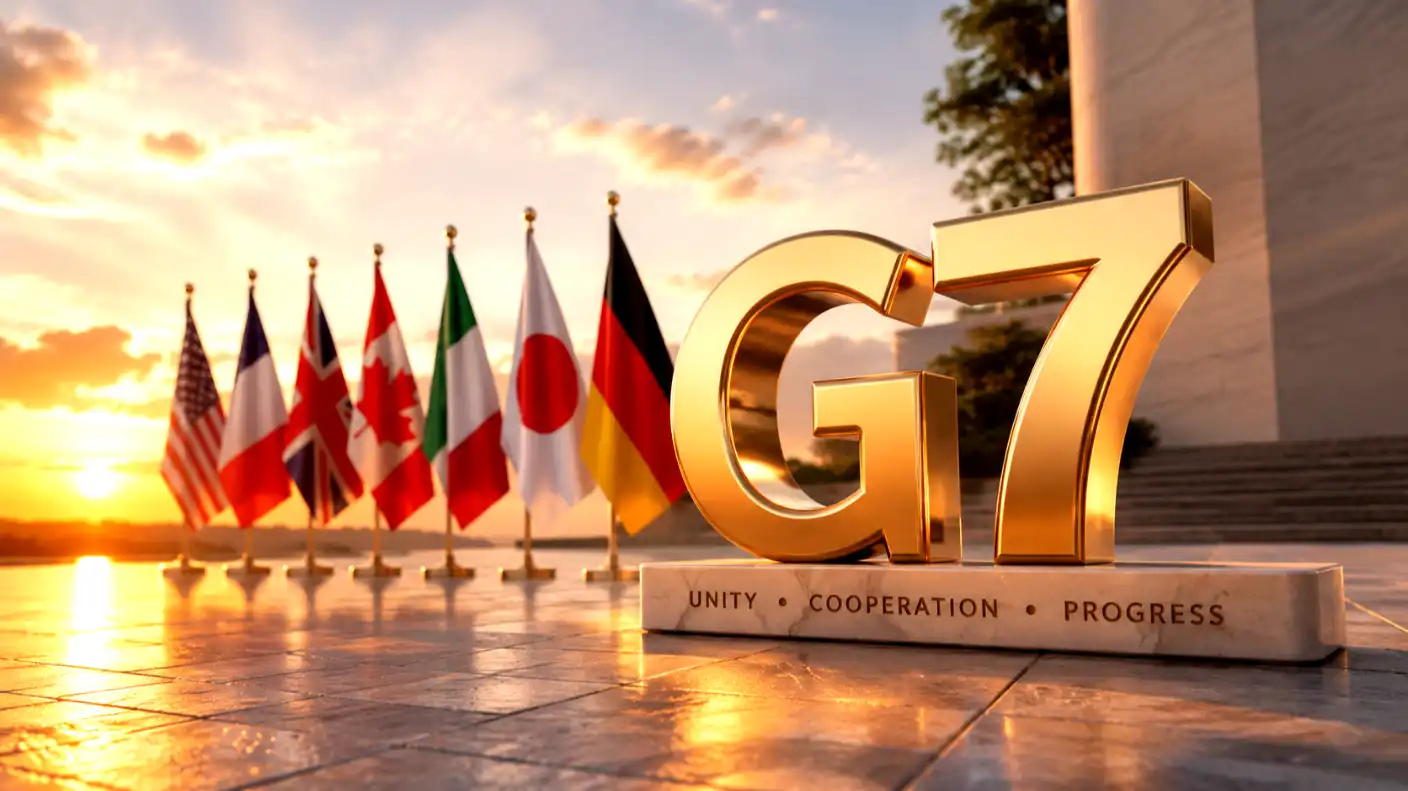
World leaders gathered at the shores of Lake Geneva have agreed to a major escalation of economic pressure against Moscow, issuing a unified declaration to choke off Russia’s highly lucrative energy revenues. At their annual three-day summit in the French spa town of Évian-les-Bains, the leaders of the Group of Seven nations announced on Wednesday morning that they will systematically tighten global sanctions, focusing heavily on Russia’s oil and gas sectors. The announcement represents a major diplomatic victory for Ukrainian President Volodymyr Zelenskyy, who addressed the leaders directly during an exclusive session. This unified mid-week declaration signals that the world’s most powerful economies remain determined to force a diplomatic resolution to the conflict, which has dragged on since Russia’s full-scale invasion in February 2022.
The robust G7 agreement came shortly after the American president publicly urged Moscow to negotiate a swift and lasting peace treaty, pointing to the catastrophic human cost on both sides. Speaking to reporters on the sidelines of the summit, the president emphasized that Russia has lost tremendous numbers of people, as has Ukraine, and declared that it is time to end the fighting. To force Moscow’s hand, the president suggested that the United States could soon terminate its temporary lifting of certain Russian sanctions. Washington originally introduced those temporary waivers to help keep global energy prices stable during the recent conflict in the Middle East, but the president asserted that the U.S. will soon have the flexibility to revoke those exemptions as alternative oil flows resume.
A key factor allowing for this sudden tightening of Russian energy sanctions is the imminent reopening of the strategic Strait of Hormuz, the world’s most critical maritime energy chokepoint. In their joint statement, G7 leaders formally welcomed and expressed strong support for the preliminary peace deal that the United States recently struck with Iran to end their nearly four-month war. The reopening of the narrow waterway, which carries nearly a fifth of the world’s daily petroleum supply, is scheduled to begin gradually as early as Friday. The American president insisted that once Gulf oil begins flowing freely again, the global market will no longer require the cushion of discounted Russian oil, allowing Western allies to clamp down on Moscow’s exports without triggering a massive global inflation spike.
During his high-stakes meeting with G7 leaders, Ukrainian President Volodymyr Zelenskyy delivered a direct, impassioned plea to strengthen his nation’s defensive capabilities and protect civilian infrastructure from ongoing aerial bombardments. Writing on social media shortly after the session, Zelenskyy stated that his discussions focused entirely on securing advanced air defense systems and advancing global diplomacy to force Russia to end its war. The exclusive session on Ukraine took place at a highly strategic moment, as Kyiv has successfully strengthened its positions on the battlefield in recent months by working much more closely with European defense partners, even as the American administration pivots its primary attention toward resolving conflicts in other hemispheres.
The call for continued pressure on Moscow received strong, vocal backing from Asian allies who are deeply concerned about the security implications of the conflict for their own region. Japanese Prime Minister Sanae Takaichi urged her G7 counterparts and Zelenskyy to preserve the group’s absolute unity to prod Russia into taking positive and concrete actions quickly. According to official summit briefings, Takaichi emphasized that unilateral attempts to change the status quo by force must not be tolerated anywhere in the world. She specifically voiced deep concern over the rapidly growing military cooperation between Russia and North Korea, as well as the deepening military and strategic ties between Moscow and Beijing, warning that these alliances threaten the stability of the entire Indo-Pacific region.
The joint G7 declaration reflects these Asian security anxieties, outlining a firm, unified stance on the rule of law in the Indo-Pacific region. Following a working dinner on Monday night, the leaders released a document that explicitly reaffirmed their strong opposition to any unilateral attempts to change the status quo through force or coercion in the East and South China Seas. Although the text carefully avoided naming China directly, the message was unmistakable. The leaders stressed that all regional disputes, particularly those across the sensitive Taiwan Strait, must be resolved peacefully through constructive dialogue rather than military posturing, signaling a unified Western resolve to protect global shipping lanes and critical maritime trade routes.
The G7 leaders also voiced deep, collective concern over the continuous escalation of North Korea’s illegal nuclear and ballistic missile programs. In their joint statement, the seven nations renewed their absolute resolve to achieve the complete, verifiable, and irreversible denuclearization of the Korean Peninsula in strict accordance with relevant United Nations Security Council resolutions. They warned that Pyongyang’s continuous weapons testing and its newly formed military supply pacts with Moscow directly violate international law and threaten to trigger a dangerous arms race in East Asia, promising to tighten global enforcement of existing maritime and financial blockades to contain the threat.
To ensure a more inclusive and representative global dialogue, the French presidency invited several prominent non-G7 leaders to participate in the summit’s key discussions. Leaders from major emerging economies, including Brazil, Egypt, India, Kenya, and South Korea, joined the sessions to provide a broader global perspective. During a working lunch on Tuesday, the G7 leaders and their counterparts from Egypt, Qatar, and the United Arab Emirates held detailed discussions on the economic fallout of the recent four-month war in the Middle East, agreeing on the urgent need to maintain regional stability and prevent further disruptions to global trade. Brazilian President Luiz Inácio Lula da Silva also used the opportunity to hold sideline talks on resolving trade bottlenecks with European leaders.
Recognizing that traditional official development assistance is no longer sufficient to meet the massive financial needs of poorer countries, the G7 leaders also focused heavily on reforming global development partnerships. Under the leadership of the French presidency, the group issued a joint declaration outlining a new strategy to build mutually beneficial, win-win partnerships with developing nations. The new framework seeks to move away from outdated donor-recipient models, focusing instead on reforming the international development system to promote more effective mobilization of private capital. By using public guarantees to de-risk long-term infrastructure projects, the G7 aims to unlock hundreds of billions of dollars in private investment to build clean energy, digital systems, and sustainable transport networks in developing economies.
Ultimately, the annual summit in France has demonstrated that despite internal political differences and strained ties over trade and defense spending, the world’s leading democracies can still forge a powerful, unified front. By simultaneously tightening energy sanctions on Russia, backing the landmark US-Iran peace deal to reopen the Strait of Hormuz, and establishing a new framework for development finance, the G7 has laid out a comprehensive roadmap to navigate a highly volatile global landscape. As the leaders prepare to leave Évian-les-Bains, the success of their declarations will depend on whether they can successfully convert these verbal commitments into concrete actions. Until the new sanctions take effect and the Strait of Hormuz reopens on Friday, the international economic and security order will remain in a state of watchful transition, waiting to see if these bold diplomatic steps can truly secure a lasting global peace.















