

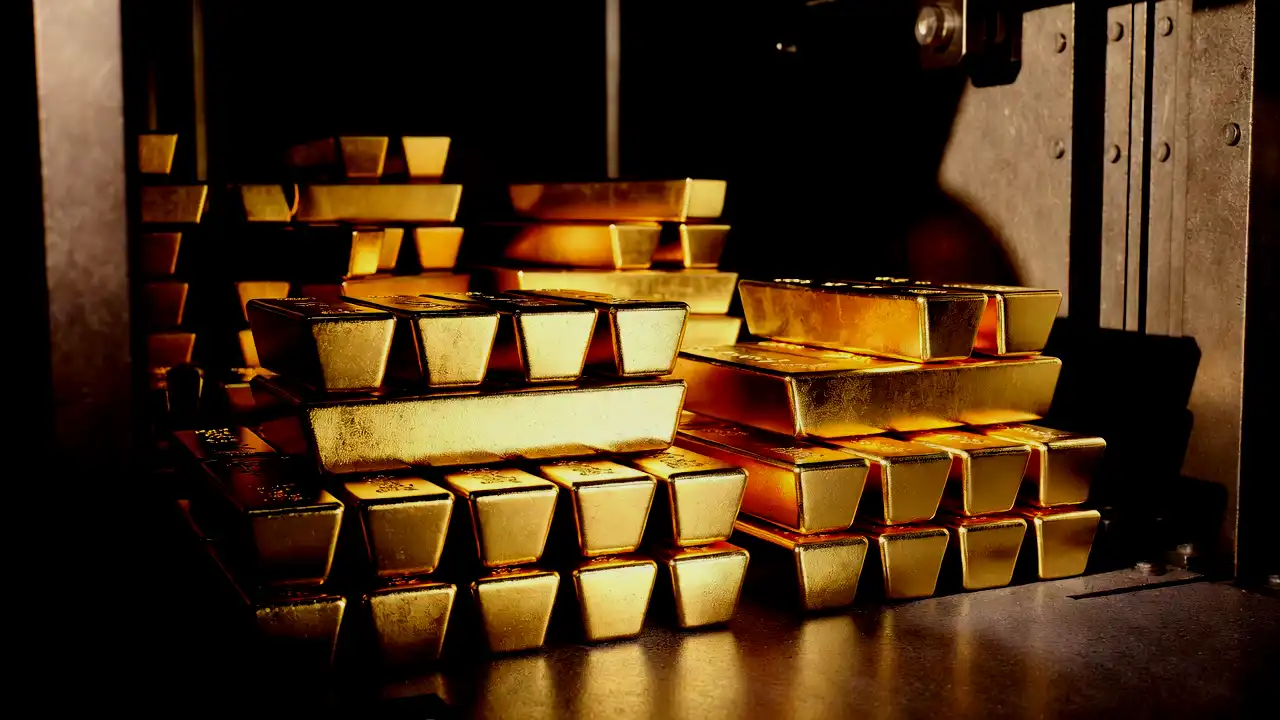
Gold prices edged slightly higher on Tuesday, June 2, 2026, as geopolitical uncertainty in the Middle East kept investors on edge. Despite the upward tick, conflicting messages from Washington and Tehran capped the precious metal’s gains. While Iranian state media reported a total halt in diplomatic communication with the United States, President Donald Trump and Secretary of State Marco Rubio quickly insisted that negotiations remain highly active. This diplomatic confusion, combined with ongoing fighting in Lebanon, left traditional markets rangebound while driving a quiet surge in safe-haven assets.
The marginal gains in gold reflect a broader, cautious upward trend across the entire commodities complex on Tuesday. Spot gold rose 0.24% to settle at $4,517.30 per troy ounce, while silver gained 0.26% to reach $75.45. Other industrial and precious metals also recorded gains, with platinum increasing 0.59% to $1,939.80, palladium rising 0.57% to $1,390.50, and aluminum jumping 2.16% to $3,790.00 per metric ton. Copper posted a strong 1.76% gain, closing at $6.6675 per pound, as supply concerns and regional conflicts continue to stoke raw material inflation.
This broad commodity rally comes as a highly fragile, two-month-old ceasefire between the U.S. and Iran faces its greatest test yet. Recent exchanges of fire in the Persian Gulf and a major Israeli ground operation in southern Lebanon have reignited regional fears of a wider war. The conflict in Lebanon has emerged as a primary bottleneck in diplomatic negotiations. On Monday, Iran’s semi-official Tasnim News Agency reported that Tehran’s negotiating team had suspended all mediated dialogues and text exchanges with Washington, accusing the United States of failing to restrain Israeli military actions.
Despite the hostile rhetoric, international partners have scrambled to salvage the peace process. Reports from Beirut indicated that Lebanon had brokered a partial ceasefire between Iran-backed Hezbollah militants and Israel. According to President Trump, Hezbollah mediators promised not to launch further attacks against Israel. At the same time, Israeli Prime Minister Benjamin Netanyahu pledged to pull back his forces from assaulting the Lebanese capital of Beirut. However, the situation on the ground remains highly volatile, as the Israeli military reported that it had intercepted two projectiles fired from Lebanese territory on Tuesday, threatening to collapse the temporary truce.
The true state of the peace talks remains a subject of intense global debate. On Tuesday, Iran’s Fars News Agency reported that both nations had completely stopped exchanging messages, citing an informed regional source. The agency claimed that the pause was a tactical decision designed to help the two sides reach a preliminary memorandum of understanding. Trump quickly and aggressively refuted this report on his Truth Social platform, labeling the Fars article “Fake News.” Trump asserted that conversations between Washington and Tehran have continued daily, noting that they spoke yesterday and every day over the past week.
In Washington, Secretary of State Marco Rubio echoed Trump’s claims during a high-profile hearing before the Senate Foreign Relations Committee. Rubio confirmed that the two administrations are actively in talks and hinted at a potentially historic breakthrough. He stated that for the first time in recent memory, Iranian negotiators have agreed to discuss sensitive aspects of their nuclear program—discussions that they had flatly refused even to mention just a year ago. Rubio suggested that a deal could materialize in the coming days, though he emphasized that preventing Iran from acquiring a nuclear weapon remains a non-negotiable U.S. objective.
Away from the geopolitical chaos of the Middle East, a groundbreaking report from the European Central Bank (ECB) on Tuesday provided a massive structural boost to long-term gold sentiment. The ECB revealed that gold has officially overtaken U.S. Treasury bonds as the largest asset in global official foreign reserves. At the end of 2025, gold accounted for 27% of total official international reserves, which comprise both physical gold and foreign exchange holdings. This marks the first time in over three decades that central banks have held more gold than U.S. government debt, highlighting a historic shift in how global institutions manage their sovereign wealth.
The ECB data shows a dramatic realignment of global reserve hierarchies. While gold took the top spot at 27% of total official reserves, U.S. Treasury bonds fell to second place, accounting for 22% of global holdings. The euro lagged further behind, representing only 15% of official international reserves. This shift represents a major symbolic blow to the long-standing dominance of the U.S. dollar and its debt instruments, which have served as the undisputed bedrock of the global financial system since the end of the Cold War.
According to the ECB’s analysis, this dramatic milestone largely reflects powerful valuation effects rather than a coordinated, physical dumping of U.S. debt. The price of physical gold surged by approximately 60% in 2025 and 30% in 2024, mechanically boosting its overall share of global reserves. However, the central bank cautioned that gold still faces significant structural limitations compared to major fiat currencies. The ECB noted that gold yields no interest, is highly volatile, incurs significant physical storage costs, and suffers from an inelastic global supply that cannot seamlessly adjust to sudden international demands for liquidity.
Ultimately, Tuesday’s market action proves that the global financial system is undergoing a profound transition. While U.S. and Iranian diplomats exchange conflicting messages on the battlegrounds of the Middle East, the quiet rise in precious metals prices highlights a deeper structural anxiety about the future of global stability. Whether Washington can successfully broker a lasting ceasefire or the ECB’s warnings about gold’s limitations prove correct, one reality remains clear. In an era of geopolitical warfare and unpredictable alliances, global investors and central banks alike are choosing the timeless security of gold over the promises of sovereign governments.















