

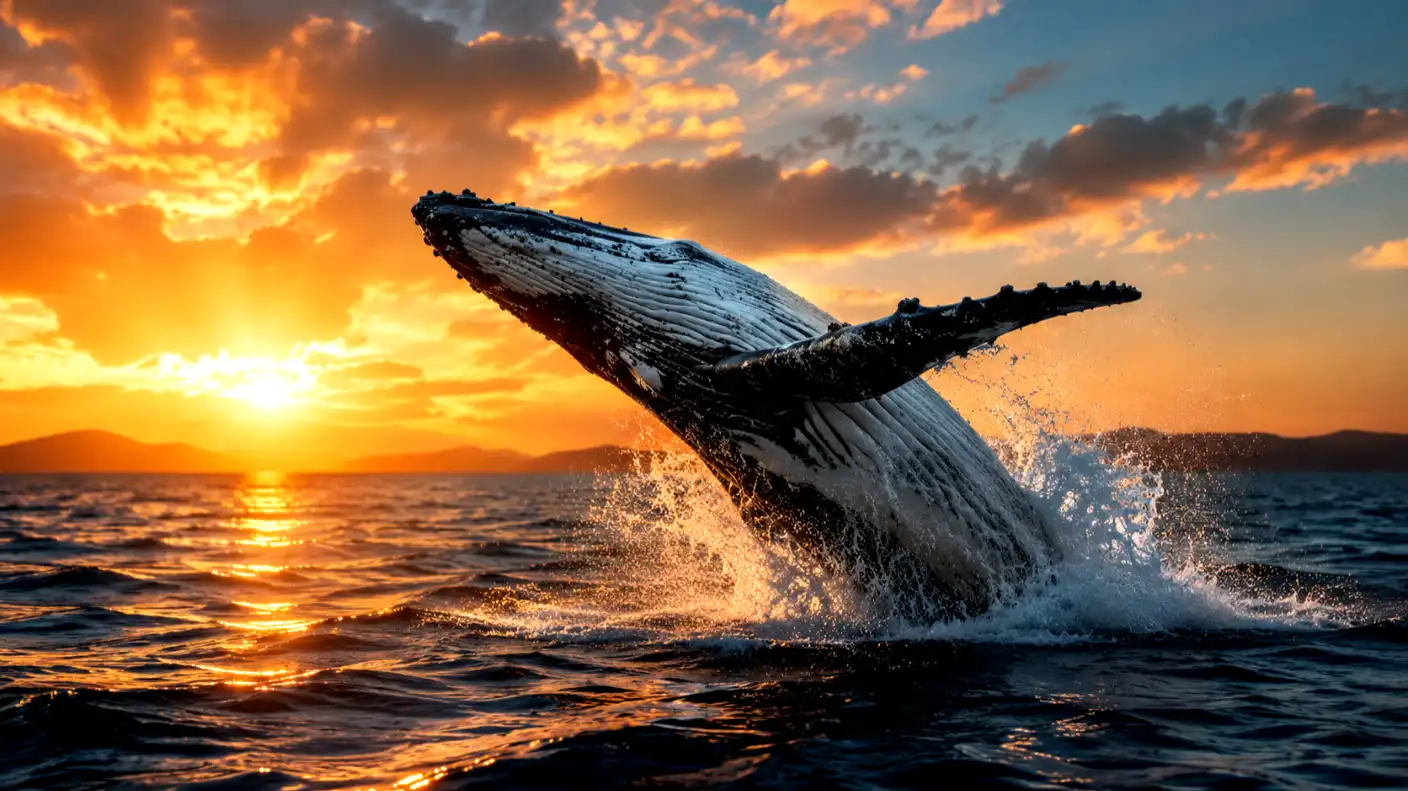
Scientists recently discovered two humpback whales that completed the longest recorded journeys for their species. These massive marine mammals traveled between the coasts of Australia and Brazil. The researchers measured the distances at roughly 9,000 miles and 9,300 miles for the two separate trips. The whales traveled in opposite directions across the vast ocean. This discovery shatters previous records for humpback whale travel and surprises marine biologists around the world.
Humpback whales usually follow very strict and predictable travel routes. Mothers teach these specific migration paths to their calves during their first year of life. The whales spend the warmer summer months feeding heavily on krill and tiny fish in cold, food-rich waters. When winter arrives, they swim toward warm tropical waters to mate and give birth. Traveling between two entirely different ocean basins and mating sites breaks all their standard rules of migration.
Tracking ocean animals that spend most of their lives deep underwater creates massive challenges for scientists. Researchers cannot simply attach GPS collars to them as they do with land animals. Instead, a team of scientists analyzed an enormous database of over 19,000 whale photographs. Research groups and everyday citizens collected these images over the past 40 years. Photographers spend thousands of hours on small boats just hoping to catch a glimpse of a tail flipping out of the water.
The research team used advanced recognition software, but they applied it to whale tails instead of human faces. Every humpback whale has a unique tail fin, which scientists call a fluke. The computer software looks at the specific color patterns, scars, and jagged edges along the back of the tail. By scanning the massive photo database, the computer successfully matched photos of the same two whales showing up in both eastern Australia and Brazil.
One of these two whales logged an incredible journey of exactly 9,300 miles across the ocean. This specific distance officially outranks all previous record holders in the scientific community. Before this study, the longest known humpback journey was made by a whale that swam from the coast of Colombia to Zanzibar. The journal Royal Society Open Science published these official findings on Tuesday.
While the photos prove the whales reached both locations, a giant mystery remains. The images show only the animals at the starting and ending points of their massive trips. Scientists have absolutely zero data about the actual route the whales took to cross the globe. They do not know how fast the whales swam, how deep they dove, or how long the total journey took from start to finish.
Marine biologists still do not fully understand why these two whales abandoned their normal homes. Whales rarely travel between different mating sites. Stephanie Stack, a study co-author from the Pacific Whale Foundation, shared a working theory. She suggested the whales might have met foreign groups while eating at shared feeding grounds near Antarctica. Instead of swimming back to their original homes, the two whales simply followed their new friends back to a completely different continent.
Phillip Clapham, the former head of a massive whale research program for NOAA, reviewed the findings. He said this type of extreme travel happens very rarely in the animal kingdom. He added that the discovery perfectly demonstrates just how capable and wide-ranging these giant marine mammals truly are. Stack also noted that finding two separate animals making this same crossing completely challenges how scientists view different whale populations. Experts previously thought the Australian and Brazilian groups never mixed.
Geography plays a huge role in these extreme trips. These long-distance odysseys happen much more easily in the Southern Hemisphere. Down south, the oceans connect freely around the freezing continent of Antarctica. If a whale tried a similar trip in the Northern Hemisphere, massive continents like North America and Eurasia would block its path. The open water of the southern oceans gives these enormous animals the freedom to roam as far as their energy allows.
This new tracking method will help scientists monitor ocean life heavily as global temperatures continue to rise. Climate change rapidly warms the oceans and melts polar ice, which directly impacts the tiny krill that whales eat. If the krill move to find colder water, the hungry humpback whales will have to change their feeding and breeding locations. Tracking these long journeys helps researchers predict exactly how marine animals will survive a rapidly changing planet.















