

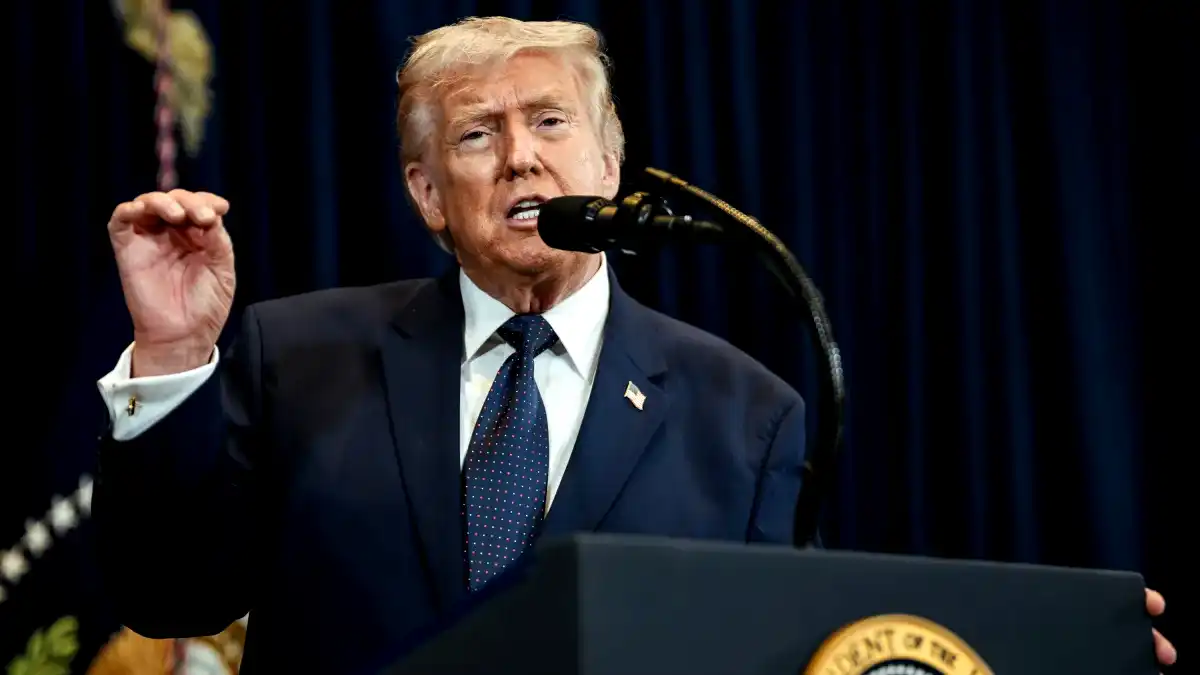
The newly signed 14-point preliminary peace agreement between the United States and Iran has ignited a massive political firestorm across Washington and the Middle East. President Donald Trump and Iranian President Masoud Pezeshkian have officially signed the Islamabad Memorandum of Understanding, a sweeping framework designed to end the devastating 110-day war. To justify the highly controversial deal, which makes substantial political and financial concessions to Tehran, Trump declared that the alternative would have been a catastrophic worldwide depression. Despite the historic signing, the U.S. leader quickly adopted a dual stance, warning that the agreement is not yet a final settlement and that American bombers will resume strikes if Iran does not behave.
The physical signing of the historic document took place on Wednesday evening, following a high-profile working dinner between Trump and French President Emmanuel Macron at the Palace of Versailles. The presidential signatures came after Vice President JD Vance and Iran’s chief negotiator, Mohammad Baqer Qalibaf, digitally signed the initial text of the Islamabad Memorandum of Understanding on Sunday. To formalize the diplomatic transition, Vance is scheduled to travel to Switzerland on Friday for a formal signing ceremony in Geneva. However, despite the celebratory mood among the diplomatic corps, the deal’s far-reaching concessions have triggered a massive backlash from defense officials and regional allies.
The most immediate economic consequence of the new agreement is the coordinated effort to reopen the Strait of Hormuz. The vital maritime channel, which handles roughly 20% of the world’s daily petroleum and liquefied natural gas shipments, has been completely choked off by a joint U.S.-Israeli naval blockade and retaliatory Iranian actions. Under the terms of the memorandum, the United States has agreed to remove its naval blockade and allow the unhindered flow of commercial vessels. Trump argued that unlocking the waterway was the only way to prevent a paralyzing global energy collapse, although shippers remain cautious about sending vessels through waters that require extensive mine-sweeping operations.
What has shocked national security observers is the unprecedented scope of the concessions that the Trump administration granted to Tehran to secure the ceasefire. In a major departure from previous American policy, Trump publicly suggested that Iran possesses the right to enrich uranium for peaceful civilian use. Furthermore, the President indicated that he would not pressure the Iranian government to abandon its highly advanced ballistic missile program. These dramatic shifts represent a total dismantling of Washington’s long-standing strategic demands, raising intense concern among non-proliferation experts who argue that the deal leaves Iran’s military infrastructure completely intact.
Financial provisions within the 14-point accord have also fueled intense domestic political anger. Under the terms of the memorandum of understanding, the United States is preparing to unblock billions of dollars in frozen Iranian financial assets held in international banks, giving Tehran immediate access to cash reserves. While media reports initially suggested the peace package included a massive $300 billion regional reconstruction program, Trump vehemently denied committing any American tax dollars. However, the prospect of rich Gulf nations or international development banks funding the reconstruction of Iranian-backed areas continues to draw fierce criticism from fiscal conservatives.
A critical and highly complex dimension of the new treaty is the inclusion of a comprehensive ceasefire across all military fronts, which explicitly covers active combat zones in southern Lebanon. This provision legally requires Iran to rein in its primary regional proxy, the Hezbollah militia, which has engaged in intense exchanges of fire with Israeli forces. Although the fighting has abated slightly, the ceasefire remains incredibly fragile. Highlighting the deep geopolitical split, the leader of Hezbollah hailed the agreement as a massive victory for the regional resistance, while Israeli officials—who were entirely excluded from the secret negotiations—warned that they retain the right to strike back if threatened.
The unprecedented concessions to Iran have also exposed deep ideological fractures within Trump’s own national security cabinet. Recent intelligence reports indicate that CIA Director John Ratcliffe has formally warned the President that the intelligence community harbors deep doubts about the agreement. Ratcliffe, along with Secretary of State Marco Rubio and Defense Secretary Pete Hegseth, expressed intense skepticism regarding Tehran’s willingness to implement its nuclear concessions. Conversely, Vice President JD Vance and senior advisers Steve Witkoff and Jared Kushner strongly championed the deal, arguing that the economic benefits of reopening global trade far outweigh the strategic risks.
The newly signed memorandum has drawn immediate, unfavorable comparisons to previous diplomatic efforts, particularly the 2015 Iran nuclear deal. Opponents of the new agreement point out that Trump has ended the war on terms that are far more favorable to Tehran than the deal his administration previously discarded. Critics argue that the current administration is giving up massive economic leverage while receiving almost no tangible guarantees in return. Because the theocratic government remains firmly in place, and its enriched uranium stockpiles and rocket arsenals are left untouched, opposition lawmakers are accusing the administration of sacrificing long-term national security for a short-term economic boost.
While government officials in Tehran are celebrating the interim ceasefire as a massive diplomatic triumph over Washington, the mood among ordinary Iranian citizens remains overwhelmingly grim. Years of crushing international sanctions and months of active war have devastated the domestic economy, driving inflation to record highs and pushing 99% of the population into a daily struggle for basic survival. Local business owners in major cities express deep cynicism about the high-level deal, explaining that the average person has completely lost hope in political solutions. For them, the upcoming Geneva signing offers no clear vision of a prosperous future, but merely a temporary pause in a cycle of conflict.
Ultimately, the Islamabad Memorandum of Understanding represents a highly calculated, high-stakes gamble by the United States to stabilize the global economy. By choosing to prioritize the immediate reopening of the Strait of Hormuz over the long-term containment of Iran’s nuclear and military ambitions, Donald Trump has permanently shifted the balance of power in the Middle East. While the upcoming signing ceremony in Geneva represents a major diplomatic achievement, the severe backlash from allies, intelligence officials, and domestic lawmakers shows that the truce is built on shifting sands. Whether this agreement truly averts a global depression or simply delays an even larger regional conflict remains a critical question that will define the geopolitical landscape for years to come.















