

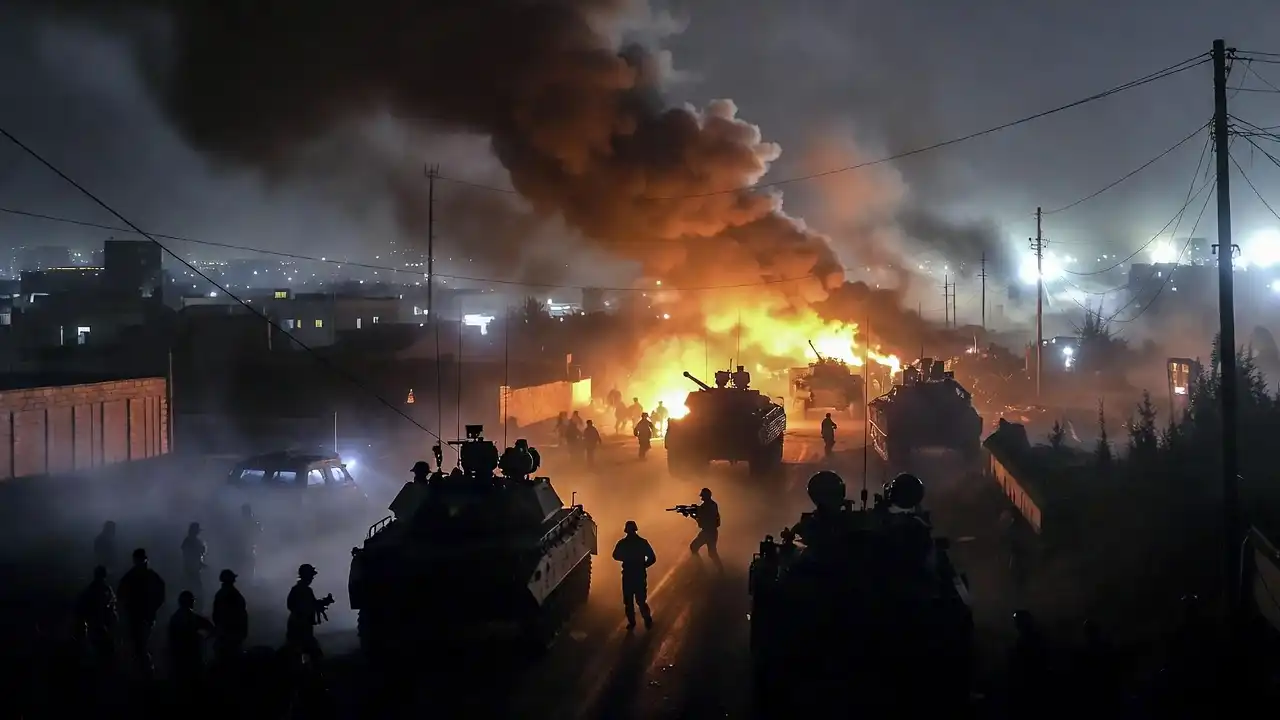
A newly brokered, high-stakes ceasefire in the Middle East has suffered a devastating blow just hours after taking effect. On Saturday, a series of relentless Israeli airstrikes, artillery bombardments, and drone attacks pounded southern Lebanon, killing at least five people and injuring several others. The deadly military operations targeted more than a dozen locations, destroying residential buildings and prompting a renewed wave of panic among local populations. This sudden escalation directly violates the fragile truce agreed upon by Israel and the Iran-backed Hezbollah militia on Friday, highlighting the immense difficulty of enforcing a lasting peace on a highly volatile battleground.
The state-run National News Agency reported that the deadly overnight strikes were concentrated across the Nabatieh area. In the southern town of Arabsalim, a devastating airstrike targeted a residential building, killing three civilians instantly. Another civilian lost his life in the nearby town of Deir Zahrani, which has seen heavy fighting in recent weeks. Meanwhile, at the entrance of the town of Dweir, an Israeli drone launched a targeted strike on a motorbike, killing the rider. The pre-dawn strikes transformed quiet residential neighborhoods into piles of concrete debris, proving that the threat of sudden destruction remains a daily reality for southern residents.
Adding to the gravity of the violations, the Lebanese Armed Forces confirmed that an Israeli strike killed one of their soldiers on Saturday morning. The lethal attack occurred in the southern village of Kfar Reman, situated just outside the city of Nabatieh. The Lebanese army has consistently attempted to maintain a neutral, peacekeeping posture throughout the conflict, making the soldier’s death a highly sensitive diplomatic incident. The military casualty threatens to complicate the delicate security arrangements on the ground, as international mediators struggle to keep national defense forces and regional militias from launching a wider, coordinated response.
The renewed military operations featured a highly coordinated combination of warplane strikes, drone runs, and heavy artillery barrages. Following the midnight deadline, Israeli artillery batteries shelled the center of Nabatieh city and its immediate outskirts, targeting suspected assembly points. Simultaneously, warplanes executed airstrikes on a dozen distinct towns, including Upper Nabatiyeh, Nmeiriyeh, Choukin, Habboosh, Kfarjouz, Zibdin, Sajd, and Mahmoudiyeh. These sweeping operations demonstrate that despite the implementation of a de jure ceasefire, the military is maintaining an active, high-intensity posture to neutralize what it calls immediate security threats.
The sudden violence stands in sharp contrast to the diplomatic breakthroughs celebrated just hours earlier. On Friday afternoon, a senior United States official announced that Israel and Hezbollah had agreed to a temporary ceasefire beginning at 4:00 PM local time. The truce was painstakingly worked out by U.S. and Qatari mediators following days of intense discussions with representatives from both Israel and Iran. Bipartisan allies had hoped the agreement would stabilize the region and allow the broader, multi-billion-dollar peace process to proceed in Switzerland, but the immediate resumption of hostilities has left those hopes in deep tatters.
The Friday ceasefire was itself a desperate attempt to halt a catastrophic spiral of violence that had decimated the region earlier in the week. Before the 4:00 PM deadline, Israeli airstrikes and bombardments had killed at least 47 people and wounded 97 others across Lebanon in a single, devastating 16-hour period. Concurrently, Hezbollah fighters had launched a lethal ambush north of the Litani River, destroying three advanced Israeli tanks and killing four soldiers. This deadly exchange had sorely tested the U.S.-Iran interim agreement signed on Wednesday, forcing negotiators to rush a separate, localized truce to prevent a complete collapse of global diplomacy.
The primary obstacle to maintaining the peace is the unresolved dispute over the military buffer zone established by Israeli forces in southern Lebanon. Under current operational rules, Israel has refused to withdraw its ground troops from a massive security corridor near the border, claiming the presence is necessary to prevent future rocket attacks on northern towns. Hezbollah’s leadership has used this ongoing military occupation to justify its continued attacks on troops stationed within Lebanese territory. This geographic overlap has created a dangerous impasse where both sides can claim they are acting in self-defense, virtually guaranteeing that any minor movement can trigger a lethal escalation.
The immediate collapse of the truce has also paralyzed the broader diplomatic pipeline. Senior technical delegations from the United States and Iran were scheduled to meet in Geneva on Friday to begin a 60-day negotiation period regarding nuclear enrichment and regional security. However, as the violence in southern Lebanon escalated, Iranian Foreign Minister Abbas Araghchi informed negotiators that talks could not continue without a comprehensive, verified ceasefire on all fronts. This prompted Swiss authorities to postpone the summit indefinitely, proving that local border violations can easily derail high-level global agreements.
The failure to secure the ceasefire prolongs a devastating humanitarian crisis that has ravaged both nations over the past 14 weeks. Since major hostilities erupted on March 2, the conflict has claimed the lives of more than 3,980 people, injured over 12,000 others, and forced the displacement of more than one million residents in Lebanon alone. Major shipping companies continue to avoid the region, and the blockades of critical routes like the Strait of Hormuz have generated severe energy shocks worldwide. While the initial peace announcements briefly brought global crude prices below $80 per barrel, the persistent fighting ensures that global supply chains will remain volatile.
Ultimately, the deadly strikes across the Nabatieh area demonstrate the extreme fragility of modern Middle Eastern diplomacy. While U.S. and Qatari mediators have successfully designed peace agreements on paper, the physical reality on the ground shows that a ceasefire is only as strong as the willingness of both sides to cease fire. As Israel maintains its security corridor in southern Lebanon and Hezbollah continues to challenge the occupation, the region remains trapped in a dangerous cycle of retaliation. Until international monitors can establish a verified withdrawal process, the hope of a lasting truce will remain an elusive goal, leaving millions of civilians caught in a relentless crossfire.















