
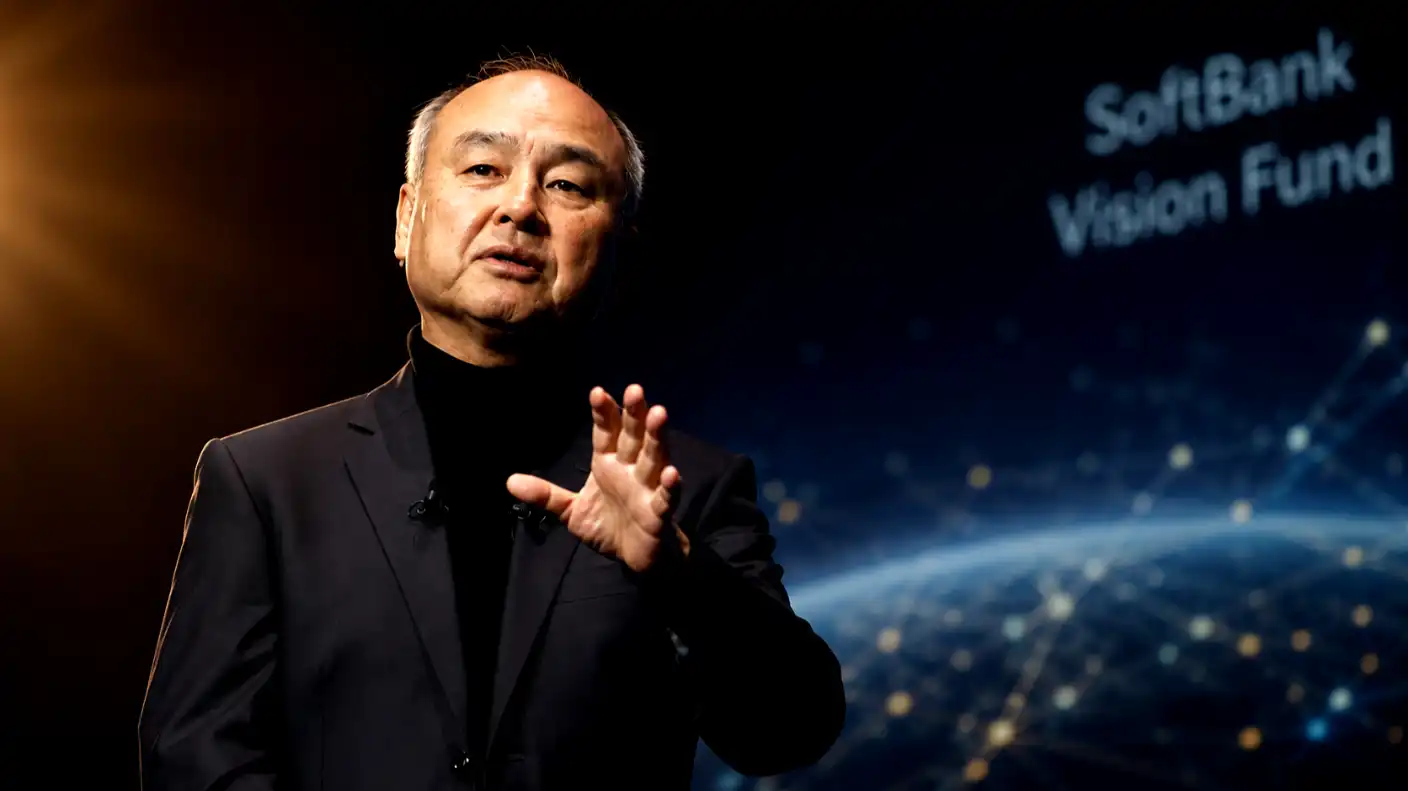
SoftBank CEO Masayoshi Son believes the ongoing artificial intelligence boom represents a technological shift that will completely dwarf the internet boom of the late 1990s. Speaking to CNBC in Paris on Monday, June 1, 2026, the legendary Japanese investor stated that the AI revolution will easily surpass the dotcom era in scale by up to 50 times. Son dismissed fears of a potential market bubble, arguing that any upcoming financial corrections should not cause panic. Instead, he framed market pullbacks as the single best opportunity for forward-looking players to acquire high-value technology assets at a discount.
Son made these resounding claims directly following a landmark announcement of SoftBank’s massive expansion into Europe. The Tokyo-based investment group committed up to €75 billion, or roughly $87 billion, to build extensive AI infrastructure across France. This historic project represents SoftBank’s largest-ever capital commitment in Europe. Speaking alongside French President Emmanuel Macron at a Paris press briefing, Son explained that the massive capital injection aims to turn France into a central technology hub for Europe. This region currently faces a severe shortage of localized high-performance computing resources.
The details of the French infrastructure program reveal an extraordinary operational scale. SoftBank plans to construct up to 5 gigawatts of total AI data center capacity, with a specific buildout of 3.1 gigawatts in the northern Hauts-de-France region scheduled for completion by 2031. This multi-year initiative will establish large-scale data facilities in Dunkirk, Bosquel, and Bouchain. To support this massive buildout, SoftBank is partnering with French engineering giant Schneider Electric to create an industrial production hub in Dunkirk, ensuring a highly reliable regional supply of power management and cooling technologies.
France is not the only region receiving massive capital injections from the Japanese conglomerate. During his CNBC interview, Son emphasized that SoftBank’s European push builds on a massive, highly successful infrastructure expansion in the United States. In the U.S., SoftBank has pledged to invest up to $500 billion in advanced data center networks as part of “Project Stargate.” This collaborative, multi-billion-dollar initiative brings together major technology stakeholders, including database giant Oracle and ChatGPT creator OpenAI, to build the physical foundations required to support next-generation supercomputers.
To justify his prediction that the AI boom is 50 times larger than the early internet era, Son drew a direct line back to his experiences during the late 1990s. While critics often point to the painful dotcom crash of 2000 as a warning sign for the current tech rally, Son described that crash as a minor, temporary bump in a much longer structural growth story. He pointed out that the peak of the dotcom era looks like a small hill when viewed against the massive, multi-trillion-dollar scale of the modern internet economy, asserting that AI is currently in a similarly early, hyper-growth phase.
While Son remains highly optimistic about the long-term potential of artificial intelligence, he openly acknowledges the probability of near-term market volatility. However, rather than fearing a downturn, the SoftBank leader welcomes potential market corrections as prime buying opportunities. He pointed to the 1929 Wall Street crash as a key historical parallel. Even though the electronics and automotive industries suffered a brutal crash in 1929, both sectors went on to grow and dominate the global economy for the next 100 years. Son believes that any upcoming AI correction will follow a similar path, acting as a springboard for decades of sustained expansion.
This aggressive investment strategy has paid off handsomely for SoftBank on its home turf. Driven by the massive global AI boom, SoftBank recently overtook the automotive giant Toyota to become Japan’s most valuable publicly traded company. The investment group’s shares have surged by nearly 80% this year, reflecting immense investor enthusiasm for Son’s strategic vision. This dramatic stock market rally represents a major vindication for Son, whose reputation suffered heavily in previous years due to highly publicized writedowns in SoftBank’s Vision Fund portfolio, including the high-profile collapse of co-working startup WeWork.
A massive pillar of SoftBank’s recent financial turnaround is its ownership of British semiconductor designer Arm Holdings. SoftBank took Arm public in 2023 while retaining a dominant stake in the firm. Driven by the insatiable global demand for energy-efficient chips to power mobile devices and AI servers, Arm’s valuation has skyrocketed, now representing roughly 40% of SoftBank’s total asset value. This lucrative holding provides the Japanese parent company with the massive financial flexibility needed to execute multi-billion-dollar infrastructure deals in Europe and North America without overleveraging its balance sheet.
SoftBank has also aggressively deepened its relationship with leading generative AI developers, particularly OpenAI. After a series of highly coordinated funding rounds, SoftBank completed a massive investment program into the ChatGPT developer, sending over a final tranche of more than $22 billion to finalize a major private funding round. Morningstar currently estimates that SoftBank’s total stake in OpenAI has ballooned to roughly $80 billion in value, representing approximately 26% of SoftBank’s total investment assets. This massive exposure positions SoftBank as a primary gatekeeper of the global generative AI ecosystem.
Ultimately, Masayoshi Son’s latest remarks to CNBC reflect a decisive shift in how the tech industry views the future of computing. The era of running isolated, experimental software pilots is giving way to a high-stakes, capital-intensive race to build the physical infrastructure of the future. By committing $87 billion to France and $500 billion to the United States, SoftBank is placing a massive bet that physical AI, advanced robotics, and heavy data center networks will redefine human productivity. For Son, the current moment is not a bubble to be feared, but the opening chapter of the most significant technological revolution in human history.