

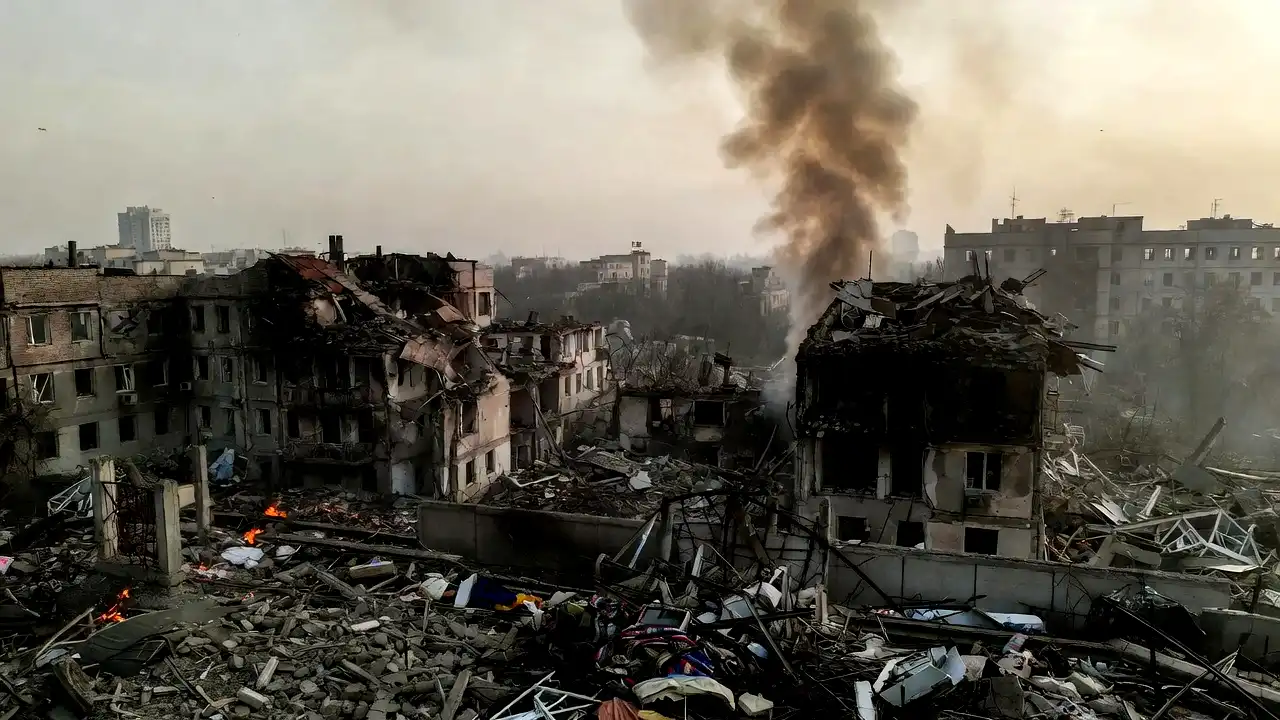
An exceptionally large and destructive aerial barrage has struck major cities across Ukraine, killing multiple civilians, knocking out electricity grids, and badly damaging one of Eastern Christianity’s most sacred landmarks. Under the cover of darkness, Russian military forces launched a coordinated strike involving hundreds of attack drones and dozens of advanced missiles. The heaviest bombardment focused on the nation’s capital, where projectiles and falling debris tore through residential apartment blocks and sparked a major fire at the 11th-century Dormition Cathedral within the historic Kyiv-Pechersk Lavra monastery complex. The scale of the devastation has shocked international observers, marking a dramatic and highly dangerous escalation of the ongoing regional war.
According to official statements from the national air defense forces, the assault was one of the most complex and heavily coordinated air raids in recent memory. Military logicians confirmed that Russia launched 70 missiles and 611 attack drones, aiming to overwhelm local defense networks in several major metropolitan areas. The diverse arsenal included six high-speed Zirkon anti-ship missiles, 34 Iskander-M and S-400 ballistic missiles, and 30 Kh-101 and Iskander-K cruise missiles, alongside hundreds of Shahed kamikaze drones. While local air defense units successfully shot down 50 of the incoming missiles and 582 of the drones, the sheer volume of the attack ensured that several warheads and large pieces of burning debris hit critical civilian infrastructure.
The immediate human toll of the bombardment has devastated local communities. In the capital alone, official search and rescue teams confirmed that the strikes killed at least four people and injured some 30 others, including young children and a pregnant woman. Projectiles directly impacted several multi-story residential buildings, trapping residents under smoking rubble and forcing thousands to flee into underground subway stations for safety. Beyond the immediate loss of life, the heavy strikes damaged crucial high-voltage power lines and distribution substations, plunging more than 140,000 households in northern districts into complete darkness and forcing emergency utilities to implement rolling blackouts.
For many citizens, the most painful blow of the overnight assault was the direct hit on the Kyiv-Pechersk Lavra, a UNESCO World Heritage site and the spiritual heart of Ukrainian Orthodoxy since its founding in 1051. A kamikaze drone crashed directly through the roof of the landmark Dormition Cathedral, triggering a massive blaze that quickly engulfed the wooden support structures. Emergency services deployed dozens of firefighters to battle the towering flames rising over the gilded domes. The head of the Orthodox Church of Ukraine condemned the act as a brutal crime against history and Christianity, prompting local priests and curators to execute an emergency evacuation to save ancient icons, historic paintings, and sacred relics from destruction.
The aerial onslaught extended far beyond the capital, causing severe casualties in other key regional hubs. In the northeastern city of Kharkiv, emergency services reported that Russian forces utilized a highly controversial “double tap” tactic, launching a secondary wave of missiles at a rescue site just minutes after an initial strike. This secondary assault killed four emergency service workers and a local municipal official who had rushed to the scene to pull survivors from the rubble. Additional missile strikes targeted critical logistics nodes in the Dnipro and Sumy regions, resulting in five more deaths and pushing the nationwide casualty count even higher.
The systematic bombardment also took a heavy toll on the country’s cultural preservation centers, raising concerns that the strikes are intentionally targeting national identity. In western Kyiv, missile fragments directly hit the historic Oleksandr Dovzhenko National Film Studio, which houses the country’s largest and oldest collection of historical movie costumes. Fires also broke out at the Mystetskyi Arsenal National Art and Culture Museum Complex, a major public cultural institution that showcases priceless historical art. Cultural preservation advocates warned that these losses are irreplaceable, erasing physical memories and artistic achievements that have survived major global conflicts for generations.
The severity and proximity of the Russian missile tracks triggered a rapid defensive response from neighboring NATO members, highlighting the risk of the conflict spilling over into Western Europe. As waves of cruise and ballistic missiles crossed western Ukraine, the Armed Forces of Poland scrambled fighter jets to patrol the country’s border and guard against a potential airspace incursion. Polish military commanders placed their regional air defense networks on high alert before eventually recalling the jets when no direct violation of their national airspace occurred. The military alert underscores how closely international observers are watching the skies as modern missile systems operate near Western borders.
In response to the widespread condemnation, Moscow’s Ministry of Defence issued a formal statement denying that its forces intentionally targeted the UNESCO-listed monastery complex. Russian military officials asserted that their overnight operations utilized long-range, high-precision weapons to hit only legitimate military-industrial facilities, conscription offices, and active military airbases. Furthermore, the Kremlin claimed that the fire at the Dormition Cathedral resulted from a malfunctioning, outdated American-made Patriot air-defense missile launched by Ukrainian forces. However, independent security experts and local police officers on the ground quickly dismissed this explanation, pointing to the recovered debris of two Russian-made kamikaze drones at the scene.
The timing of the massive bombardment is highly political, occurring just as world leaders gather in Evian, France, for the annual Group of Seven summit. In a passionate public address, the Ukrainian president condemned the burning of the cathedral as a grave offense against global culture and urged the world’s most powerful economies to take decisive action. He emphasized that the G7 nations must respond to this cultural tragedy by implementing far tighter economic sanctions on Moscow and immediately delivering advanced anti-ballistic air defense systems. The president argued that verbal condemnation is no longer enough to protect innocent lives and historical monuments from modern warfare.
Ultimately, the devastating strikes have left the nation’s capital grieving its dead while mourning the damage to its most sacred spiritual sanctuary. The fire at the Kyiv-Pechersk Lavra serves as a stark, smoking reminder of the immense human and cultural cost of a war that has dragged on for more than four years. As emergency crews work to restore power to thousands of dark homes and engineers assess the structural stability of the ancient cathedral, the international community faces growing pressure to act. Until global powers can coordinate a decisive diplomatic and defensive response, the historic cities and priceless heritage of Eastern Europe will remain highly vulnerable to the unpredictable violence of modern air campaigns.















