

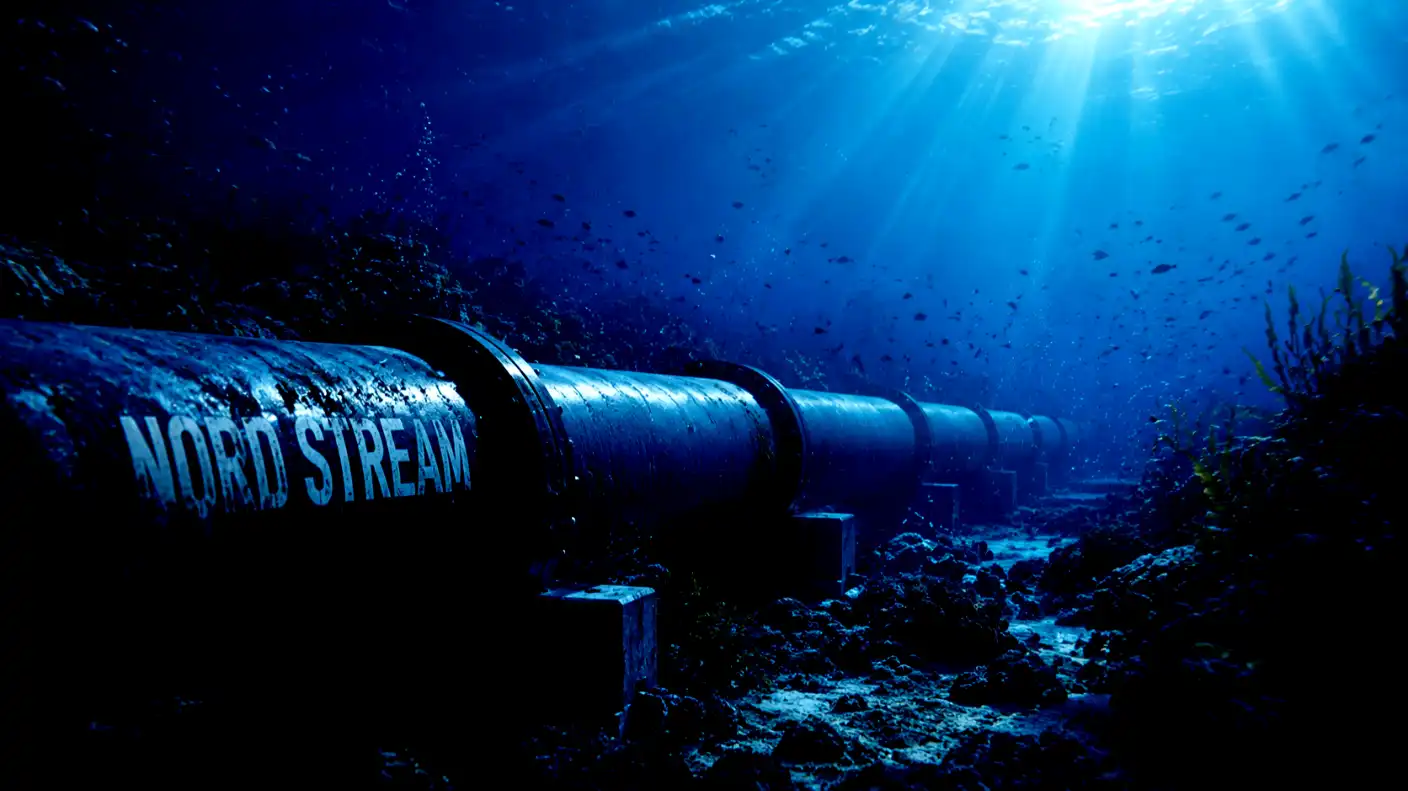
In the small hours of September 26, 2022, Scandinavian seismologists recorded strong signals indicating an underwater earthquake near the Danish island of Bornholm in the Baltic Sea. The real cause was far more destructive. Three massive underwater explosions tore through the Nord Stream 1 and Nord Stream 2 pipelines, releasing an unprecedented volume of natural gas into the sea. This audacious act of sabotage immediately worsened Europe’s energy crisis, leaving the continent cold, vulnerable, and searching for answers.
For months, global intelligence agencies and media organizations speculated about who possessed the capability to execute such a complex, deep-sea operation. Theories swirled around nuclear submarines, deep-diving naval units, and advanced military drones.
However, a Wall Street Journal investigation recently revealed a different reality. The entire sabotage plot was born during a night of heavy drinking among a handful of senior Ukrainian military officers and private businessmen, who managed to destroy the multi-billion-dollar pipelines using a rented 15-meter sailing yacht and a tiny budget.
As the German federal police continue to issue arrest warrants and trace the chain of command directly to senior Ukrainian military leaders, the political fallout is threatening to fracture Europe’s support for Kyiv. This article explores the planning, execution, and investigation of the sabotage and analyzes the deep diplomatic divisions it has triggered across the continent.
The Origin: A Drunken Night and a Cheap Budget
The plan to destroy Europe’s most critical energy infrastructure began not in a heavily guarded military bunker, but in a local bar.
The May 2022 Blueprint
In May 2022, a small group of senior Ukrainian military officers, special forces soldiers, and private businessmen gathered to discuss the war’s progress. Angered by Russia’s invasion and seeking to cripple Moscow’s finances, the group turned its attention to the Nord Stream pipelines.
These undersea pipelines, majority-owned by the Russian state-backed giant Gazprom, had long served as Russia’s primary economic link to Germany, generating billions of dollars in export revenues.
The group realized that by destroying the pipelines, they could permanently sever Germany’s reliance on Russian energy, ensuring that Berlin would remain fully committed to supporting Ukraine over the long term.
The plotters believed that if they could execute the attack without leaving any official state footprint, they could achieve a massive strategic victory while maintaining complete deniability.
Private Funding and Low-Tech Execution
To ensure that the operation left no paper trail in official Ukrainian military budgets, the plotters turned to the private sector. A group of wealthy Ukrainian businessmen agreed to fund the entire operation, which ultimately cost approximately $300,000.
This private financing allowed the team to acquire equipment, rent a vessel, and cover travel expenses entirely outside government channels.
Rather than utilizing a military warship or a specialized research vessel, the team chose to operate under the guise of tourists.
They rented a 15-meter (50-foot) German sailing yacht named the Andromeda—a Bavaria Cruiser 50—from the charter company Mola Yachting based in the German port of Rostock.
This low-tech approach allowed the group to blend in with the thousands of vacationers who sail the Baltic Sea every summer, bypassing the naval surveillance networks of Denmark, Sweden, and Germany.
The Crew and the Dive: How a Pleasure Cruise Masked Sabotage
To maintain their cover story, the plotters assembled a small, highly specialized crew capable of executing a complex deep-sea dive without drawing suspicion.
The Six-Member Cover Crew
The crew of the Andromeda consisted of six individuals: a captain, two civilian deep-sea divers, two diving assistants, and a female doctor.
The presence of the female doctor was a deliberate tactical decision, designed to reinforce the illusion that the crew was simply a group of close friends on a summer pleasure cruise.
The team used forged Bulgarian and other European passports to rent the yacht and travel across the Baltic Sea, ensuring that their real identities remained hidden.
The crew departed from the German port of Rostock on September 6, 2022.
Over the next two weeks, the yacht sailed through the Baltic, stopping at several island ports to restock supplies and prepare for the dive operations.
By operating a standard leisure yacht, the crew successfully avoided drawing any attention from regional coast guards or maritime security agencies.
Executing the Undersea Explosions
The physical execution of the sabotage was an extraordinary, high-risk engineering feat. The Nord Stream pipelines lie on the seabed at depths of up to 80 meters (260 feet).
At these depths, the water is dark, cold, and subject to strong, unpredictable currents.
The two civilian divers had to make multiple deep descents to locate the steel-reinforced, concrete-coated pipelines.
Operating in complete darkness, the divers planted high-potency octogen (HMX) explosives directly on the pipeline tubes.
The explosives were wired to acoustic timers, designed to detonate simultaneously days after the crew had safely returned to port.
After completing the final placement, the Andromeda returned to Rostock on September 23, three days before the timed charges tore through three of the four pipeline tubes, bringing a permanent halt to the flow of Russian gas.
The Chain of Command: Insubordination at the Highest Levels
While civilian divers carried out the physical execution, the internal struggle over the political authorization of the plot reveals a major rift within Ukraine’s wartime leadership.
Zelenskyy’s Initial Approval and the CIA’s Intervention
The political chain of command behind the operation was highly complex. According to senior defense officials, Ukrainian President Volodymyr Zelenskyy initially gave his verbal approval to the plan, viewing it as a legitimate target in a total war.
However, the plot did not remain secret for long. The Dutch military intelligence agency learned of the planning and immediately alerted the Central Intelligence Agency in Washington.
Recognizing that destroying Germany’s primary energy infrastructure would trigger a massive political crisis within the Western alliance, the CIA contacted Zelenskyy directly and demanded that he call off the operation.
Zelenskyy complied, issuing a direct order to his Commander-in-Chief, General Valeriy Zaluzhnyi, to halt the mission immediately.
Zaluzhnyi Ignores the Order
General Zaluzhnyi chose to ignore the president’s direct command. Instead of canceling the operation, he brought the planning completely offline, placing the unit into a highly classified, deniable compartment that was entirely insulated from presidential oversight.
To manage the logistics, Zaluzhnyi appointed Serhiy Kuznetsov, a 46-year-old veteran of Ukraine’s Security Service, to command the sabotage unit.
When Zelenskyy later confronted his Commander-in-Chief about the ongoing operation, Zaluzhnyi reportedly shrugged and compared the team to a launched missile that could not be recalled once dispatched.
By keeping the president in the dark, the military leadership ensured that Zelenskyy could maintain complete, honest deniability on the global stage. At the same time, they carried out one of the most significant acts of economic warfare in modern history.
The Potsdam Investigation: Reconstructing the Electronic Footprint
Following the explosions, Germany, Sweden, and Denmark launched separate national investigations. While Sweden and Denmark quietly closed their probes without publicly assigning blame, a specialized team of German detectives has spent years piecing together the evidence.
Tracking the Andromeda’s Footprint
Operating from the Federal Police headquarters in Potsdam, near Berlin, the German investigative team has successfully reconstructed a highly detailed account of the plot.
Detectives began by searching the Andromeda after it returned to port, discovering traces of military-grade explosives on the cabin table.
From there, the Potsdam team tracked the crew’s digital footprint.
By analyzing data from the yacht’s navigation equipment, satellite phones, and Gmail accounts, investigators fully mapped out the vessel’s exact route through the Baltic Sea.
They also traced the bank transactions of the shell companies used to rent the yacht, which eventually led them directly to private Ukrainian backers.
The Facial Recognition Breakthrough
The breakthrough that allowed German authorities to identify the individual divers came from a highly unexpected source.
Investigators obtained a grainy, black-and-white photograph taken by a high-speed German traffic camera of a car near the Rostock marina.
Using advanced facial recognition software, detectives matched the face of a passenger in the car to a Ukrainian deep-sea diver’s social media and professional profiles.
This match allowed the police to identify other members of the dive team, eventually leading German prosecutors to issue formal European arrest warrants for three Ukrainian special forces soldiers and four veteran civilian divers.
The Diplomatic Fallout: Fracturing European Unity
The findings of the German investigation have created intense political and diplomatic tensions, threatening to fracture the European coalition that supports Ukraine.
The Polish Refusal and the Diplomatic Escape
The legal effort to prosecute the suspects has run into a major diplomatic wall in Poland. German authorities tracked one of the primary suspects, a diver named Volodymyr Z., to his residence near Warsaw.
However, Polish authorities refused to execute the German arrest warrant, viewing the destruction of the pipeline as a necessary blow against Russian influence.
The tension escalated when the suspect was spotted fleeing Poland in a black BMW with diplomatic plates, driven by Ukraine’s military attaché in Warsaw.
The diplomatic escape has outraged German security officials, who view Poland’s refusal to cooperate as a direct betrayal of their European partnership.
Tusk’s Dismissal and Germany’s Dilemma
Polish Prime Minister Donald Tusk publicly highlighted the political division. Dismissing the German investigation, Tusk wrote on social media that the only thing the sponsors of Nord Stream should do is apologize and keep quiet, arguing that the pipeline should never have been built in the first place.
This public defiance has placed the German government in an exceptionally difficult position. Germany is currently Ukraine’s largest financial and military backer in Europe, providing billions of euros in advanced air defense systems and heavy weaponry.
If Berlin must publicly acknowledge that its most critical energy infrastructure was destroyed by a Ukrainian military unit acting under the command of General Zaluzhnyi, it will place immense political strain on the ruling coalition, potentially fueling domestic demands to halt military aid to Kyiv.
Conclusion: The Shifting Coordinates of European Energy
The Nord Stream sabotage remains one of the most audacious and successful acts of infrastructure warfare in modern history. By proving that a small, privately funded crew using a rented sailing yacht could destroy the primary economic link between Russia and Western Europe, the plotters have permanently altered the geopolitical landscape.
While the physical pipelines may lie permanently ruined at the bottom of the Baltic Sea, the real-world consequences of that drunken night in Kyiv continue to ripple through Europe’s capitals.
As Germany grapples with the political fallout of the Potsdam investigation, the Western alliance faces a historic test of unity.
The case serves as a sober reminder that in modern warfare, the lines between ally and adversary can become dangerously blurred, and that a low-tech, private operation can permanently alter global energy politics for generations to come.















