

The ongoing battle over America’s energy future has shifted directly to the federal courts, exposing a deep conflict between national security policies and clean energy development. On Friday, June 12, 2026, a coalition of nine prominent renewable energy trade associations filed a major lawsuit in the U.S. District Court for the District of Oregon. The legal challenge, titled Renewable Northwest v. Hegseth, asks a federal judge to order the U.S. Department of Defense to immediately lift an indefinite freeze on military airspace approvals for wind energy projects. The industry groups warn that the Pentagon’s deliberate refusal to complete these mandatory safety reviews has brought almost all onshore commercial wind development in the country to a complete halt, threatening billions of dollars in investments.
The comprehensive complaint names several high-ranking defense officials as defendants, including Secretary of Defense Peter Hegseth and Assistant Secretary for Energy, Installations, and Environment Dale Marks. The plaintiffs argue that the Defense Department’s review freeze violates both the federal Administrative Procedure Act (APA) and the statutory mandates governing the agency’s own review processes. Under the APA, federal agencies possess a clear, legally binding duty to conclude any matters presented to them within a reasonable timeframe. By indefinitely withholding approvals, the plaintiffs contend that the Pentagon has acted in an arbitrary, capricious, and unlawful manner, using bureaucratic delay as a weapon to bypass congressional intent.
The lawsuit details how the Pentagon systematically implemented the permitting freeze in three distinct, increasingly restrictive stages over the past several months. The freeze originally began in August 2025, when the DoD Siting Clearinghouse—the body that has assessed energy projects for military compatibility since 2011—abruptly stopped countersigning completed radar mitigation agreements. By December 2025, the clearinghouse ceased issuing even draft mitigation agreements. Finally, on April 13, 2026, the department halted all review activity for wind energy projects. A subsequent interim guidance issued on May 7 confirmed that wind developments will remain subject to indefinite, open-ended reviews, even as other energy sources continue to receive prompt approvals.
This bureaucratic gridlock has effectively blocked developers from obtaining the critical federal permits needed to begin on-the-ground construction. To build tall wind turbines, companies must secure a “Determination of No Hazard” from the Federal Aviation Administration (FAA). However, the FAA cannot issue these crucial safety determinations until the Defense Department completes its military airspace reviews to ensure the turbines do not interfere with low-level flight paths, base operations, or training routes. By freezing the clearinghouse reviews, the Pentagon has blocked the FAA process, stalling at least 125 utility-scale wind energy projects across 25 states.
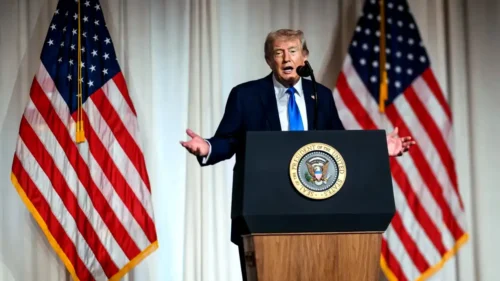
Geopolitical and legislative observers trace the apparent permit freeze to a secret political compromise that President Donald Trump made to pass his signature tax and spending law. In July 2025, Trump signed the massive “One Big Beautiful Bill Act” into law after winning over a skeptical coalition of conservative lawmakers in the House Freedom Caucus. To secure their critical votes, Trump reportedly promised the caucus—which strongly opposes renewable energy subsidies—that he would utilize his executive authority to prevent new wind projects from moving forward. Shortly afterward, Trump issued an executive order directing the Treasury and other administrative departments to strictly enforce rules and close loopholes to starve wind and solar projects of federal tax incentives.
To justify the permitting freeze, the Defense Department has consistently cited national security concerns, arguing that massive, modern wind turbines can severely impair military radar operations. Acting Pentagon press secretary Joel Valdez defended the reviews, stating that the agency is actively evaluating land-based projects to ensure they do not interfere with testing, training, and operational readiness. Moving turbine blades can indeed create radar clutter and mock-reflections, making it difficult for military operators to track aircraft. However, clean energy advocates point out that the Siting Clearinghouse has successfully reviewed thousands of wind projects since 2011, resolving potential interference issues through simple engineering and layout adjustments while making only one “unacceptable risk” determination in its entire history.
The administrative blockade has triggered an intense bipartisan backlash, with both Democratic and Republican lawmakers urging the Pentagon to end the gridlock. Prominent Republican Senator Roger Wicker, who chairs the Senate Armed Services Committee, recently stepped in to press the Defense Department over the ongoing delays. Wicker’s home state of Mississippi, along with other conservative-led states such as Texas, Ohio, and North Carolina, has enjoyed significant economic benefits from clean energy development. The ongoing permit freeze has stalled over $50 billion in active investments, representing roughly 1.5% of the energy sector’s annual capital spending, while forcing several regional developers to absorb more than $1 billion in wasted construction and development costs.
As the legal battle in Oregon moves forward, the outcome of the lawsuit will have profound consequences for the future of the American energy transition. The ongoing permit freeze has exposed the deep, structural conflicts that can arise when national security mandates clash with environmental and economic priorities. For the hundreds of farmers leasing their land for wind turbines, and the local counties relying on those projects for vital tax revenues, the court’s decision represents a matter of economic survival. Until the federal courts force the Pentagon to resume its statutory duties and restore a predictable, timely approval process, the development of American wind energy will remain at a standstill, keeping billions of dollars in investments locked in a legal limbo.