

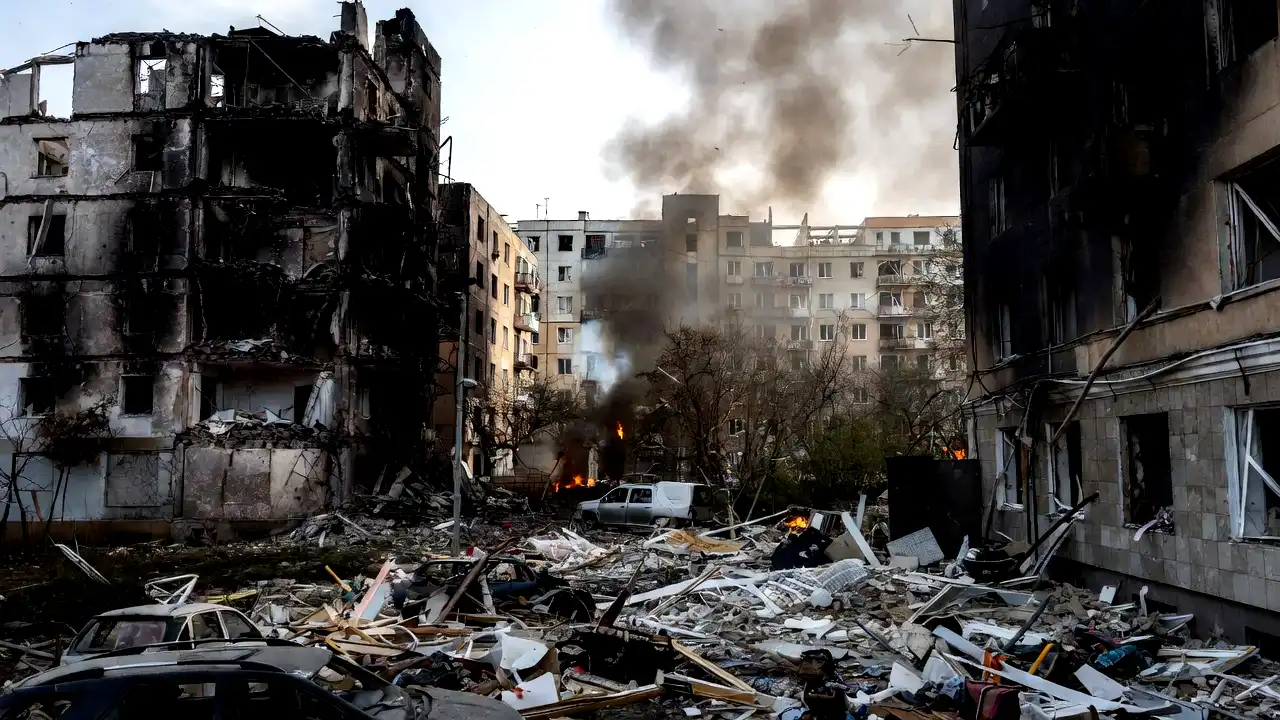
Global outrage has erupted following a devastating overnight barrage across Ukraine, highlighting the brutal nature of the ongoing conflict. On Tuesday, June 2, 2026, Russia unleashed a massive wave of missiles and drones targeting seven Ukrainian regions, including the capital city of Kyiv, Kharkiv, Zaporizhzhia, and Dnipro. The Russian Defense Ministry quickly claimed that these Russian retaliatory strikes responded directly to what it labeled “terrorist acts” by Ukrainian forces inside Russian-controlled territory. In contrast, Ukrainian authorities reported extensive civilian casualties and widespread damage to residential areas.
The human cost of Tuesday’s overnight bombardment is incredibly high. Ukrainian emergency services confirmed that the strikes killed at least 11 people and wounded more than 100 others across the country. In the city of Dnipro, a particularly cruel “double tap” attack—where a second strike hits the same location after first responders arrive—killed a rescue worker and eight other civilians, while leaving 36 people injured. In Kyiv, falling debris and direct missile impacts killed at least four people and injured 58 others, including three children, trapping many residents under the rubble of collapsed apartment blocks.
The Russian government wasted no time in providing its justification for the large-scale assault. In an official statement, the Russian Defense Ministry declared that the military carried out the massive strike using high-precision, long-range air-, land-, and sea-based weapons, including advanced hypersonic missiles. Moscow framed the operation as a direct, proportional retaliation for a devastating Ukrainian drone attack last week on a student dormitory in Russian-held Luhansk, which killed 21 people. While the Kremlin accused Ukraine of deliberately targeting students, Kyiv firmly rejected the claim, insisting that its drone strike targeted a military command center.
Russian President Vladimir Putin intensified the political rhetoric on Monday evening, setting the stage for the overnight bombardment. During a televised address, Putin asserted that Kyiv had opened a new, highly dangerous page in its series of crimes by launching the Luhansk dormitory strike and a subsequent artillery strike on a residential apartment building in Russian-occupied Kherson. Even though both militaries publicly deny deliberately targeting civilian populations, the sheer volume of high-precision weapons hitting urban residential zones in Kyiv and Dnipro on Tuesday contradicts Moscow’s claims of surgical precision.
The massive scale of Tuesday’s bombardment did not catch Ukrainian defense planners entirely by surprise. Over the previous three days, Ukrainian President Volodymyr Zelensky had issued multiple urgent warnings, pleading with citizens to remain vigilant and seek immediate cover when air raid sirens sounded. Citing detailed reports from Ukrainian intelligence, Zelensky warned on May 29, May 30, and June 1 that Russia was actively prepping a major, coordinated aerial assault. Despite these early warnings and high operational readiness, the sheer volume of hypersonic missiles and explosive drones managed to penetrate several regional air defense grids.
The strikes triggered widespread chaos in urban centers, transforming peaceful neighborhoods into active disaster zones. In Kyiv’s Podilskyi district, falling debris from an intercepted missile tore through a nine-story apartment building, trapping families in their homes and starting massive fires. In the Obolon district, residents watched in horror as parked cars burst into flames near a local kindergarten. Meanwhile, the Polish Air Force scrambled Polish and allied fighter jets to secure and defend Poland’s airspace, illustrating how easily the localized violence can threaten neighboring NATO territories as stray missiles fly near Western borders.
The deadly attacks have sparked intense diplomatic anger in Kyiv, with Ukrainian officials calling for immediate international retaliation against Moscow. Ukraine’s Foreign Minister, Andrii Sybiha, issued a scathing statement on Tuesday, labeling Putin a war criminal and a loser who has run completely out of strategic options on the battlefield. Sybiha argued that Russia is visibly losing ground in the conventional land war, forcing the Kremlin to rely entirely on aerial terror to demoralize the Ukrainian population. He urged Ukraine’s international partners to respond to the tragedy by immediately increasing military aid, tightening economic sanctions, and fast-tracking Ukraine’s European Union membership.
In the wake of the devastating strikes, President Zelensky moved quickly to shore up international defense support, directly addressing key U.S. political figures. Zelensky publicly appealed to former U.S. President Donald Trump, urging him to advocate for the immediate delivery of advanced, long-range defensive missiles to Ukraine. With the U.S. presidential transition and upcoming political cycles creating uncertainty in Washington, Kyiv is desperately trying to secure bipartisan American commitment to bolster its air defense networks before Russia can execute its promised systematic strikes on Kyiv’s decision-making centers.
Military analysts warn that the massive June 2 bombardment signals a dangerous shift toward a more aggressive phase of the air war. Over the past month, Ukraine has successfully waged a long-range drone campaign, striking oil refineries, military ports, and key logistic corridors inside Russia and occupied Crimea. By launching a massive, multi-regional response, Moscow is attempting to establish a policy of harsh deterrence, warning Kyiv that any successful deep-strike operation inside Russia will meet with devastating, high-volume strikes against Ukrainian cities.
Ultimately, Tuesday’s deadly strikes prove that the war in Ukraine remains a brutal, high-intensity conflict with no peaceful resolution in sight. As both sides trade devastating blows and reject diplomatic compromises, civilians continue to bear the heaviest burden. Unless international partners can provide Ukraine with the advanced air defenses necessary to seal its skies, or diplomats can find a way to halt the cycle of retaliation, the coming summer months will likely see more urban devastation and tragic loss of life, keeping the region locked in a state of perpetual violence.















