

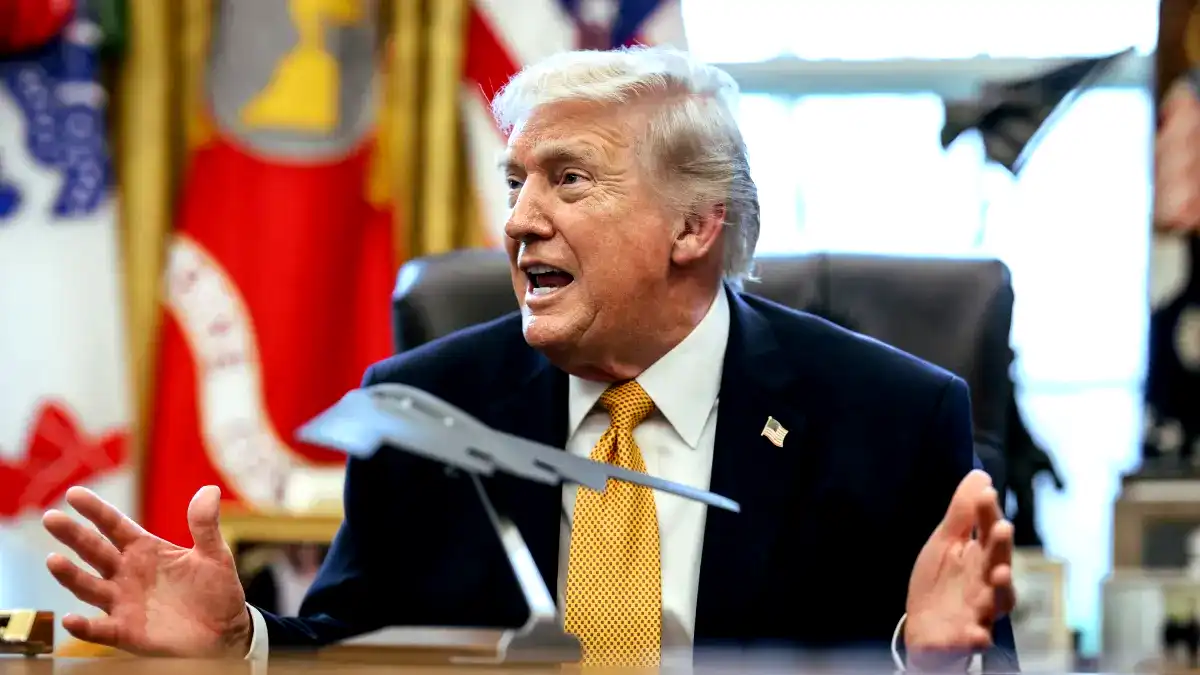
The picturesque resort town of Evian-les-Bains in the French Alps is hosting a highly critical gathering of global leaders. Running from Monday to Wednesday, the annual Group of Seven summit is taking place under a cloud of intense diplomatic friction, strategic uncertainty, and deep-seated alliance distrust. While the world leaders had initially planned to focus their discussions on the war in Ukraine, trade imbalances, and supply chain security, the entire agenda has been completely upended by a sudden, late-night development from Washington.
Just hours before his departure for France, U.S. President Donald Trump announced that the United States and Iran had agreed on a preliminary framework to bring a permanent end to their three-month-old war. This conflict, which erupted in late February, had severely disrupted global energy markets, pushed domestic gasoline prices past $4.00 per gallon, and shut down one of the world’s most critical maritime corridors.
While the announcement of a ceasefire offers a long-awaited path to peace, Trump is arriving in Europe to face a wall of skepticism and difficult questions from his closest traditional allies, transforming the summit into a high-stakes test of the Western alliance.
The June Fifteen-Seventeen Evian Summit: An Uneasy Gathering
The timing of the diplomatic breakthrough has completely reset the mood of the summit, turning what was expected to be a highly coordinated allied meeting into a tense cross-examination of American foreign policy.
The Timing of the Rebound
President Trump arrived in France fresh off his 80th birthday celebrations and a last-minute diplomatic push in Washington. The summit’s schedule began on Monday with a highly anticipated bilateral meeting between Trump and French President Emmanuel Macron, followed immediately by a working dinner with all G7 participants.
While the White House is promoting the preliminary agreement as a historic personal victory for the president, European leaders are viewing the development with extreme caution. The Wall Street Journal recently reported that senior European officials are deeply concerned that Trump has negotiated a highly fragile, secretive deal that leaves major regional security issues completely unresolved, while failing to consult the very allies who are expected to help manage the economic and physical fallout of the conflict.
The Frustrated Allies
The underlying friction at the summit stems from the unilateral manner in which the U.S. administration has managed the war since its inception. Leaders from the European members of the G7—including British Prime Minister Keir Starmer, French President Emmanuel Macron, German Chancellor Friedrich Merz, and Italian Prime Minister Giorgia Meloni—remain deeply resentful that Trump launched a major military campaign in the Middle East in February without consulting his NATO allies.
To compound these tensions, Trump has spent weeks publicly pushing back on these same European leaders, criticizing them for failing to provide military or financial support to the United States during the active phase of the conflict.
As a result, the European allies are determined to use the three-day summit to demand concrete, detailed answers from the U.S. president, ensuring that any final agreement does not compromise their own strategic security or leave them vulnerable to future energy shocks.
Inside the Deal: What We Know and What Remains Secret
While the announcement of a ceasefire has temporarily halted the active fighting, the actual text of the preliminary understanding remains highly classified, leaving diplomats and intelligence agencies scrambling to understand the details.
The Geneva Signing on June Nineteen
The logistical pathway to a final agreement is moving quickly. Under the current schedule, President Trump plans to dispatch Vice President JD Vance to Geneva on June 19 to formally sign the final peace accord with Iranian representatives.
The breakthrough negotiations were heavily facilitated by Pakistani Prime Minister Shehbaz Sharif, whose country acted as the primary mediator and backchannel corridor between Washington and Tehran throughout the conflict.
Sharif confirmed that there will be a series of crucial pre-implementation discussions this week to lay the necessary groundwork for 60 days of highly technical, international talks regarding the future of Iran’s nuclear and ballistic missile programs.
The Three Core Obstacles
Despite the optimism in Washington, diplomatic sources warn that several massive, unresolved issues could easily derail the agreement before the June 19 signing ceremony:
First, the unfreezing of Iranian assets remains a major point of contention. The U.S. has frozen tens of billions of dollars of Iranian funds in foreign bank accounts, and Tehran is demanding the immediate release of these assets as a condition for compliance.
Second, the future limits on Tehran’s nuclear enrichment programs are highly disputed. While the U.S. is demanding a permanent, verified halt to all enrichment activities above 3.67%, Iranian negotiators are resisting any deal that strips them of their sovereign rights under the Non-Proliferation Treaty.
Third, Israel’s ongoing military campaign in southern Lebanon against Hezbollah remains a highly volatile wildcard. Hezbollah is Iran’s most powerful regional proxy, and if Israeli forces continue their offensive, Tehran may feel forced to withdraw from the ceasefire agreement to protect its regional security network, turning Lebanon into a dangerous trigger point that could easily reignite the wider war.
The Strait of Hormuz: Demining the Global Energy Artery
The most urgent economic issue confronting G7 leaders is the immediate and safe reopening of the Strait of Hormuz, which has been closed to commercial shipping for approximately 100 days.
The Physical Danger of Undersea Mines
While the preliminary agreement orders an immediate stop to the U.S. naval blockade and the cessation of Iranian drone strikes on shipping, commercial insurance companies and maritime operators remain highly reluctant to send their vessels into the Persian Gulf.
During the active phase of the conflict, both sides deployed a significant number of naval mines to secure their positions, leaving the narrow shipping lanes highly dangerous.
Reopening the strait, through which approximately 20% of the world’s daily oil supply and 25% of global liquefied natural gas pass, is an absolute necessity to stabilize global energy prices and lower domestic fuel costs.
However, until these waters are physically cleared of explosives, commercial tanker traffic will remain stalled, keeping global energy markets in a state of high anxiety.
The Anglo-French Demining Proposal
To address this critical bottleneck, the United Kingdom and France have offered to lead a major, international demining operation to clear the shipping lanes.
Host leader Emmanuel Macron announced on Sunday evening that British and French naval assets are already in place and ready to deploy as soon as the ceasefire is formally signed and verified.
While President Trump has welcomed this European assistance, the issue has also fueled further transatlantic tension.
U.S. officials have pointed out the irony of European allies refusing to support the military campaign to contain Iran, while rushing to deploy their navies to clear shipping lanes once the fighting is over to protect their own commercial interests, highlighting the transactional nature of the modern alliance.
Expanding the Table: Arab Leaders Join the Middle East Session
Recognizing that the stability of any peace deal depends on the cooperation of regional powers, French President Emmanuel Macron has taken the initiative to expand the G7 table, inviting key Middle Eastern leaders to participate in the discussions.
Macron’s Tuesday Initiative
During a special session scheduled for Tuesday afternoon, G7 leaders will be joined by several highly influential non-G7 heads of state, including Egyptian President Abdel Fattah el-Sisi, the Emir of Qatar, and the President of the United Arab Emirates.
The goal of this expanded session is to conduct a comprehensive assessment of the wider regional consequences of the U.S.-Iran agreement.
Because Qatar and Egypt served as critical backchannel mediators alongside Pakistan, their leaders possess vital insights into Tehran’s real-world compliance limits, making their participation essential to building a durable regional security framework.
The Regional Security Balance
The Arab leaders are arriving in France with their own deep-seated concerns regarding the terms of the deal.
While they welcome the end of the active war, which had severely disrupted their own trade and food import corridors, they are highly skeptical of any agreement that allows Iran to preserve its regional influence.
The primary concern of the Gulf Cooperation Council states is whether the U.S. deal includes verifiable mechanisms to restrain Iran’s ballistic missile transfers and its regional proxy networks, particularly Hezbollah in Lebanon and the Houthis in Yemen.
They warn that if the U.S. unfreezes billions of dollars of Iranian assets without securing strict, enforceable guarantees on regional behavior, Tehran will simply use those fresh funds to rebuild and rearm its proxy networks, creating a more dangerous and unstable Middle East in the long term.
The Ukraine Dynamic: Zelenskyy’s Counter-Offensive for Funding
While the Middle East dominates the headlines, the G7 summit remains a critical battleground for the future of European security, with Ukrainian President Volodymyr Zelenskyy scheduled to arrive on Tuesday to make a powerful personal appeal for continued military aid.
The Strike on the Dormition Cathedral
Zelenskyy’s arrival in France is taking place against a tragic and highly symbolic backdrop.
Over the weekend, Russian forces launched a massive drone and missile barrage against Kyiv, severely damaging the historic Dormition Cathedral of the Kyiv Pechersk Lavra, one of Ukraine’s most sacred and culturally significant religious sites, while destroying several nearby residential buildings.
This cultural destruction has outraged European leaders and provided Zelenskyy with a powerful moral argument as he prepares to meet with G7 heads of state.
The Ukrainian leader is expected to use the destruction of the cathedral to demand an immediate increase in advanced air defense systems and a long-term, multi-billion-dollar military funding commitment from Western allies to protect Ukrainian airspace from future Russian terror.
Reminding Trump of Western Commitments
For Zelenskyy and his European supporters, the primary goal at the G7 is to ensure that President Trump remains committed to supporting Ukraine’s territorial integrity.
They are deeply concerned that Trump’s unilateral approach to the Middle East conflict could be replicated in Europe, with the U.S. president potentially negotiating a swift, unilateral deal with Vladimir Putin that forces Ukraine to accept a highly unfavorable peace agreement.
During a scheduled working session on Tuesday, Zelenskyy and European leaders will seek to remind Trump that his strategic hand in Europe has actually improved since 2025.
With Russian ground advances slowing to a crawl and Ukraine successfully launching long-range strikes that damage Russia’s industrial core, they will argue that the Western alliance is closer than ever to forcing Moscow to accept a peace deal on Ukraine’s terms, and that any premature withdrawal of U.S. support would represent a historic strategic failure.
Conclusion: The Fragile State of the Postwar Order
The Group of Seven summit in Evian-les-Bains is proving to be a historic and deeply tense gathering that will define the future of the Western alliance.
By arriving in France with a major, preliminary peace agreement with Iran in his pocket, President Trump has successfully demonstrated his unique ability to close high-stakes, unilateral deals, but he has also exposed the deep fractures that now divide the United States from its traditional partners.
As the world leaders debate the terms of the Iran deal, the demining of the Strait of Hormuz, and the future of military aid to Ukraine, the fundamental question hanging over the summit is whether the postwar global order can survive.
In an era defined by unilateral transactions, shifting alliances, and regional wars, the success of the G7 will depend not on the signatures on the communique but on whether the Western powers can successfully find a way to balance their national security interests with the collective responsibility of maintaining global stability.















