

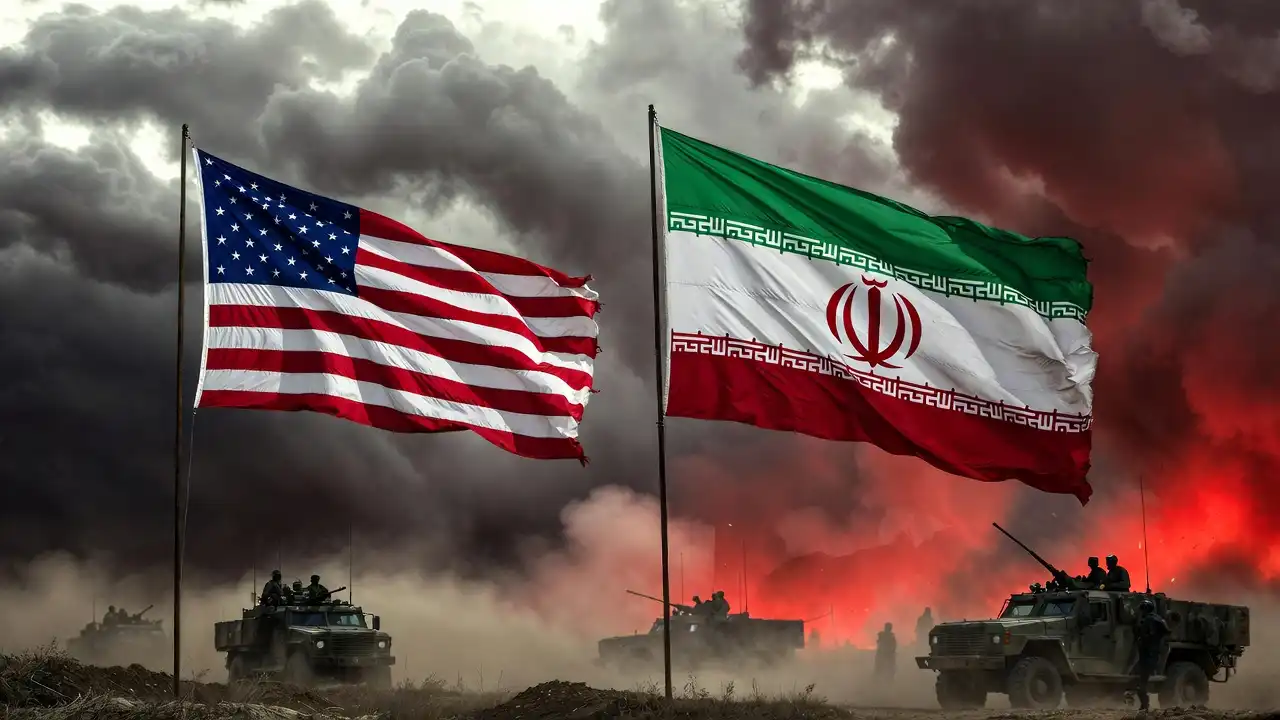
A massive military escalation has pushed the Middle East to the edge of an all-out regional war, completely undermining a fragile peace agreement. The United States and Iran traded heavy air and missile attacks for a second consecutive day. U.S. President Donald Trump issued a fierce ultimatum to Tehran, vowing to unleash even heavier bombing campaigns unless Iranian leaders immediately sign a comprehensive peace treaty. This rapid spiral of violence represents the most severe threat to the shaky ceasefire that the two nations originally brokered on April 8, dampening hopes for a swift end to the conflict.
The sudden escalation of hostilities began earlier in the week with the downing of a U.S. Army AH-64 Apache attack helicopter near the strategic Strait of Hormuz on June 9, 2026. The incident triggered a swift and destructive cycle of tit-for-tat military reactions. In response to the helicopter’s downing, the U.S. military launched waves of retaliatory airstrikes targeting Iranian surveillance capabilities, communication hubs, and air defense networks. U.S. Central Command confirmed that its forces completed a major, four-hour-long bombardment shortly after midnight in Tehran on Thursday, utilizing U.S. Air Force, Navy, and Marine assets to hit targets across southern Iran.
Iran’s Islamic Revolutionary Guard Corps (IRGC) responded to the American airstrikes by launching a massive wave of counterattacks against U.S. and allied military bases. The IRGC announced that its forces successfully targeted 18 separate U.S. military facilities across the region, including the U.S. Navy’s Fifth Fleet headquarters in Manama, Bahrain, and the Ali al-Salem airbase in Kuwait. In Kuwait, the national military confirmed that its air defense systems successfully engaged hostile aerial targets. Meanwhile, Bahraini air defense batteries went on high alert, intercepting and destroying multiple incoming drones and missiles before they could strike critical naval infrastructure.
The Iranian military also extended its counteroffensive deep into neighboring countries, targeting long-range American air assets. For a second consecutive night, the IRGC launched 12 ballistic missiles at the Muwaffaq Salti (al-Azraq) Air Base in Jordan, which hosts U.S. F-35 fighter jets. While the Jordanian military successfully intercepted five of the incoming missiles, the remaining projectiles caused localized damage near the base. Additionally, Iran’s Fars News Agency reported a separate missile strike targeting the Harir U.S. military facility in Erbil, northern Iraq, showing that Tehran is willing to hit American assets across multiple countries to enforce its deterrence.
Amidst the heavy exchange of fire, the strategic struggle over the Strait of Hormuz has intensified. The Iranian military announced the complete closure of the narrow waterway, warning that its coastal batteries will fire on any commercial or military vessel attempting passage. However, U.S. Central Command quickly denied these claims, asserting that commercial ships continue to transit the strait safely. Speaking to reporters at the White House, President Trump revealed that the U.S. military has secretly escorted vessels carrying over 100 million barrels of oil through the strait in the middle of the night, defying Iran’s blockade. U.S. Defense Secretary Pete Hegseth supported this tough stance, declaring that the U.S. will “negotiate with bombs” if needed.
The heavy airstrikes have also resulted in tragic civilian casualties and severe damage to infrastructure. A U.S. Navy missile strike in the Gulf of Oman hit the Settebello oil tanker, killing two Indian seafarers and leaving a third sailor missing. Inside Iran, a nation of 93 million people, state-run news agencies reported powerful explosions in several major southern cities, including Sirik, Kargan, Bandar Abbas, Minab, and Varamin, near the Caspian Sea. Local officials reported that the strikes destroyed critical water reservoirs and energy grids, disrupting daily life and cutting off clean drinking water for tens of thousands of residents.
The sudden outbreak of intense, uncoordinated military actions sent immediate shockwaves through global financial and commodity markets. On Thursday, oil prices surged by nearly $3 a barrel during early Asian trading. Brent crude futures jumped by 1.59% to settle at $94.58 a barrel, while U.S. West Texas Intermediate (WTI) crude climbed 1.90% to trade at $91.74 a barrel. At the same time, global equity markets experienced a major sell-off, with Wall Street’s major indexes dropping by more than 1% as technology and industrial shares plunged. The persistent blockade and naval clashes have cost global shipping networks over $1 billion in rising insurance and logistical expenses, while shaving nearly 1.5% off the region’s overall trade GDP.
This rapid return to open warfare has cast deep doubt over the prospects of a permanent diplomatic settlement. On Wednesday evening, a high-level Qatari negotiating team arrived in Tehran on a high-stakes mission to bridge the remaining differences between Washington and Tehran, following close consultations with U.S. officials. However, the Qatari delegation reportedly left the Iranian capital on Wednesday night without making any visible progress. Diplomatic sources warn that the chances of a breakthrough have severely diminished, as hard-line elements within the IRGC now dominate Tehran’s national security council and show little willingness to compromise. At the same time, the U.S. continues its heavy bombardment.
As both nations remain locked in this volatile cycle of direct retaliation, the Middle East faces its most dangerous security crisis in decades. The rapid collapse of the April ceasefire proves that localized tactical incidents can easily derail months of painstaking diplomatic work. Until Washington can relax its aggressive economic blockade and Tehran halts its missile campaigns, the region will likely remain trapped in this costly holding pattern. For global consumers and international shipping lines, the ongoing conflict represents a severe economic burden, proving that the price of geopolitical instability is always paid in rising energy costs and lost human lives.















