

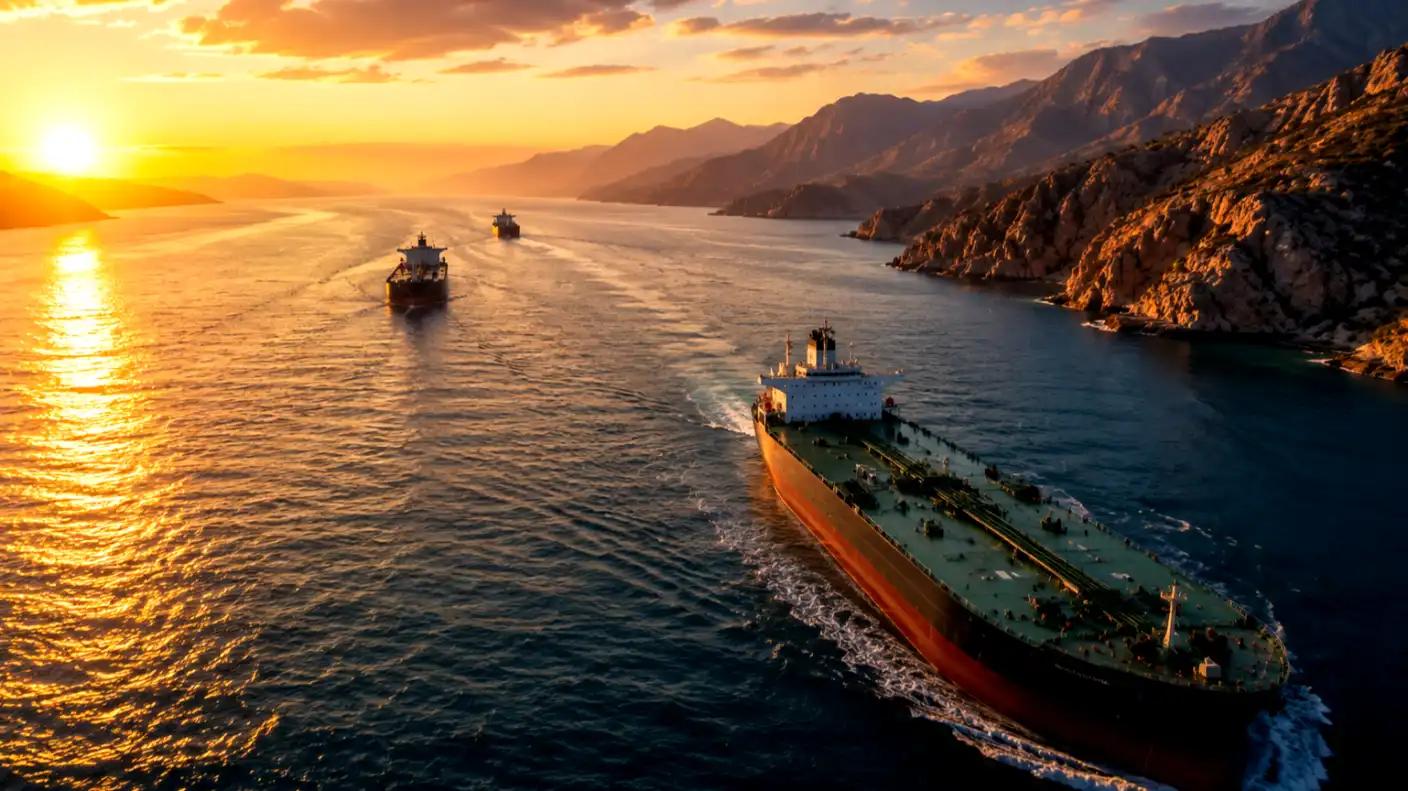
U.S. military forces are actively executing high-stakes, late-night naval escorts to guide stranded commercial tankers and cargo ships through the heavily mined Hormuz Strait. This covert operation has successfully unleashed millions of barrels of crude oil onto the global market, providing critical relief to an international energy system crippled by the ongoing conflict in the Middle East. Interior Secretary Doug Burgum revealed during a national broadcast interview on Friday, June 12, 2026, that on some nights, more than 20 massive vessels have successfully cleared the perilous waterway under the protection of American forces.
The highly secretive operations became possible only after U.S. and allied naval units completed the dangerous task of clearing sea mines that Iranian forces had laid along the shipping channels. To minimize the risk of being targeted by coastal missile batteries or drone swarms, the navy escorts the tankers during the dead of night. Ships extinguish all their navigation lights, disable their satellite transponders, and run completely dark through the narrow corridor. Burgum confirmed that these stealth maneuvers have successfully opened a vital pipeline for energy shipments, allowing ultra-large crude carriers—some carrying up to 2 million barrels of oil each—to safely exit the Persian Gulf.
The decision to order the nighttime escorts aligns directly with President Donald Trump’s recent disclosures. Earlier in the week, on Wednesday, June 10, 2026, President Trump claimed on social media that a “secret mission” had successfully guided over 200 commercial ships and 100 million barrels of oil out of the restricted waterway. Trump told reporters that the U.S. Navy had taken 22 massive ships out of the strait “late at night, with no lights” to avoid detection. Burgum’s comments provide the first official, detailed confirmation of this high-stakes maritime operation, proving that the U.S. military has successfully bypassed Iran’s blockades to maintain the flow of global commerce.
The crisis originally began on February 28, 2026, when joint U.S. and Israeli air forces launched massive strikes against Iranian military and nuclear targets. In immediate retaliation, Iran declared the complete closure of the Hormuz Strait, the world’s most critical maritime chokepoint. Before the conflict, approximately 20% of the world’s daily oil supply passed through this narrow strait every day. The sudden closure of the waterway triggered a massive global supply shock, driving Brent crude prices past $120 a barrel earlier in the spring and forcing countries to search for alternative energy corridors frantically.
To bypass the blockade, U.S. Central Command deployed guided-missile destroyers, over 100 land- and sea-based aircraft, and 15,000 soldiers to support the naval effort. Concurrently, the U.S. has enforced its own aggressive naval blockade against Iranian ports, disabling 9 non-compliant vessels and turning back over 130 ships since April 13, 2026. This dual-track strategy—blockading Iranian oil while guiding friendly commercial tankers—aims to starve Tehran of revenue while protecting global markets from a catastrophic inflationary spike.
Beyond the naval escorts, Burgum announced that U.S. oil companies are rapidly accelerating domestic production to offset the global supply deficit. Speaking on a national broadcast, the Interior Secretary confirmed that American producers will soon announce record-breaking extraction rates, fueled by rising prices and the urgent need to support international allies. This domestic surge, which represents a massive mobilization of capital, has helped ease global energy panic. However, environmental groups warn that opening Alaska’s public lands to industrial drilling will cause long-term ecological damage.
Despite the successful nighttime transits, the ongoing conflict is imposing a massive financial penalty on the global economy. The maritime bottlenecks have cost global shipping networks over $1 billion in rising war-risk insurance premiums, which spiked from a pre-war average of 0.25% of a vessel’s hull value to over 5%. While the successful transit of 100 million barrels of oil has helped suppress crude costs, keeping Brent prices in the $90 to $98 range, the persistent supply disruptions have still shaved nearly 1.5% off the region’s overall trade GDP, keeping retail fuel costs high across the United States.
As negotiators in Washington, Tehran, and Doha struggle to finalize a durable, permanent peace agreement, the ongoing nighttime escorts serve as an essential lifeline for global markets. The success of these covert naval operations proves that advanced military technology and strategic resolve can bypass even the most aggressive trade blockades. However, operating multi-million-barrel supertankers in the dark without navigation lights remains an incredibly risky, temporary solution. Until the international community can secure a verifiable diplomatic treaty that permanently reopens the Strait of Hormuz, the global energy architecture will continue to run silent in the dark, vulnerable to a sudden, catastrophic shock.















